
Puma Exploration confirms gold system at Jaguar; Kinross drilling Williams Brook, New Brunswick
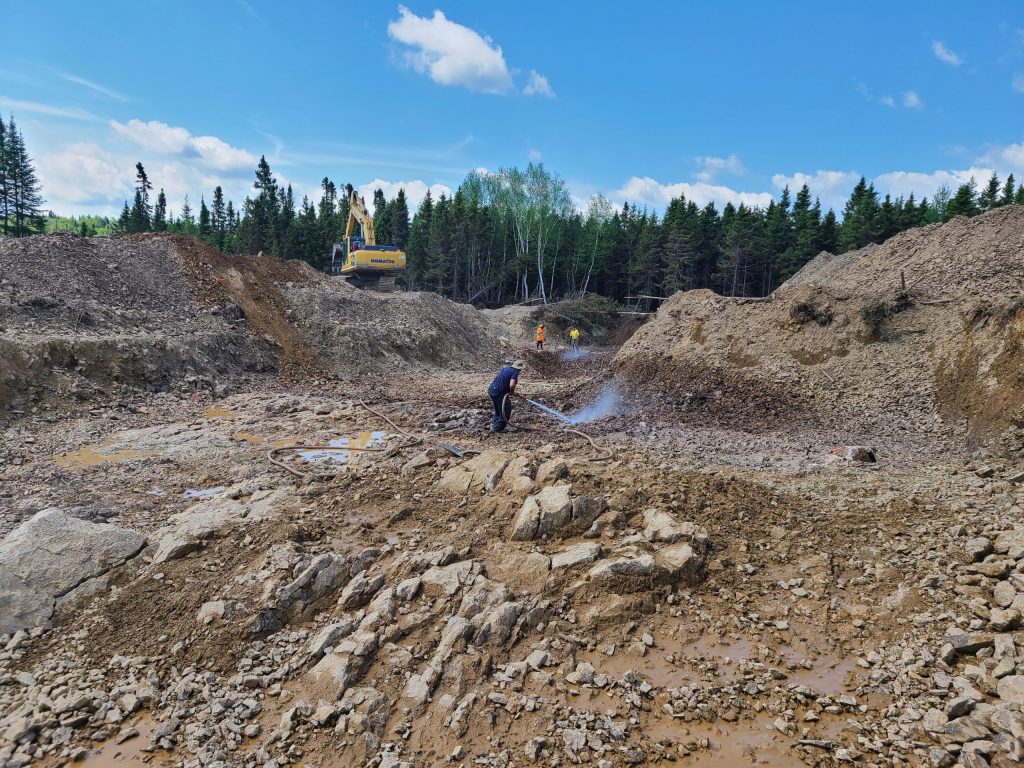
Puma Exploration Inc. [TSXV: PUMA; OTCQB: PUMXF] reported results from Kinross Gold Corp.’s [TSX: K; NYSE: KGC] 1,870-metre Winter 2026 diamond drilling campaign at the Williams Brook Gold Project in Northern New Brunswick, which was completed and funded under its option agreement with Puma Exploration.
At the Jaguar Gold Zone (JGZ), hole WB26-195 intersected a wide mineralized envelope grading 0.45 g/t Au over 56.50 metres, including a higher-grade interval of 1.03 g/t Au over 16.0 metres. Although only five shallow holes were drilled in the area, the consistent downhole mineralization, along with drilling by a previous operator in 2008, highlights the area’s potential.
Kinross is targeting Jaguar for follow-up drilling this summer. At the Lion Gold Zone (LIGZ, the presence of high-grade gold mineralization (16 g/t Au over 0.50 m) in the first drilling ever conducted in the area confirms that the zone merits further investigation.
Marcel Robillard, Puma’s President and CEO, stated, “The broad mineralized interval in hole WB26-195 shows that what was sampled at Jaguar and what previous operators drilled is not a narrow, high-grade occurrence, but a wider gold-bearing system with strong potassic alteration and pyrite mineralization. Jaguar has been added as a high-priority target within the Williams Brook Gold System. Kinross’ Option agreement commitments have been instrumental in advancing the project, and with another $13M+ in potential work expected over the next 4 years, we are confident we’ll unlock Williams Brook’s full potential.”
Kinross has already launched its 2026 Summer Exploration Program at Williams Brook, with three field crews on site and deployed until the end of September. Planned initial work includes a soils survey, a geophysical drone magnetic survey, and general prospecting and trenching. A follow-up drilling program at Jaguar is expected this summer. Other areas and targets may also be drilled if initial findings and results warrant it. Details will be provided as they become available.
The Jaguar Gold Zone (JGZ): The five diamond drill holes (WB26-191-195), totalling 1,360 metres, drilled at the JGZ tested the pyritic gold mineralization in altered rhyolite at depth to assess the lateral and depth continuity of the Jaguar gold system, evaluate geophysical and geological targets, and better define the structural, lithologic, and alteration controls associated with gold mineralization.
Hole WB26-195 returned the most continuous results of the campaign, with 0.45 g/t Au over 56.50 metres, from 80.00 metres to 136.50 metres downhole depth. This broad interval includes several higher-grade zones, including 5.71 g/t Au over 1.00 metre, 3.42 g/t Au over 1.00 metre, 3.14 g/t Au over 1.00 metre, and 2.44 g/t Au over 1.00 metre.
The mineralized interval in WB26-195 coincides with a large geophysical (Induced Polarization “IP”) anomaly identified at surface, suggesting that the gold-bearing system may be associated with a broader chargeability response. This relationship provides an important exploration vector at Jaguar and supports the potential for additional mineralized zones along other IP anomalies in the area and at depth.
The broad nature of the mineralized envelope, characterized by intense potassic alteration of the rhyolite unit and pervasive coarse pyrite mineralization, is significant because it suggests that gold mineralization at Jaguar is not restricted to isolated veins or narrow high-grade structures. Instead, the results indicate a potential wider hydrothermal system with multiple gold-bearing intervals distributed over a substantial downhole width and spatially associated with a geophysical anomaly that remains open for follow-up exploration.
The Jaguar Gold Zone lies approximately 5 km northeast of the Lynx Gold Zone, one of the principal gold discoveries within the Williams Brook Gold Project. Previous operators first explored Jaguar in 2007 and 2008, when soil geochemical anomalies, trenching and limited drilling confirmed near-surface gold mineralization.
Historical drilling at Jaguar returned significant gold mineralization, including 2.10 g/t Au over 9.00 metres in hole WB-08-03, within a broader interval grading 0.72 g/t Au over 38.00 metresj. Puma later advanced the target through prospecting, trenching and sampling, identifying an approximately 80 metres by 50 metres gold-enriched zone, with selected grab samples returning up to 34.70 g/t Au.
The Winter 2026 drilling campaign was designed to follow up on historical and surface results using a more systematic approach. The program tested the Jaguar system from different drilling orientations and targeted extensions of known mineralization, as well as identifying new structural and geophysical indicators.
The Lion Gold Zone (LIGZ): The 2026 Lion campaign consisted of only three diamond drill holes (WB26-196-198) totalling 510 metres. The program was designed to get fresh rock under the alteration zone stripped at surface and to better define the structural, lithological and alteration controls associated with gold mineralization.
Gold mineralization at Lion differs from that at the Lynx and Jaguar Gold Zones. Here, gold appears to be associated with mafic volcanic rock intruded by multiple little quartz veins and veinlets.
Despite the limited Winter 2026 drilling program at Lion, the results confirm high-grade gold mineralization along the McCormack Brook Fault, warranting follow-up. The McCormack Fault has been traced for more than 10 km and will be further investigated by the Kinross team this summer.
A drilling highlight of the Lion Gold Zone included drillhole WB26-196 that returned 3.76 g/t gold over 2.00 metres, including 12.70 g/t gold over 0.50 metres.
Following its gold discovery at Williams Brook in 2021, Puma spun out its base-metal and non-core assets to unlock their potential and maximize shareholder value through Puma’s equity interests in other explorers and carried royalties on their projects. This approach provides Puma shareholders with diversified commodity exposure and significant upside potential from the spinoffs’ success, while allowing Puma to maintain its primary focus on advancing its gold assets in New Brunswick.
As part of this strategy, Puma holds equity interests in several companies and maintains a portfolio of NSR royalties on selected assets. Puma also maintains the following net smelter return (NSR) royalties: 2% NSR on Murray Brook West, 2% NSR on Chester West, 1% NSR on Beresford Copper and 2% NSR on Little Stull Lake.
Puma Exploration is focused on identifying and developing a pipeline of precious metals projects in New Brunswick, near Canada’s renowned Bathurst Mining Camp.
Resource World Magazine Inc. has prepared this editorial for general information purposes only and should not be considered a solicitation to buy or sell securities in the companies discussed herein. The information provided has been derived from sources believed to be reliable but cannot be guaranteed. This editorial does not take into account the readers investment criteria, investment expertise, financial condition, or financial goals of individual recipients and other concerns such as jurisdictional and/or legal restrictions that may exist for certain persons. Recipients should rely on their own due diligence and seek their own professional advice before investing.