
Metals Creek Resources posts high-grade mineralization at Ogden Gold Project in Timmins, Ontario
Metals Creek Resources Corp. [TSXV: MEK; OTC Pink: MCREF; FSE: M1C1] reported high-grade gold assays for one diamond drill hole from the recently completed three-hole diamond drill program at the Ogden Gold Project located in Timmins, Ontario. The Ogden Gold Project is a 50/50 Joint Venture with Discovery Mining Ltd., with the company serving as the operator.
This program entailed three diamond drill holes totaling 1233 meters(m) targeting the lower portion of a Thomas Ogden Zone (TOG) fold structure which has a shallow easterly plunge. TOG is host to gold bearing flat lying secondary structures within strongly altered conglomerates and felsites with pyrite. High-grade gold mineralization within TOG has a strong preferential association with the TOG fold axis.
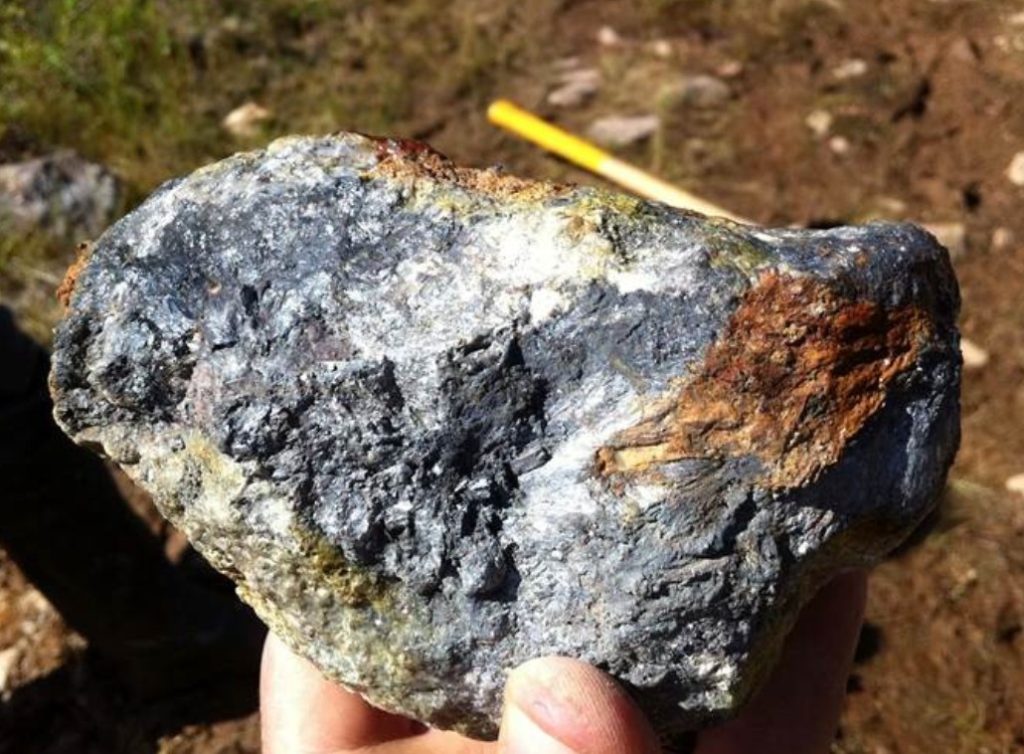
TOG-26-76 returned additional high-grade gold mineralization with a downhole intercept of 115.51 g/t gold over 9.85 metres (296.95-306.80m), including 3.10 metres (301.85-304.95m) of 356.85 g/t Au and also including 0.50 metres (304.45 – 304.95m) of 2050 g/t Au, with very strong visible gold.
This hole was engineered to follow-up on a previously released hole TOG-22-73 which returned a downhole intercept of 4.24 g/t gold over 5.61 metres within altered conglomerate and felsite units with strong albitization, silicification and quartz veining.
TOG-22-73 is located 75 metres vertically below TOG-26-76. Hole TOG-26-76 encountered highly silicified felsite with associated quartz flooding, veining and disseminated pyrite. All primary features have been obliterated due to the intense alteration and associated overprinting from quartz flooding. Visible Gold (VG) is present within quartz rich areas as well as along cross cutting healed fractures with associated fuchsite. Higher grade gold mineralization has a strong spacial association within TOG folds with strong to intense folding, the emplacement of quartz veining as well as significantly stronger hydrothermal alteration. Hole TOG-22-73 is also proximal to the fold hinge with high-grade mineralization as well.
Management is highly encouraged with the assay results to date, especially with hole TOG-26-76 returning multiple occurrences of VG and very high-grade gold assays within strongly altered felsite and conglomerate. This hole returned the second highest grade intercept to date on the Ogden Project with hole TOG-13-25 returning the highest.
Hole TOG-13-25 retuned an intercept of 210.19 g/t Au over 12.53 metres and is located 325 metres west of TOG-26-76 along the TOG fold structure. The high-grade nature of hole TOG-26-76 with strong visible gold content demonstrates the strong nugget effect within TOG, thus requiring a systematic approach for drilling on the TOG fold hinge. Refer to original release for complete assays.
Assay results for the final remaining hole will be released as they are received and compiled.
Michael MacIsaac, P.Geo and VP Exploration and a qualified person as defined in NI 43-101, is responsible for this release, and supervised the preparation of the information forming the basis for this release.
Metals Creek has earned a 50% interest in the Ogden Gold Property including the former Naybob Gold mine, located 6 km south of Timmins, Ontario and has an 8 km strike length of the prolific Porcupine-Destor Fault (P-DF).
Metals Creek has also jointly acquired through staking on a 50/50 basis with Benton Resources, potential natural white hydrogen projects in Newfoundland. The Smoking Gun Prospect was selected after research uncovered highly anomalous helium with values up to 8,900 parts per billion (ppb) in water collected from an historic drill hole. These licenses are located within the Deer Lake Basin, which is thought to be a prospective environment for the presence Helium (He) and Natural (White) Hydrogen (H₂).
At Parson’s Pond, research of historical drill logs in two holes 14.2 km apart, have observed C1 methane gas levels reaching 72%. The area is underlain by thrust faulted rocks of the Humber Arm Supergroup. Drill logs indicate unique sedimentary units composed of shales along with sandstones containing fragments of serpentine and chrome. Of particular interest, is the presence of the mineral glauconite, which, combined with these geological indicators, suggests a highly prospective environment for the potential formation of white hydrogen, (natural hydrogen) to form within the basin. The presence of such high concentrations of methane alongside hydrogen indicators suggests a potentially active gas system within the basin. In addition, surface areas have been noted to vent gas within the project boundaries.