
Doubleview Reports first 2026 drill results from Hat Project, British Columbia
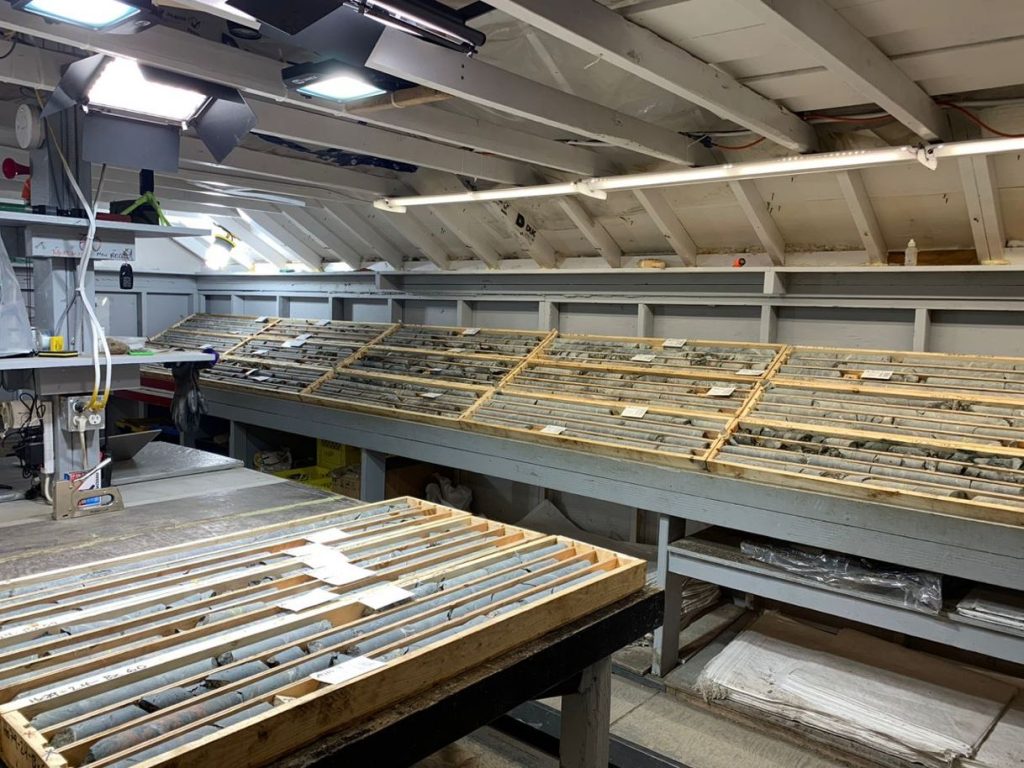
Doubleview Gold Corp. [TSXV: DBG; OTCQX: DBLVF; FSE: 1D4] reported assay results for drill holes H109, H110, H113 and H114, the first reported assay results from the 2026 drilling campaign at its 100%-owned Hat Polymetallic Deposit in northwestern British Columbia.
The company has completed approximately 7,400 metres of drilling at the Hat Project during 2026 to date, and drilling is ongoing. Drill holes H109 and H110 were drilled from the Hat East area, while drill holes H113 and H114 were drilled from the South-West Extension area. The holes were designed to provide additional geological and assay information in areas where the company’s current block model and mineralization model indicated a need for additional definition.
The results reported in this release add data from two separate locations on the Hat Deposit: the east side of the deposit and the south-west extension area. Additional assay results from both areas remain pending and will be announced following receipt, validation and review by the Company’s Qualified Person. The Company’s geological interpretation remains subject to change as additional drilling and assay data are received and integrated.
Drill holes H109, H110, H113 and H114 were not included in the Mineral Resource Estimate with an effective date of February 4, 2026, or in the Preliminary Economic Assessment disclosed by the Company in March 2026. These results will be considered for future geological modelling, resource estimation and engineering studies. No updated mineral resource estimate, pit design, economic analysis or resource classification change has been completed using the results reported in this news release.
Highlights: First 2026 assay release: H109, H110, H113 and H114 are the first drill holes from the 2026 Hat drilling campaign to be reported by assay.
Two target areas reported: H109 and H110 provide additional data from Hat East, while H113 and H114 add data from the South-West Extension area.
H109 returned 541.2 metres grading 0.27% CuEq from 60.0 metres, including 128.0 metres grading 0.48% CuEq, 19.0 metres grading 1.36% CuEq and 13.0 metres grading 1.80% CuEq.
H110 returned 408.4 metres grading 0.20% CuEq from 38.7 metres, including 111.7 metres grading 0.30% CuEq, 30.0 metres grading 0.78% CuEq, 19.0 metres grading 1.01% CuEq and 6.0 metres grading 1.89% CuEq.
H113 returned 417.6 metres grading 0.23% CuEq from 24.8 metres, including 174.4 metres grading 0.31% CuEq, 82.4 metres grading 0.37% CuEq and 7.4 metres grading 1.37% CuEq.
H114 returned 567.7 metres grading 0.16% CuEq from 36.3 metres, including 89.3 metres grading 0.41% CuEq and 55.0 metres grading 0.49% CuEq.
The holes were designed to fill important data gaps and provide additional drill density for future modelling. No change to current resource categories is implied until an updated MRE is completed and approved by a Qualified Person. Copper equivalent values in this release exclude scandium oxide (Sc2O3), which is reported separately in the assay table.
Selected Assay Results – Hat East – H109 and H110: H109 returned 541.2 metres grading 0.27% CuEq from 60.0 metres, including 432.0 metres grading 0.30% CuEq, 217.2 metres grading 0.37% CuEq, 128.0 metres grading 0.48% CuEq, 19.0 metres grading 1.36% CuEq and 13.0 metres grading 1.80% CuEq. H110 returned 408.4 metres grading 0.20% CuEq from 38.7 metres, including 111.7 metres grading 0.30% CuEq, 30.0 metres grading 0.78% CuEq, 19.0 metres grading 1.01% CuEq and 6.0 metres grading 1.89% CuEq. All reported intervals are drill core lengths. True widths have not been determined.
References in this news release to the 2026 PEA pit shell or proposed pit outline are provided only for geological context. They do not imply that the new drill holes are included in a mine plan, that mineral reserves have been estimated, or that an updated economic analysis has been completed. The PEA is preliminary in nature and includes inferred mineral resources that are considered too speculative geologically to have the economic considerations applied to them that would enable them to be categorized as mineral reserves.
Farshad Shirvani, President and CEO of Doubleview Gold, commented: “These first 2026 assays are important because they add disciplined follow-up data from two separate parts of the Hat Deposit. H109 and H110 provide additional close-spaced information from Hat East, including a strong interval in H109 beneath the 2026 PEA pit shell, while H113 and H114 add meaningful data from the South-West Extension area.
“These holes were drilled with a clear purpose: to fill gaps, test continuity and improve the data available for future modelling. While these results do not change the current MRE or PEA on their own, they are important building blocks for future updates. We look forward to reporting additional assays from both areas after they are received, validated and reviewed.”
Geological Interpretation – Hat East – H109 and H110: H109 and H110 were drilled from the same Hat East platform and were planned to test close-spaced mineralization on the east side of the Hat Deposit. The drill holes provide additional assay and geological information in an area where the company is seeking to improve the continuity, geometry and grade distribution inputs for future block model work.
H109 intersected a broad mineralized interval beginning at 60.0 metres and continuing for 541.2 metres. Within this interval, stronger mineralization occurs between 467.0 and 486.0 metres, including 13.0 metres grading 1.80% CuEq. The company interprets this as further support for mineralization below the 2026 PEA pit shell in the Hat East area.
H110 also returned broad mineralization, including 408.4 metres grading 0.20% CuEq from 38.7 metres and higher-grade intervals near the lower portion of the reported intercept, including 19.0 metres grading 1.01% CuEq and 6.0 metres grading 1.89% CuEq. Together, H109 and H110 achieved their intended purpose by adding close-spaced assay information to an important eastern part of the mineralized system.
South-West Extension – H113 and H114: H113 and H114 were drilled from the South-West Extension area to add assay information in a part of the Hat Deposit where additional drilling is required to better define mineralization continuity and geometry. The company interprets these holes as adding mineralization confirmation to the south-west area, while also providing data that may assist future modelling of the overall mineralization envelope.
H113 returned 417.6 metres grading 0.23% CuEq from 24.8 metres, including 174.4 metres grading 0.31% CuEq, 82.4 metres grading 0.37% CuEq and 7.4 metres grading 1.37% CuEq. H114 returned 567.7 metres grading 0.16% CuEq from 36.3 metres, including 89.3 metres grading 0.41% CuEq and 55.0 metres grading 0.49% CuEq.
These intervals are interpreted by the company to further support mineralization in the south-west part of the Hat system; however, the final interpretation is subject to change as additional drill holes from this and other locations are received, validated and modelled.
The results reported in this release are expected to be incorporated into future geological modelling after completion of standard QA/QC review and Qualified Person verification. Until an updated mineral resource estimate is completed, these results should not be interpreted as changing current mineral resource quantities, mineral resource classifications, pit geometry or project economics.
The Hat Deposit in northwestern B.C. is a polymetallic porphyry project with copper, gold, cobalt, silver and scandium mineralization. The company continues to advance the Hat Project through exploration drilling, metallurgical studies, environmental and engineering work, and technical studies required for responsible project advancement.