
Freegold drills 1.24 g/t Au over 213m including 21m of 5.77 g/t Au at Golden Summit
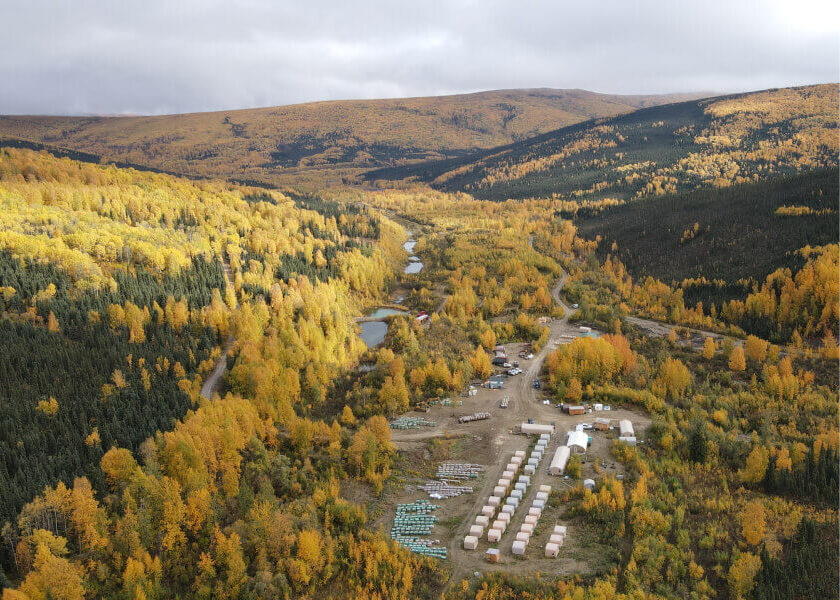
Drilling is defining a focused starting point for the 2027 pre-feasibility study, within one of North America’s largest undeveloped gold resources.
HIGHLIGHTS
- CONTINUITY AT DOLPHIN: Drilling continues to confirm a very large, growing and relatively continuous resource with long mineralized intervals consistent with the resource model, including 79.3 m at 1.11 g/t Au and 21 m at 5.77 g/t Au, with 3.1 m at 32.7 g/t Au.
- A FOCUSED STARTING APPROACH: Drilling is defining an initial development step for the PFS while preserving the broader resource’s long-term expansion potential.
- TECHNICAL DE-RISKING: Eight planned geotechnical holes are complete, while metallurgical testing and baseline programs continue to advance PFS design and planning.
- DIRECT PATH TO THE 2027 PFS: Freegold moved directly to a PFS to develop more detailed engineering and capital-cost estimates. More than 58,000 m drilled in 2026 to date supports the study and future development work.
- CURRENT RESOURCE: 17.2 Moz Indicated at 1.24 g/t Au and 11.9 Moz Inferred at 1.04 g/t Au, as of July 2025.
Freegold Limited (“Freegold”) (TSX: FVL, OTCQX: FGOVF) reports results from eight additional drill holes at its Golden Summit project in Alaska. At Dolphin, GS2647 and GS2656 returned long continuous runs of gold mineralization with higher-grade intervals that are the signature of the Dolphin Area. Near-surface mineralization was also encountered in GS2648 starting at 63.1 m (2.47 g/t Au over 18m), supporting starter pit optimization studies. Drilling in the Cleary Area further defined controls on mineralization within early proposed pit shells and supported the geological model.
“Golden Summit advanced on every major front this year, led by the largest drill program in the project’s history, with more than 100 holes completed to date. Our strategy is focused, disciplined and designed to unlock value in stages. The PFS’s development concept centres on a smaller pit—not the full scale of the current deposit—creating the potential for a more manageable capital profile and faster capital payback. A key part of this work is evaluating the near-surface oxide resource (nearly 1 million ounces) as potential early feed for an initial starter pit, with the objective of bringing cash flow forward and strengthening project economics during the critical early years. In parallel, we are strengthening the geological model, advancing metallurgical test work and trade-off studies, and progressing pit design and water management to optimize recovery, capital efficiency and operating performance. Together, these programs are laying the technical foundation for a credible 2027 PFS to define a clear development path and demonstrate the economic potential of a focused first-stage operation. The broader resource provides substantial leverage to future expansion, resource growth and long-term value creation. Golden Summit offers a compelling combination: a capital-disciplined path toward development, meaningful scalability and exposure to one of North America’s largest undeveloped gold resources, with significant discovery potential remaining across the broader property,” said Kristina Walcott, President and CEO.
Drilling results
The eight drill holes in this release are from the ongoing 2026 program and include infill holes in the Dolphin and Cleary areas, as well as condemnation holes testing the margins of the known deposit.
DOLPHIN AREA (GS2647, GS2648, GS2656)
Dolphin results continue to show strong continuity of mineralization, including higher-grade corridors within the broader trend. Closer-spaced infill drilling and refinements to the geological model are now connecting previously isolated higher-grade intercepts into more coherent mineralized corridors. Results continue to confirm the resource model as of July 2025. Further drilling is testing the core zones of proposed deep-seated structural traps within the schist host rock.
|
Hole |
Easting |
Northing |
Depth |
Dip |
Az. |
From (m) |
To (m) |
Interval |
Au (g/t) |
|
GS2647 |
479001 |
7215086 |
898.2 |
-90 |
360 |
136.2 |
218.5 |
82.3 |
0.98 |
|
242.9 |
267.2 |
24.3 |
0.86 |
||||||
|
367.8 |
742.8 |
375 |
0.73 |
||||||
|
Incl |
388 |
425.8 |
37.8 |
0.84 |
|||||
|
Incl |
447.1 |
559.9 |
112.8 |
0.84 |
|||||
|
Incl |
474.6 |
520.3 |
45.7 |
0.97 |
|||||
|
Incl |
633.1 |
660.5 |
27.4 |
0.83 |
|||||
|
Incl |
709.3 |
742.8 |
33.5 |
1.02 |
|||||
|
GS2648 |
479358 |
7215450 |
630 |
-90 |
360 |
63.1 |
93.6 |
30.5 |
1.67 |
|
Incl |
63.1 |
81.1 |
18 |
2.47 |
|||||
|
118 |
123.1 |
5.1 |
2.09 |
||||||
|
163.4 |
182 |
18.6 |
0.68 |
||||||
|
227.7 |
245.8 |
18.1 |
0.82 |
||||||
|
296.4 |
306.9 |
10.5 |
0.74 |
||||||
|
343.2 |
492.9 |
149.7 |
0.89 |
||||||
|
incl |
377 |
456.3 |
79.3 |
1.11 |
|||||
|
GS2656 |
478898 |
7215339 |
758 |
-90 |
360 |
111.1 |
117 |
5.9 |
1.89 |
|
139 |
142.5 |
3.5 |
1.88 |
||||||
|
203 |
222.6 |
19.6 |
1.23 |
||||||
|
236 |
306.3 |
70.3 |
0.79 |
||||||
|
incl |
203 |
222.6 |
19.6 |
1.23 |
|||||
|
incl |
236 |
242 |
6.0 |
2.85 |
|||||
|
422 |
635 |
213.0 |
1.24 |
||||||
|
incl |
467 |
488 |
21 |
5.77 |
|||||
|
incl |
482 |
485 |
3.0 |
32.7 |
|||||
|
incl |
515 |
526.7 |
11.7 |
1.20 |
|||||
|
incl |
539 |
545 |
6.0 |
3.29 |
|||||
|
incl |
562.9 |
581.8 |
18.9 |
1.26 |
|||||
|
incl |
596 |
635 |
39.0 |
1.05 |
The widths refer to drill hole intercepts; true width cannot be determined due to the uncertain geometry of mineralization.
GS2656 drilled the central part of Dolphin to better understand structural controls in the host rock schist and to drill down the keel of a proposed pit shell sequence. The drill hole was collared in the hanging wall block of the Tolovana Fault. Drilling returned 21.0 m of 5.77 g/t Au starting at 467 m, within a broader zone of 213.0 m at 1.24 g/t Au starting at 422.0 m. Sampling highlights include:
- 5.56 g/t Au over 3.0 m from 212-215 m, associated with quartz-Fe-carbonate veining with pyrite-arsenopyrite.
- 32.7 g/t Au over 3.1 m from 482-485 m, associated with high-angle open-space quartz-arsenopyrite veins with multiple visible gold grains distributed along vein walls.
- 5.97 g/t Au over 3.0 m from 542-545 m, associated with a large (metre-wide) high-angle white quartz-arsenopyrite-pyrite-jamesonite vein.
- 7.66 g/t Au over 3.0 m from 614-617 m, associated with moderate-to-high-angle white quartz-arsenopyrite-pyrite veins in strongly sheared black schist (phyllonite).
GS2648 drilled the eastern part of Dolphin where it transitions into the Cleary Area. Drilling tested the eastern Tolovana Fault where it intersects a potential cross-structure. Near-surface mineralization was encountered, returning 30.5m at 1.67 g/t Au from 63.1- 93.6 m. Further downhole in the Tolovana footwall, drilling returned 79.3 m of 1.11 g/t Au starting at 377 m, within a broader zone of 149.7 m at 0.89 g/t Au starting at 343.2 m. Sampling highlights include:
- 3.79 g/t Au over 10.3 m from 68.3-78.6 m, associated with a fault zone (breccia, rubble and gouge) with disseminated sulphides in the breccia matrix.
GS2647 drilled the Dolphin Stock, testing the southern wall of proposed pit shells and continuing to greater depth. Drilling returned 112.8 m at 0.84 g/t Au starting at 447 m, within 375 m of 0.73 g/t Au, again demonstrating the broad continuity of mineralization within the stock. Sampling highlights include:
- 3.93 g/t Au over 3.1 m from 212.4- 215.5 m, associated with quartz-pyrite-arsenopyrite-jamesonite veining and crackle breccia with argillic alteration in granodiorite.
- 5.50 g/t Au over 3.1 m from 794.6–797.7 m, associated with quartz-pyrite-arsenopyrite vein stockwork in faulted hornfelsed schist within the contact margin of the stock.
CLEARY AREA (GS2644, GS2652)
Two reported holes (GS2644 and GS2652) were drilled in the southern part of the Cleary Area to infill previous drilling along the southern wall of proposed pit shells and to better define controls on mineralization. These holes were intentionally limited in depth. Drilling confirmed a series of gently dipping mineralized splay structures branching off the moderately south-dipping main trend farther to the north (and continuing at greater depth). Sampling highlights include:
- 3.35 g/t Au over 3.0 m from 261.2-264.2 m in GS2644, associated with moderate-to-high-angle quartz-sulphide veins in a crackle-brecciated deformation zone with narrow fault lenses.
|
Hole |
Easting |
Northing |
Depth |
Dip |
Az. |
From (m) |
To (m) |
Interval |
Au (g/t) |
|
GS2644 |
479803 |
7215303 |
349.6 |
-90 |
360 |
160.6 |
169.7 |
9.1 |
0.97 |
|
252.1 |
270 |
17.9 |
1.03 |
||||||
|
315.1 |
322.2 |
7.1 |
1.01 |
||||||
|
GS2652 |
479754 |
7215281 |
346.6 |
-75 |
360 |
270.4 |
279.5 |
9.1 |
2.1 |
The widths refer to drill hole intercepts; true width cannot be determined due to the uncertain geometry of mineralization.
CONDEMNATION HOLES (GS2642, GS2643, GS2645)
Reported condemnation holes (GS2642, GS2643, GS2645) were designed to test the limits of the system in the northern part of the Dolphin Area. The holes were collared in the hanging wall block of the western extension of Cleary Road Cut Shear (CRCS Fault). Drilling intersected narrow zones of structurally controlled mineralization continuing up-dip of known mineralization. GS2642 was ended early after its trajectory began steepening. GS2643 was designed as a short hole to test the northern margin of an early proposed pit. GS2645 intersected three notable near-surface intervals. Sampling highlights include:
- 3.45 g/t Au over 3.0 m from 134-137 m in GS2643, associated with the upper margin of a narrow (0.5 m wide) faulted contact between marble and schist.
- 5.47 g/t Au over 1.2 m from 57.7-59.9 m in GS2645, associated with a shear zone in calcareous schist with quartz-arsenopyrite-jamesonite.
|
Hole |
Easting |
Northing |
Depth |
Dip |
Az. |
From (m) |
To (m) |
Interval |
Au (g/t) |
|
GS2642 |
479255 |
7215624 |
209 |
-75 |
360 |
70.2 |
75.7 |
5.5 |
1.81 |
|
GS2643 |
479154 |
7215742 |
281.6 |
-75 |
360 |
134 |
137 |
3 |
3.45 |
|
161 |
166.8 |
5.8 |
0.96 |
||||||
|
GS2645 |
479200 |
7215703 |
425 |
-75 |
360 |
20 |
24.1 |
4.1 |
0.85 |
|
51.1 |
61.5 |
10.4 |
1.12 |
||||||
|
140 |
146 |
6 |
2.55 |
The widths refer to drill hole intercepts; true width cannot be determined due to the uncertain geometry of mineralization.
How the Current Program provides the basis for the PFS.
Freegold’s decision to advance Golden Summit directly to a pre-feasibility study reflects a disciplined value-creation strategy: concentrating capital and technical effort on the work needed to define the development opportunity and reduce uncertainty. Unlike a PEA, a PFS requires substantially more resource definition, test work, engineering, trade-off analysis, infrastructure planning and cost estimation. This work will provide greater confidence in production rates, recoveries, capital and operating costs, and project economics, while avoiding duplicative study work and supporting subsequent engineering and development planning.
Golden Summit’s scale and potential as a generational asset demand realistic capital and operating cost estimates. PFS trade-off studies will assess mine plans, production rates, infrastructure and processing routes—including Albion Process™, GlassLock Process™, BIOX®, and POX—to identify the strongest balance of recovery, capital efficiency, operating performance, and technical risk. Testing of 2025 and 2026 core, together with separate oxide-resource work, will further advance the understanding of the best process methods to help define an initial development scenario while preserving flexibility to expand or adapt over time.
Power supply remains a major economic consideration and is being evaluated through an independent study because of its potential influence on infrastructure requirements, processing options, capital costs and operating margins. The results will be integrated with the broader trade-off studies to help define the initial development scenario.
Tighter-spaced infill drilling is refining the geological model, defining higher-grade structural controls and increasing confidence in the resource. The planned mineral resource update will provide the strongest basis at this stage for PFS planning, engineering, trade-off studies and economic evaluation.
Geotechnical and hydrogeological work will help determine pit and infrastructure design, while environmental, cultural, archaeological and paleontological baseline programs advance alongside the PFS.
2026 Program progress
- Drilling: more than 58,000 m completed in 2026; drilling continues.
- Geotechnical: Eight planned holes completed, with core submitted for rock-quality, strength and slope-stability testing to support pit design.
- Condemnation: drilling is refining mineralized boundaries and evaluating potential infrastructure locations.
- Hydrological groundwater monitoring, VWP installations, wildlife studies.
- Power: the exploration camp is now connected to grid power, improving reliability and reducing diesel use, noise and emissions. Power for the PFS remains under study.
Ongoing Results
- Further results from the 2026 program over the next several months.
- Drilling expected to continue until early December.
- Foundation drilling 2027 – ongoing baseline work
- Additional metallurgical results
- An updated mineral resource estimate, to be incorporated into the PFS targeted for 2027
About Golden Summit
Golden Summit combines a large and growing mineral resource within a long-established gold-producing district. Streams draining the project area have produced more than 6.75 million ounces of placer gold since the Alaskan gold rush, with an additional 500,000 ounces of historical lode production. The currently defined resource occupies only the western portion of Freegold’s 13-kilometre-by-6-kilometre property, within a compact 2-kilometre-by-1.5-kilometre footprint, leaving substantial room for expansion along trend.
This scale, together with early success at the Tamarack Zone and emerging anomalies in the Saddle Zone, reinforces the potential for continued discovery, resource growth and broader district-scale development at Golden Summit. Ongoing targeting work is defining new drill opportunities that could add ounces, extend mineralization and improve the project’s long-term development profile.
As of July 2025, Golden Summit hosts an Indicated Oxide Resource of 920,000 ounces at 0.45 g/t Au (63.7 million tonnes) and an Inferred Oxide Mineral Resource of 287,000 ounces at 0.47 g/t Au (18.8 million tonnes (using a 0.15 g/t cut off) and an Indicated Primary Mineral Resource of 17.2 million ounces at 1.24 g/t Au (432 million tonnes) and an Inferred Primary Mineral Resource of 11.9 million ounces at 1.04 g/t Au (358 million tonnes), using a 0.5 g/t cut-off grade and a gold price of $2,490.
Plan Map of Current Drilling & Section
https://wp-freegoldventures-2026.tor1.cdn.digitaloceanspaces.com/media/2026/10/14150556/478900E.pdf
Analytical Program and QA/QC
HQ core is logged, photographed and cut in half using a diamond saw. One-half is placed in sealed bags for preparation and subsequent geochemical analysis by ALS facilities in Vancouver and Thunder Bay. Core samples were delivered to ALS’s facility in Vancouver, Canada, where each sample was crushed to 70% passing a 2 mm (Tyler 9 mesh, U.S. Std. No. 10) screen. In Thunder Bay, a representative ~500 g subsample was obtained by riffle splitting (SPL-32a) and analyzed for gold using the ALS method Au-PA01 (PhotonAssay), which provides a detection range of 0.03 ppm to 350 ppm. In Vancouver, a subsample was also analyzed for multi-element geochemistry using the ALS method ME-ICP61 (34-element, four-acid ICP-AES). Occasionally, samples are smaller than 500 g and are then assayed by Fire Assay with an AAS finish, method code Au-AA23 (30 g sample size); samples over 10 g/t Au are then automatically assayed using a FA Grav method, Au-GRAV21. Additional Au screening may be performed using ALS’s Au-SCR24 method; select samples are dry-screened to 100 microns. A duplicate 50 g fire assay is conducted on the fine fraction, and the entire oversize fraction is assayed. Total Au content, individual assays, and weight fractions are reported. The QA/QC program includes laboratory and field standards inserted every ten samples. Blanks are inserted at the start of each submittal, and at least one blank is inserted every 25 standards.
Qualified Person and Disclosure
Alvin Jackson, P.Geo., Vice President of Exploration and Development for Freegold, is the Qualified Person who has approved the scientific and technical disclosure in this release.
About Freegold Limited
Freegold is a TSX-listed company focused on advancing exploration and development-stage gold projects in Alaska.