
Capitan Silver expands silver mineralization and announces new CRD Discovery at Cruz De Plata Project, Mexico
Capitan Silver Corp. [TSXV: CAPT; OTCQX: CAPTF] reported additional results from its 60,000-metre drill program at its Cruz de Plata silver-gold project, located in Durango, Mexico. The company is reporting assay results from 22 drill holes.
Highlights: Capitan Silver announces new discovery of CRD mineralization 500 metres below the Jesus Maria Silver Trend. Capitan continues to expand silver mineralization at depth along the Jesus Maria Silver Trend; intersecting high-grade silver and base metal mineralization 600 metres down-dip in drill hole 26-ERDD-49.
Deep drilling confirms presence of Carbonate Replacement Deposit (CRD) mineralization. Drill holes 26-ERDD-32 and 26-ERDD-49 encounter replacement style, massive sulphide, CRD-type mineralization at depth. CRD deposits are often associated with prolific, high-grade polymetallic mineralization. The presence of CRD is evidence of a separate mineralizing event that occurred in addition to the intermediate sulphidation epithermal mineralization that is present throughout the Jesus Maria Trend
Capitan intersected impressive CRD mineralization in drilling. Highlights include drill hole 26-ERDD-49.
Lower Zone: 1,639.3 g/t AgEq over 0.9 metres (959 g/t Ag, 2.72% Cu, 0.62 g/t Au, 12.26% Pb, and 7.96% Zn, over 0.9 m).
Upper Zone: 883.8 g/t AgEq over 0.5 metres, within a wider interval of 9.3 metres of 155.41 g/t AgEq (405 g/t Ag, 2.15% Cu, 0.75 g/t Au, 4.4% Pb, and 6.99% Zn over 0.5 metres, within a wider interval of 9.3 metres of 101.7 g/t Ag, 0.19% Cu, 0.13 g/t Au, 0.49% Pb, and 0.92% Zn).
Drill hole 26-ERDD-32: Upper Zone: 1,142.01 g/t AgEq over 0.9 metres, within a wider interval of 4.1 metres of 330.2 g/t AgEq (730 g/t Ag, 1.58% Cu, 0.17 g/t Au, 6.49% Pb, and 6.56% Zn over 0.9 m, within a wider interval of 4.1 m of 201.3 g/t Ag, 0.38% Cu, 0.06 g/t Au, 1.85% Pb, and 2.41% Zn).
Lower Zone: 315.9 g/t AgEq over 1.1 metres, within a wider interval of 5.6 metres of 230.1 g/t AgEq (225.0 g/t Ag, 0.17% Cu, 0.23 g/t Au, 1.32% Pb, and 1.63% Zn, within a wider interval of 5.6 metres of 127.96 g/t Ag, 0.13% Cu, 0.14 g/t Au, 1.29% Pb, and 2.15% Zn)
Additional drill highlights include: 676.8 g/t AgEq over 1.4 metres and 599.5 g/t AgEq over 1.1 m in drill hole 26-ERDD-35; 572.4 g/t AgEq over 0.3 metres and 302.8 g/t AgEq over 0.9 metres, within a wider interval of 7.1 m of 90.80 g/t AgEq in drill hole 26-SRDD-01; 411.4 g/t AgEq over 1.0 metre, within a wider interval of 8.5 metres of 212.2 g/t AgEq in drill hole 26-ERDD-34; 363.6 g/t AgEq over 2.4 metres, within a wider interval of 3.4 m of 290.5 g/t AgEq and 551.3 g/t AgEq over 1.0 metre in drill hole 26-ERDD-19 and 240 g/t AgEq over 3.0 metres, within a wider interval of 6.1 metres of 154.3 g/t AgEq in drill hole 26-SRRC-31.
Upcoming Catalysts: Assays are pending for 80 drill holes in multiple priority targets, including newly permitted areas: 22 core, 58 reverse circulation (RC) holes, with more arriving weekly.
Alberto Orozco, CEO of Capitan Silver, commented: “The recent set of results from our 2026 drill program continues to impress, as we have further expanded silver mineralization at depth along the Jesus Maria Silver Trend, including hitting high-grade silver approximately 600 metres down-dip – our deepest mineralized intercept to date. This marks an important milestone for Cruz de Plata, as we have reached our initial goal of 500 metres of vertical depth, with the system remaining open in multiple directions. More importantly, the strong silver equivalent grades we’re seeing as we go deeper continue to be driven mainly by silver grade itself, while also containing higher contents of copper, lead, and zinc.
“What I find most significant about these results is that with this new drilling and the discovery of CRD mineralization at depth, we are now seeing evidence for three distinct mineralizing events at Cruz de Plata: High-grade silver intermediate sulphidation epithermal, the distal oxide gold deposit at Capitan Hill, and the very exciting new CRD mineralization, which is often associated with rich, high-grade polymetallic deposits.
“This new discovery, in addition to what we have previously outlined for the project, clearly supports our view that Cruz de Plata is a large, rich, deep-rooted system where the scale potential is only just beginning to show.”
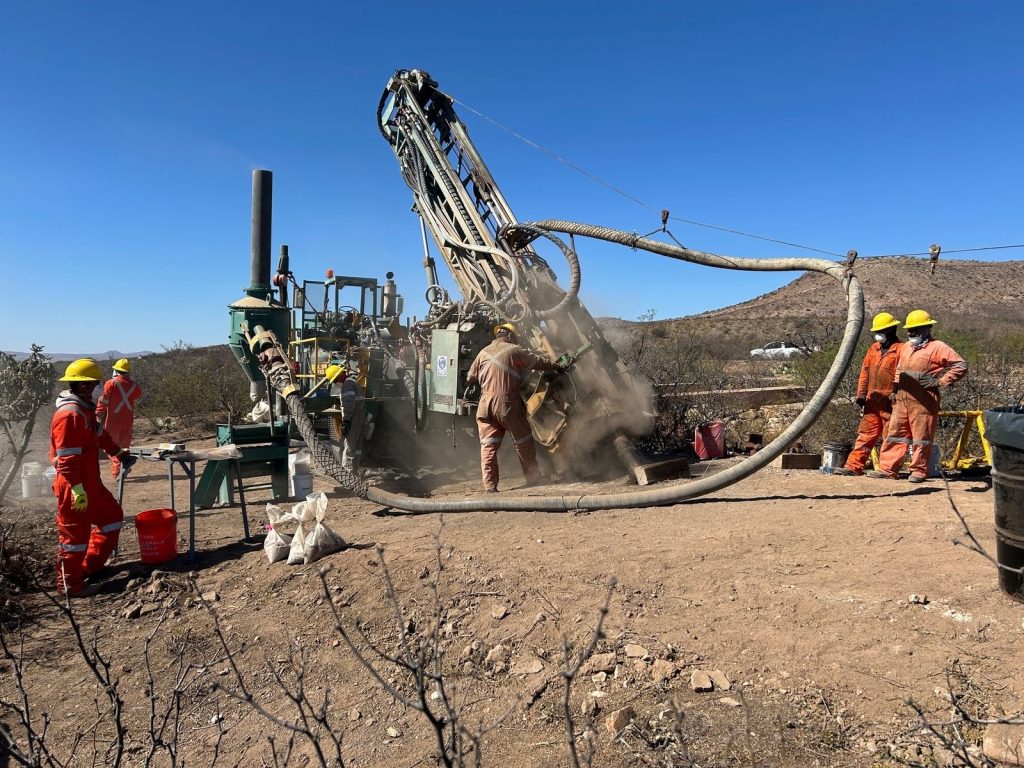
The 2026 drill program at the Cruz de Plata silver-gold project continues to expand the mineralized footprint down-dip along the 2.85 km Jesus Maria Silver Trend. The Company is currently operating three diamond core rigs focused on expansion drilling at Targets A, B, and C, while the RC rig continues to evaluate new targets across the consolidated property package. Results in this news release focus on Target Areas A and B.
For the remainder of the 60,000-metre program, drilling will continue to focus on large >150-metre step-outs at Targets Areas A, B, and C.
Drill Results: Target Area A: Recent drilling at Target Area A has resulted in the extension of high-grade silver mineralization down-dip along the target area. The Company also intersected high-grade silver mineralization more than 600 metres down-dip in drill hole 26-ERDD-49, the deepest hole drilled on the Cruz de Plata property to date.
Drill highlights from Target Area A include: 1,639.3 g/t AgEq over 0.9 metres and 883.8 g/t AgEq over 0.5 metres, within a wider interval of 9.3 m of 155.4 g/t AgEq in drill hole 26-ERDD-49; 1,142.0 g/t AgEq over 0.9 metres, within a wider interval of 4.1 metres of 330.2 g/t AgEq, and 315.9 g/t AgEq over 1.1 metres, within a wider interval of 5.6 metres of 230.1 g/t AgEq in drill hole 26-ERDD-32; 676.8 g/t AgEq over 1.4 metres and 599.5 g/t AgEq over 1.1 metres in drill hole 26-ERDD-35; 411.4 g/t AgEq over 1.0 metres, within a wider interval of 8.5 m of 212.2 g/t AgEq in drill hole 26-ERDD-34; 363.6 g/t AgEq over 2.4 m, within a wider interval of 3.4 metres of 290.5 g/t AgEq and 551.6 g/t AgEq over 1.0 metre in drill hole 26-ERDD-19.
Drill hole 26-ERDD-49 intersected multiple, sub-parallel zones of mineralization hosted in strongly brecciated carbonaceous, siliciclastic to carbonate bearing sediments. The drill hole returned 1,639.3 g/t AgEq over 0.9 metres, and 883.8 g/t AgEq over 0.5 metres, within a wider interval of 9.3 metres of 155.4 g/t AgEq. Drill hole 26-ERDD-49 also intersected 0.9 m of 2.72% Cu and 0.5 metres of 2.15% Cu at depths of 436.7 metres and 429.2 metres from surface, respectively, showing increasing copper grades as the company continues to drill deeper into the higher temperature portions of the system.
Further up-dip on the same section, drill hole 26-ERRD-32 returned several high-grade intervals, including 1,142.0 g/t AgEq over 0.9 metres, within a wider interval of 4.1 metres of 330.2 g/t AgEq, and 315.9 g/t AgEq over 1.1 metres, within a wider interval of 5.6 metres of 230.1 g/t AgEq. Drill hole 26-ERRD-32 also intersected 0.9 metres of 1.58% Cu.
These results are significant as both holes confirm that the high-grade silver system extends well beyond the previous limits of historic drilling at the Cruz de Plata project, with mineralization remaining open at depth.
Additional step-out drilling along the Target A portion of the Jesus Maria Silver Trend also returned strong silver grades, extending mineralization down-dip between 60 and 80 m along their respective sections, most notably in drill hole 26-ERDD-34, which returned 411.4 g/t AgEq over 1.0 metre, within a wider interval of 8.5 metres of 212.2 g/t AgEq, and drill hole 26-ERDD-35, which returned 676.8 g/t AgEq over 1.4 metres and 599.5 g/t AgEq over 1.1 metres.
Confirmation of CRD-Type mineralization found in multiple Target A drill holes: Drill holes 26-ERDD-49 and 26-ERDD-32 intersected multiple areas of replacement-style massive sulphide mineralization. These new drill holes, in addition to previously released drill holes JMDD-02, 04, 08 and 09, 21-JMRC-03, and historic drill hole JM_DDH_13_06, strongly suggest that a late, overprinting CRD hydrothermal system has been deposited in a separate mineralizing event that occurred in addition to the intermediate sulphidation epithermal style of mineralization that is present across the Jesus Maria Silver Trend.
Previously reported high-grade intervals with CRD mineralization include JM_DD_13_06 that intersected 3,532 g/t AgEq (3,409 g/t Ag, 0.36 g/t Au, 0.31% Cu, 3.4% Pb, and 7.1% Zn) over 0.9 metres. 26-JMDD-09 intersected 1,366.3 g/t AgEq (1324 g/t Ag. 1.04 g/t Au, 0.12% Cu, 0.8% Pb, and 0.7% Zn) over 1.1 metres.
26-JMDD-02 intersected 1,035 g/t AgEq (792 g/t Ag, 0.42 g/t Au, 0.16% Cu, 5.2% Pb, and 4.6% Zn) over 1.1 metres. 26-JMDD-08 intersected 740.7 g/t AgEq (407 g/t Ag, 0.22 g/t Au, 0.16% Cu, 4.6% Pb, and 8.0% Zn) over 1.0 metre.
21-JMRC-03 intersected 737.9 g/t AgEq (370 g/t AgEq, 0.27 g/t Au, 0.2% Cu, 5.6% Pb, and 8.1% Zn) over 1.5 metres. 26-JMDD-04 intersected 605.9 g/t AgEq (278 g/t Ag, 0.57 g/t Au, 0.44% Cu, 5.2 % Pb, and 5.5% Zn) over 1.5 metres.
CRD deposits occur frequently within the same magmatic framework, with larger systems showing strong vertical and lateral continuity away from the main magmatic source, typically as mantos and along feeder structures. Based on the drilling to date, it appears that this style of mineralization occurs within close proximity to where north-northeast and north-northwest trending, extensional structures crosscut earlier east to northeast trending structures.
Examples of these structures at Cruz de Plata include the Gully Fault and the Peñoles Fault structures, which have been interpreted to be feeders to the main zones of mineralization along the Jesus Maria Silver Trend, including the historic Jesus Maria and El Refugio underground workings.
Drill Results Target Area B: First pass diamond drilling at Target Area B returned encouraging results, with drilling focused on extending mineralization down-dip from known high-grade zones in the vicinity of the historic Jesus Maria Mine.
Drill highlights from Target Area B include 572.4 g/t AgEq over 0.3 metres and 302.8 g/t AgEq over 0.9 metres, within a wider interval of 7.1 metres of 90.8 g/t AgEq in drill hole 26-SRDD-01 and 240 g/t AgEq over 3.0 metres, within a wider zone of 6.1 metres of 154.3 g/t AgEq in drill hole 26-SRRC-31.
Drill hole 26-SRDD-01 was designed to test the Jesus Maria Silver Trend down-dip from previously reported RC drill hole 26-SRRC-28, in the vicinity of high-grade silver mineralization returned from previously reported drill holes 26-SRRC-32 and 26-SRRC-33. The drill hole returned anomalous silver mineralization over multiple intervals ranging in width from 0.3 metres to 11.2 metres, within strongly brecciated and fractured carbonaceous sediments.
Core from drill hole 26-SRDD-01 indicates that this area contains significant fault zones, with mineralization potentially displaced down-dip to the east, similar to what occurred to the east of the Peñoles Fault. In addition, zones of post-mineral, intermediate dyking appear to have interrupted the mineralized zone in drill holes 26-SRDD-02 and 26-SRDD-03, resulting in weaker grades where the mineralized zone has been displaced.
Deeper and more concentrated step-out drilling at this target is currently being carried out along a 600-metre portion of the Jesus Maria Trend bounded by the San Rafael Mine to the east and the Peñoles Fault to the west to help develop a more detailed geologic model of this zone and target higher-grade mineralization in the vicinity of the Peñoles Fault.
Drill hole 26-SRRC-31 was designed as a down-dip step-out hole from previously reported drill hole 26-SRRC-08. The drill hole returned multiple intervals of mineralization, including 240 g/t AgEq over 3.0 metres, within a wider interval of 6.1 metres of 154.4 g/t AgEq, extending mineralization down-dip between 40-80 metres from the previous intersection.
Capitan Silver is defining a new high-grade silver system at its Cruz de Plata Project, located in the heart of Mexico’s primary silver belt. The company is led by a proven and accomplished management team that has previously advanced three projects into production, on time and on budget.
The company has been diligent in maintaining a tight share structure and has one of the tightest share structures among its peer group, with the top three shareholders owning approximately 37% of the company’s share capital. Capitan Silver is fully funded and actively drilling at its Cruz de Plata silver project.