
Canterra Minerals drills 18.75 metres of 5.35% CuEq, including 5.15 metres of 8.83% CuEq, at the Lemarchant Deposit, Newfoundland
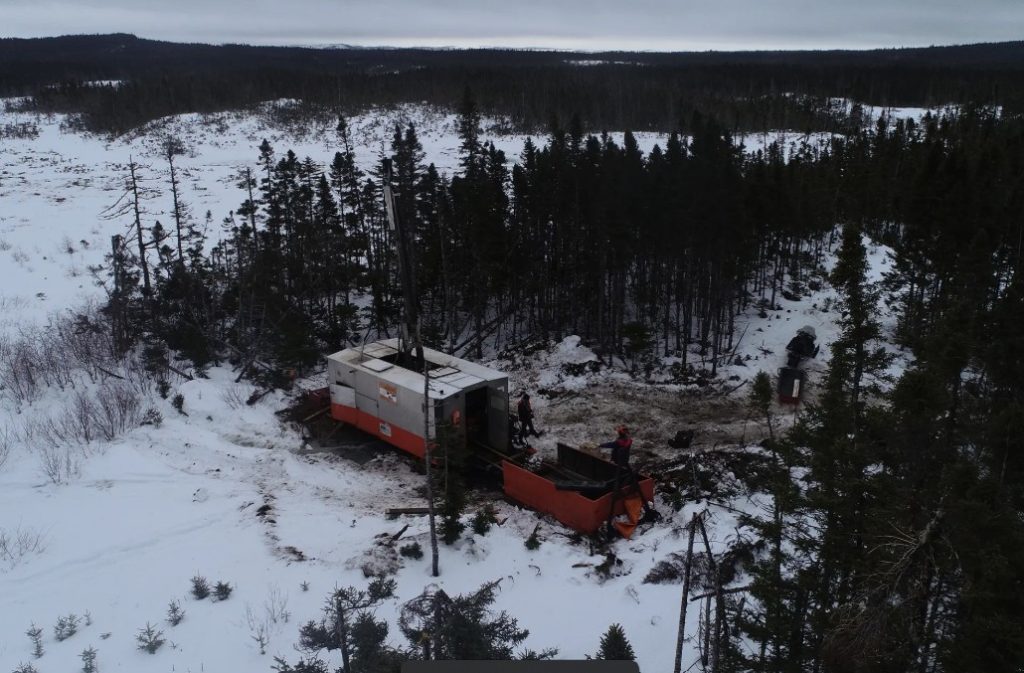
Canterra Minerals Corp. [TSXV: CTM; OTCQB: CTMCF; FSE: DXZB] reported assay results from seven diamond drill holes at the Lemarchant Deposit, including 18.75 metres of 5.35% CuEq in hole LM-26-172. Lemarchant is the largest known satellite deposit within Canterra’s Buchans District portfolio in central Newfoundland and hosts a 2018 historical mineral resource estimate of 2.42 million tonnes Indicated at 4.89% CuEq and 0.56 million tonnes Inferred at 3.66% CuEq.
Following the recently announced 55% increase in Indicated Mineral Resource tonnage at its cornerstone Lundberg Deposit to 26.1 Mt, Canterra is advancing the next stage of its district strategy: demonstrating the potential for additional high-grade mineralization across its surrounding satellite deposits to contribute to the scale and value of the broader Buchans District. Lemarchant is located approximately 20 km southwest of Teck Resources’ former Duck Pond VMS Mine.
Chris Pennimpede, President and CEO of Canterra, commented: “Our investment thesis at Buchans has always been about more than one deposit. We have now grown the Indicated resource at Lundberg by 55%, and these first results from Lemarchant demonstrate the high grades that make our surrounding satellite deposits so compelling.
“Nearly 19 metres exceeding 5% copper equivalent, including more than 5 metres approaching 9% copper equivalent, reinforces why we believe Lemarchant could become an important contributor to the broader Buchans District opportunity. With additional assays pending from step-outs and new exploration targets, we have more opportunities ahead.
“Our focus is on building scale around an established resource base while demonstrating the high-grade potential of the surrounding deposits. That’s how we intend to unlock the broader value of the district for shareholders.”
He added, “With a significantly expanded resource at Lundberg and now high-grade results from Lemarchant, we are beginning to demonstrate the broader opportunity across our consolidated Buchans District.”
LM-26-172, an infill hole through the Lemarchant Main Zone, intersected 18.75 metres of 5.35% CuEq (0.61% Cu, 6.00% Zn, 1.45% Pb, 77.2 g/t Ag, 1.72 g/t Au) from 238.00 metres, at a vertical depth of approximately 180 metres.
The interval includes 5.15 metres grading 8.83% CuEq from 240.85 metres, carrying 165.4 g/t Ag and 2.98 g/t Au. A separate deeper interval was intersected from 275.00 to 284.00 metres grading 0.66% CuEq over 9.00 metres.
LM-26-176 intersected the Lemarchant Main Zone at 190.90 metres, at a vertical depth of approximately 142 metres, returning 13.10 metres of 1.21% CuEq, including 2.10 metres grading 3.86% CuEq. The upper 1.10 metres is semi-massive sulphide with approximately 30% pyrite and 5 to 10% sphalerite and chalcopyrite with trace galena, grading 4.55% CuEq with 2.82 g/t Au and 23.4 g/t Ag. It is underlain by rhyolite breccia with strong silica-sericite alteration and stockwork pyrite with base metal sulphides, characteristic of the footwall alteration zone beneath the Lemarchant Deposit.
LM-26-171 was drilled up-dip and west of the Main Zone to a depth of 196.0 metres and intersected two zones of zinc-copper mineralization, including 3.00 metres of 1.03% CuEq from 61.00 metres. Holes LM-26-173 and LM-26-175 returned only low-grade intervals, the best being 1.00 metre of 1.03% CuEq from 144.60 metres in LM-26-175, where the Lemarchant Horizon contains only minor sulphides. Hole LM-26-174 and the extension of historical hole LM-11-049 (LM-11-049EXT), which was deepened to test a deep IP anomaly down plunge of the Lemarchant Northwest Zone, returned no significant assays.
The results confirm the continuity of polymetallic massive sulphide mineralization while further highlighting the prospective host horizon that remains open along strike and at depth beyond the limits of past deposit-focused drilling.
The Lemarchant Deposit hosts a historical mineral resource estimate from 2018, reported at a 4.0% zinc equivalent cut-off, as set out in the Technical Report titled “NI 43-101 Technical Report and Updated Mineral Resource Estimate on the Lemarchant Deposit, South Tally Pond Property, Central Newfoundland, Canada.”
Historical Indicated resources are 2.42 million tonnes at 0.68% copper, 6.15% zinc, 1.60% lead, 64.04 g/t silver, 1.22 g/t gold for a 4.89% CuEq and a ZnEq of 12.40%. Historical Inferred resources stand at 0.56 million tonnes at 0.45% copper, 4.68% zinc, 1.08% lead, 44.67 g/t silver, 1.06 g/t gold for a CuEq of 3.66% and a ZnEq of 9.31%.
Canterra would like to acknowledge financial support it received from the Government of Newfoundland and Labrador’s Junior Exploration Assistance Program related to the completion of its 2024 and 2025 programs, and any support it may receive for its 2026 exploration programs in the Buchans District.
Canterra is a diversified minerals exploration company focused on critical minerals and gold in central Newfoundland. The company’s projects include seven mineral deposits located in close proximity to the world-renowned, past-producing Buchans Mine and Teck Resources’ Duck Pond Mine, which collectively produced copper, zinc, lead, silver and gold. Several of Canterra’s deposits support current and historical Mineral Resource Estimates prepared in accordance with NI 43-101 standards.
Canterra’s gold projects are located on trend of Equinox Gold’s Valentine Mine and cover an approximately 55 km extension of the same structural corridor that hosts gold mineralization within Equinox Gold’s mine.
Past drilling by Canterra and others within the company’s gold projects intersected multiple occurrences of orogenic-style gold mineralization within a large land position that remains underexplored.
Resource World Magazine Inc. has prepared this editorial for general information purposes only and should not be considered a solicitation to buy or sell securities in the companies discussed herein. The information provided has been derived from sources believed to be reliable but cannot be guaranteed. This editorial does not take into account the readers investment criteria, investment expertise, financial condition, or financial goals of individual recipients and other concerns such as jurisdictional and/or legal restrictions that may exist for certain persons. Recipients should rely on their own due diligence and seek their own professional advice before investing.