
Goldshore Resources drills 25.3 metres of 0.92 g/t gold, proving continuity of shears between Main and Southwest Zones, Moss Gold Project, Ontario
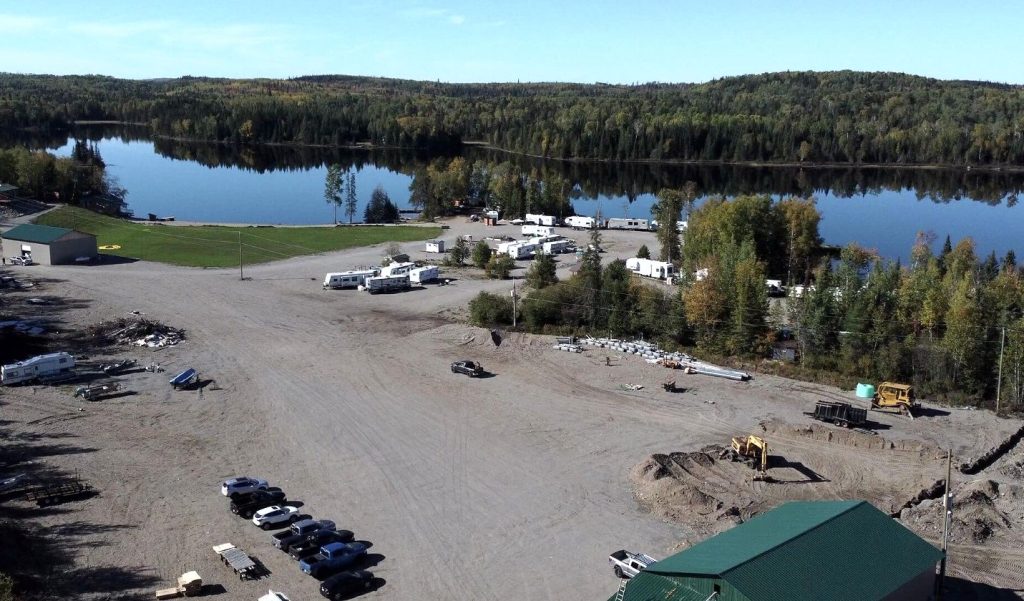
Goldshore Resources Inc. [TSXV: GSHR; OTCQB: GSHRF; FSE: 8X00] reported its latest assay results from its recently completed 20,000-metre winter drill program with the final results from the Golden Gate Zone, a previously undrilled section between the Main and Southwest Zones of the Moss Gold Project in Northwest Ontario, Canada. A total of 1,380 metres were drilled underneath a saddle in the conceptual open pit with the goal of expanding the resource beneath the current proposed open pit for a future mineral resource estimate.
Michael Henrichsen, CEO of Goldshore, commented, “We are pleased to drill mineralization within the Golden Gate Zone, the gap between the Southwest and Main zones. The recent drilling has occurred in a volume that is currently modelled as having few shears extending from the neighbouring zones and as a result the numerous shears intersected will convert waste in the current resource mode to mineralized resource. This should enable the Southwest and Main Zone conceptual open pits to join into a single proposed pit with a less pronounced saddle.”
Highlights: Four drill holes were completed to infill a data gap beneath a saddle in the conceptual open pit between the Main and Southwest Zones, an area that was previously untested and had mineralized shears extended from the neighboring areas. Drilling intersected medium-grade marginal shears that confirm the continuity of mineralized shears through this volume with best intercepts of 2.75 metres of 3.08 g/t gold from 119.25 metres in MMD-25-184; 20m of 0.92 g/t Au from 154m in MMD-25-186, including 4m of 3.01 g/t Au from 159m; 26.35m of 0.59 g/t Au from 279.85m in MMD-25-187, and 25.3m of 0.92 g/t Au from 390m, including 3.15m of 5.15 g/t Au from 391.85m.
Results from the two remaining shallow holes drilled from ice last winter tested shallow parts of marginal shears on the southern flank of the Main Zone confirming the extension of marginal shears including 12m of 0.90 g/t Au from 157m in MMD-25-172, including 10m of 1.00 g/t Au from 157m; 8.2m of 0.88 g/t Au from 90.8m in MMD-25-173, including 2.2m of 2.84 g/t Au from 157m.
Hole MMD-25-172 was drilled from Snodgrass Lake during the winter ice drilling program testing the shallow extension of deeper marginal shears on the southern flank of the Main Zone. Stronger sheared sections of diorite were mineralized with the presence of pyrite and chalcopyrite returning a modest intercept of 12 metres of 0.90 g/t gold from 157 metres, including 10 metres of 1.00 g/t gold from 157 metres up dip and along strike of existing mineralized marginal shears.
Hole MMD-25-173 was drilled from Snodgrass Lake, approximately100 metres north of MMD-25-172. The hole collared into alternating dacitic and andesitic volcanics before intersecting the Main Zone sericite-hematite and epidote-chlorite altered diorite complex at 90m. Local areas of more intense shearing contained higher-grade mineralization of pyrite and chalcopyrite with intercepts of 8.2m of 0.88 g/t Au from 90.8m, including 2.2m of 2.84 g/t Au from 90.8m, and 14.0m of 0.35 g/t Au from 160m. The hole was stopped short of the core shear network as the volume had been previously drilled.
Holes MMD-25-184, MMD-25-186, and MMD-25-187 were drilled from the same setup on the western shore of Snodgrass Lake, targeting the gap between the Main and Southwest Zones to test the continuity of mineralized shears between the two zones.
All holes collared in a porphyritic diorite and quickly transitioned into dacite volcanics with swarms of weak to moderately sheared, sericite-silica-hematite altered diorite and granodiorite dykes increasing in frequency and alteration and mineralization intensity with depth. At approximately 100 metres the hole intersected roughly one hundred metres of sheared, sericite-silica-hematite altered diorite package with pyrite mineralization returning intercepts, including 8.3m of 0.63 g/t Au from 105.7m and 2.75m of 3.08 g/t Au from 119.25m in MMD-25-184; 20m of 0.92 g/t Au from 154m, including 4m of 3.01 g/t Au from 159m in MMD-25-186; and 26.35m of 0.59 g/t Au from 279.85m in MMD-25-187.
The overall lithological and alteration package appear more similar to the Southwest Zone than the Main Zone with the location of the intercepts suggesting the two zones are not directly connected. MMD-25-187, which was drilled more steeply beneath MMD-25-186, intersected the zone of late brittle deformation notably deeper than the up-dip holes after intersecting a second 150-metre wide sericite-chlorite altered diorite complex, returning an intercept of 25.3 metres of 0.92 g/t gold from 390 metres, including 3.15 metres of 5.15 g/t gold from 391.85 metres, suggesting a modest western dip to the structure.
Hole MMD-25-195 was drilled 135m northwest along the shore of Snodgrass Lake at a similar oblique angle. The hole collared into a dacite volcanic dominated sequence with swarms of weakly sheared, sericite-silica-hematite altered diorite, porphyritic diorite, and granodiorite dykes. The dykes are weakly mineralized with pyrite and narrow low-grade intercepts such as 5.55m of 0.52 g/t Au from 213.45 and 6.45m of 0.51 g/t Au from 328m.
The company has entered into an amending agreement to the net profit interest (NPI) purchase agreement dated May 1, 2025, previously disclosed in the company’s news release dated May 30, 2025. Under the amendment, the company set a limit on the number of shares issuable to the NPI vendor as part of the final consideration payable under the agreement. Specifically, the total number of shares issuable on the fourth anniversary of the NPI Agreement will not exceed 1,176,470 common shares. All other terms and conditions of the Agreement remain unchanged.
Goldshore’s current focus is the advanced-stage, 100%-owned Moss Gold Project, Ontario, with direct access from the Trans-Canada Highway, hydroelectric power near site, supportive local communities and skilled workforce.
The company has invested over $75 million of new capital and completed approximately 100,000 metres of drilling on the Moss Gold Project, which, in aggregate, has had over 255,000 metres of drilling. The 2024 updated NI 43-101 mineral resource estimate (MRE) has expanded to 1.54 million ounces of Indicated gold resources at 1.23 g/t Au and 5.20 million ounces of Inferred gold resources at 1.11 g/t Au.
The MRE only encompasses 3.6 km of the 35+ km mineralized trend, remains open at depth and along strike and is one of the few remaining major Canadian gold deposits positioned for development in this cycle.