
Azincourt Energy launches initial work program at Harrier Uranium Project, Labrador
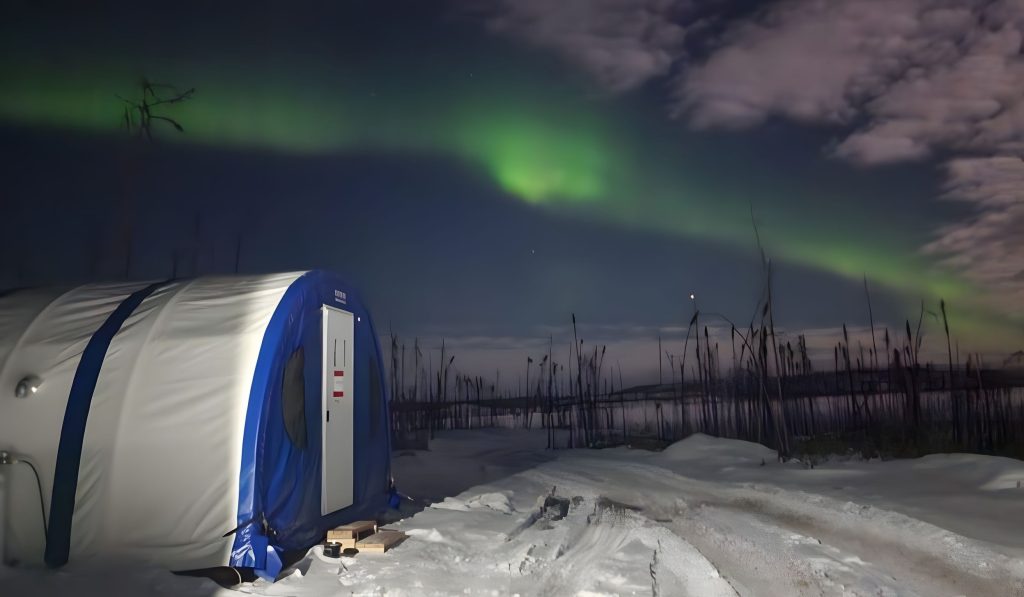
Azincourt Energy Corp. [TSXV: AAZ; OTCQB: AZURF] reported that the introductory work program has commenced on the Harrier Project in the Central Mineral Belt in Labrador, Canada.
Azincourt’s Harrier Project – which includes its previously acquired Snegamook deposit – covers 49,400 hectares over five distinct licence groups, representing one of the largest land positions in the Central Mineral Belt. The Harrier Project straddles key uranium-bearing structural corridors directly adjacent to and on trend with Atha Energy’s Moran Lake and Anna Lake projects, and Paladin Energy’s Michelin project – placing Azincourt at the center of a proven and growing uranium camp.
The Harrier Project, with over a dozen known uranium mineralization zones and surface rock samples grading up to 7.48% UΓéâOΓéê (and >1.0% UΓéâOΓéê in 10 distinct zones), offers a rare combination of grade, scale, and geological continuity. Notably, only 124 drill holes (19,851 metres total, over half of this on the former Snegamook project area) have ever been completed across the combined property – leaving ample opportunity for new discovery with modern methods.
The introductory work program is underway and consists of up to three weeks of helicopter supported reconnaissance of existing identified uranium occurrences and prospecting of previously identified radiometric anomalies. The purpose of this program is to expand the target inventory on the project and prepare the higher priority targets for diamond drilling.
A high priority target for diamond drilling is the Snegamook Uranium Deposit, where drilling in 2007 and 2008 to follow up a radon gas anomaly identified uranium mineralization located 1.3 km along strike to the southeast of the Two Time Zone (Indicated and Inferred resource of 5.55 Mlb U3O8, Silver Spruce Resources, June 2008). 17 drill holes intersected a 20 to 50 m wide section of uranium bearing brecciated and altered monzodiorite with moderate to strong chlorite, hematite and carbonate alteration, the same geological setting as the Two Time Zone.
In 2008 a preliminary resource estimate for the Snegamook Zone was prepared by Silver Spruce Resources, however it was never finalized in a report or filed. Preparing an updated NI 43-101 compliant resource for this deposit will be a priority in conjunction with the 2026 field program.
“I am excited to get into the field with the crew and see what we have at the Harrier Project,” commented Trevor Perkins, Vice President of Exploration. “We are eager to get working on this underexplored land package in the center of the CMB and see where we can take it,” continued Mr. Perkins.
Labrador’s Central Mineral Belt (CMB) is one of Canada’s most underexplored yet highly prospective uranium regions. Known for its numerous uranium and base metal deposits and showings, the CMB has seen renewed interest due to growing global demand for secure, domestic uranium supply as countries aim to increase nuclear power capacity to meet net-zero emissions goals.
The CMB hosts multiple large-scale uranium discoveries, including Paladin Energy’s Michelin Uranium Project (127.7 million lbs UΓéâOΓéê), the Moran Lake C Deposit (historical resource of 9.6 Mlbs UΓéâOΓéê and 11.8 Mlbs VΓééOΓéà), and the Anna Lake Deposit (historical resource of 4.9 Mlbs UΓéâOΓéê). These known resources demonstrate the Belt’s exceptional uranium endowment – but vast areas remain underexplored, with modern techniques only recently being applied across the region.
Azincourt is currently active at its East Preston uranium project located in the Athabasca Basin, Saskatchewan, and its Snegamook and Harrier uranium projects, located in the Central Mining Belt of Labrador.