
Antimony Resources reports visible gold in New Brunswick drill core
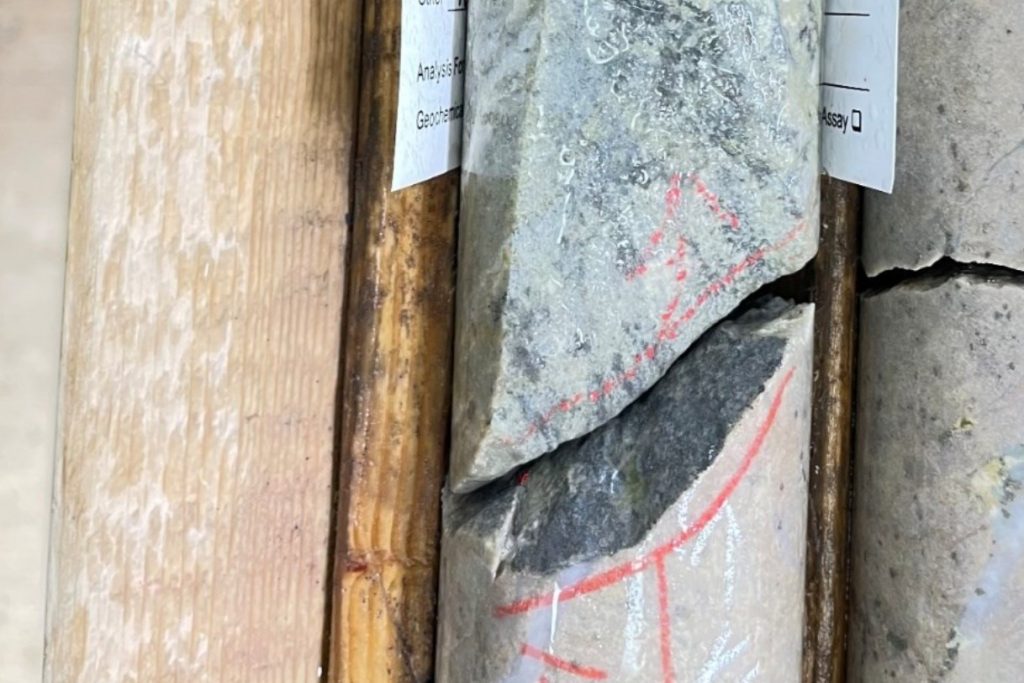
Antimony Resources Corp. [ATMY-CSE, ATMYF-OTCQB, K8J0-FSE] said visible gold has been observed in drill core at the Central Zone of the Bald Hill Antimony Property in New Brunswick. Visible gold was identified in Central Zone drill hole BHC-26-13 at 165.85 metres depth. Examination of the occurrence using a portable XRF (analysis) reported 285 g/t gold.
“This is a very exciting discovery,’’ said Antimony Resources CEO James Atkinson. “While we have suspected the presence of gold associated with the antimony-bearing stibnite mineralization at Bald Hill, we have received assays indicating the presence of gold; this was the first instance of observing gold in the drill core,’’ he said. “While we understand that Bald Hill is dominantly an antimony deposit, the association of antimony and gold is well known worldwide.’’
Antimony shares were unchanged at 56 cents on Friday and trade in a 52-week range of $1.65 and 20 cents.
Bald Hill is a well-known, high-grade antimony deposit in southern New Brunswick. The company said assays indicate that Bald Hill is the highest-grade antimony deposit in North America with mineable grades and widths indicated by drilling, which has outlined an antimony deposit in the Main Zone over 600 metres long and to a depth of at least 350 metres. The mineralization is open in all directions.
A press release dated July 27, 2026, provided geological descriptions of drill holes into the Central Zone. The presence of stibnite mineralization (the main host for antimony mineralization) has been noted in the drill holes. Assays have not been received for these holes.
A NI-43-101-compliant Technical Report has estimated the quantity and grades of the drilled area at approximately 2.7 million tonnes with a grade of between 3.0% and 4.0% antimony. However, the company says it has not completed enough work to confirm this estimate.
Antimony, a silvery-white metalloid that can be used in the production of ammunition, has emerged on investor radar screens following China’s decision to impose export restrictions.
The global antimony market has been dominated by China since the mid 1800s, with the largest producing mine being the Xikuangshan Mine in Hunan Province. In 2022, according to the U.S. Geological Survey, China accounted for 54.5% of total mined antimony production, followed by Russia with 18.2% and Tajikistan with 15.5%
Antimony often combines with sulfur to form antimony sulfide or stibnite. Antimony trioxid (Sb203) is the most commonly used form of antimony in industrial applications. When combined with halogens, such as bromine and chlorine, it acts as a flame retardant, and is widely used in flame retardants, lead-acid batteries, glass manufacturing and as an alloy in ammunition.
The U.S. Department of the Interior has designated antimony a critical mineral because it is also essential for armour-piercing ammunition, infrared sensors and precision optics.