
Copper Fox discovers new porphyry copper target at Mineral Mountain, Arizona
Copper Fox Metals Inc. [TSXV: CUU; OTCQX: CPFXF; FSE: HPU] and its wholly owned subsidiary, Desert Fox Mineral Mountain Co. provided additional results of preliminary exploration completed on its Mineral Exploration Permit located on the southeast corner of its 100%-owned Mineral Mountain porphyry copper project.
Mineral Mountain is a permitted, drill-ready project hosting three porphyry copper targets covering 2,692.4ha in the Mineral Mountain Mining District, Arizona. The project is located on a northeast trending porphyry copper belt approximately 25 km southwest from Rio Tinto and BHP’s giant Resolution porphyry copper-molybdenum deposit and approximately 20km northeast of the Florence Copper project.
Highlights: A broadly defined northeast trending zone of quartz vein hosted copper mineralization (>500 – 30,000 parts per million (ppm)) extends over an area that is approximately 2,000 metres (m) long by up to 750m wide.
The molybdenum mineralization (>10 – 282ppm) is located within the area of copper mineralization and extends over an area of approximately 1,600m long by 400m wide.
Host rocks to the mineralization are interpreted Laramide age porphyritic quartz monzonite, biotite granite and Precambrian age Pinal Schist.
The intrusive rocks exhibit strong potassic and propylitic alteration locally overprinted by phyllic alteration.
Elmer B. Stewart, President, and CEO of Copper Fox, stated, “The current preliminary exploration combined with the historical results has identified a large, broadly defined area exhibiting the host rocks and proximal style of alteration and mineralization expected in a Laramide age porphyry copper-molybdenum system. The identification of this target combined with the large, open-ended porphyry target found approximately 1.5km to the north (scheduled for a maiden drilling program in October) significantly expands the size of the district and enhances its porphyry potential. Mapping, geochemistry, age dating, and petrographic studies are planned to further evaluate this target.”
The recently identified target is in a Mineral Exploration Permit (MEP) located on the southeast side of the project. MEPs require annual expenditure to be maintained in good standing, the credit for which can be either as work on the ground or cash in lieu. Mapping, prospecting, and sampling of the intrusive phases for petrographic studies, whole rock, and trace element geochemistry and possibly age dating of the intrusives was completed. Results of the petrographic studies are reported in this news release. The whole rock and trace element geochemistry are pending.
The geology in the new target area consists of Precambrian aged Ruin granite, Pinal Schist and diabase dikes intruded by interpreted Tertiary age hypabyssal and plutonic intrusive phases consisting of fine-medium grained porphyritic quartz monzonite, coarse grained biotite granite, pegmatite, and fine-grained aplite and pegmatitic aplite occasionally containing tourmaline. The quartz monzonite exhibits strong potassic alteration, K-spar-quartz flooding and resorption and secondary overgrowth textures on its quartz phenocrysts. The biotite granite is coarse grained, weakly magnetic and interpreted to encircle the quartz monzonite intrusive. An intrusive breccia is located at the northeast end of the target.
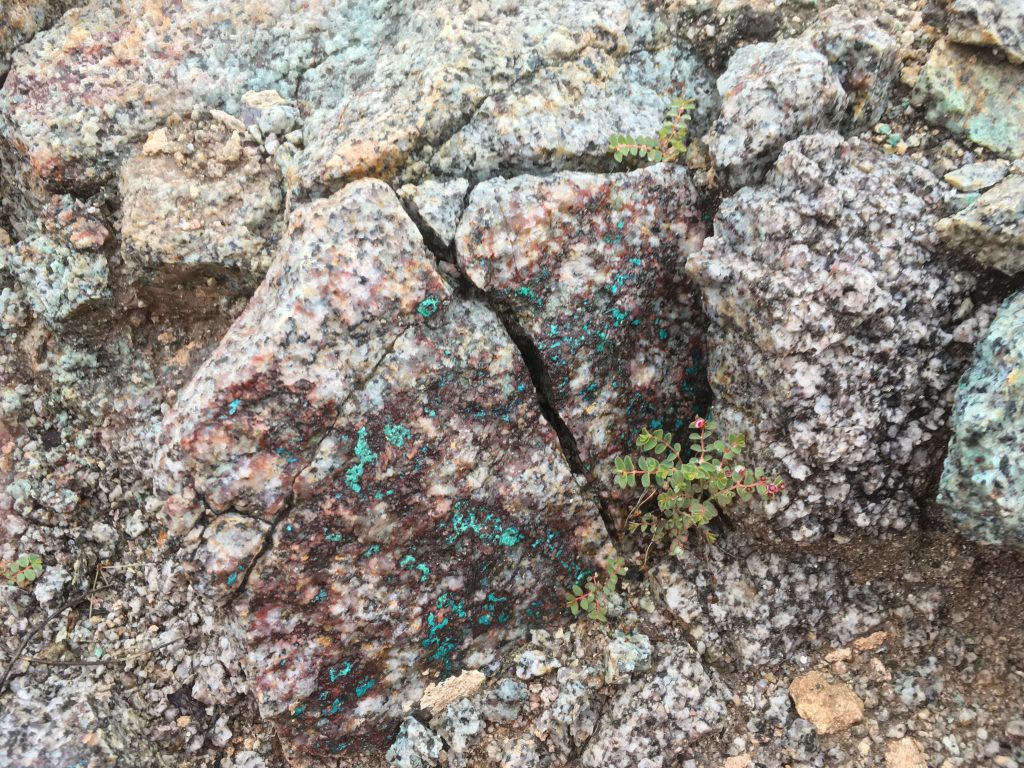
The quartz-copper-magnetite mineral association quartz veining and copper mineralization are like the porphyry style mineralization found on other parts of the property. Malachite, chrysocolla, neotocite and rare covellite occur in quartz-copper and quartz-copper-hematite veinlets exhibiting sericitic envelopes. Quartz-limonite (magnetite) veins show an inner sericitic halo and an outer potassic halo interpreted to represent phyllic overprinting of an earlier potassic alteration. Quartz-copper-hematite, malachite, copper-hematite, quartz-calcite, and quartz veins and veinlets occur in outcrop and petrographic samples.
In two samples, quartz-copper veins cross-cut earlier quartz veinlets. The dominant vein set trends NE from 050 to 080 and dips between 45 to 85 degrees SE. Quartz-copper-hematite veins have a similar strike direction and dip 60 to 70 degrees NW.
The samples show three stages of alteration. Early stage potassic alteration (hydrothermal K-spar, secondary biotite and quartz-K-spar flooding) has been overprinted by a later stage propylitic alteration (epidote, chlorite-sericite). Six of the samples show the potassic phase overprinted by phyllic alteration (sericite/muscovite, quartz, chlorite rutile). The petrographic studies indicate the mineralized quartz veinlets show an early stage potassic alteration envelope overprinted by propylitic alteration and a later phyllic alteration phase.
Sixteen rock samples were submitted to Vancouver Petrographics Ltd. in Langley, British Columbia for petrographic analyses to describe mineral percentages, grain size, textures, vein alteration halos, alteration patterns, copper mineralization, and other minerals present.
Copper Fox’s wholly owned subsidiaries being Northern Fox Copper Inc. and Desert Fox Copper Inc., are the 100% ownerships of the Van Dyke ISCR project, and the Mineral Mountain and Sombrero Butte porphyry copper exploration projects all located in Arizona, the 25% interest in the Schaft Creek Joint Venture with Teck Resources Limited on the Schaft Creek copper-gold-molybdenum-silver project and the 100%-owned Eaglehead polymetallic porphyry copper project, each located in northwestern British Columbia.