
Critical Elements Lithium updates its Summer Drill Program at Rose West, Québec
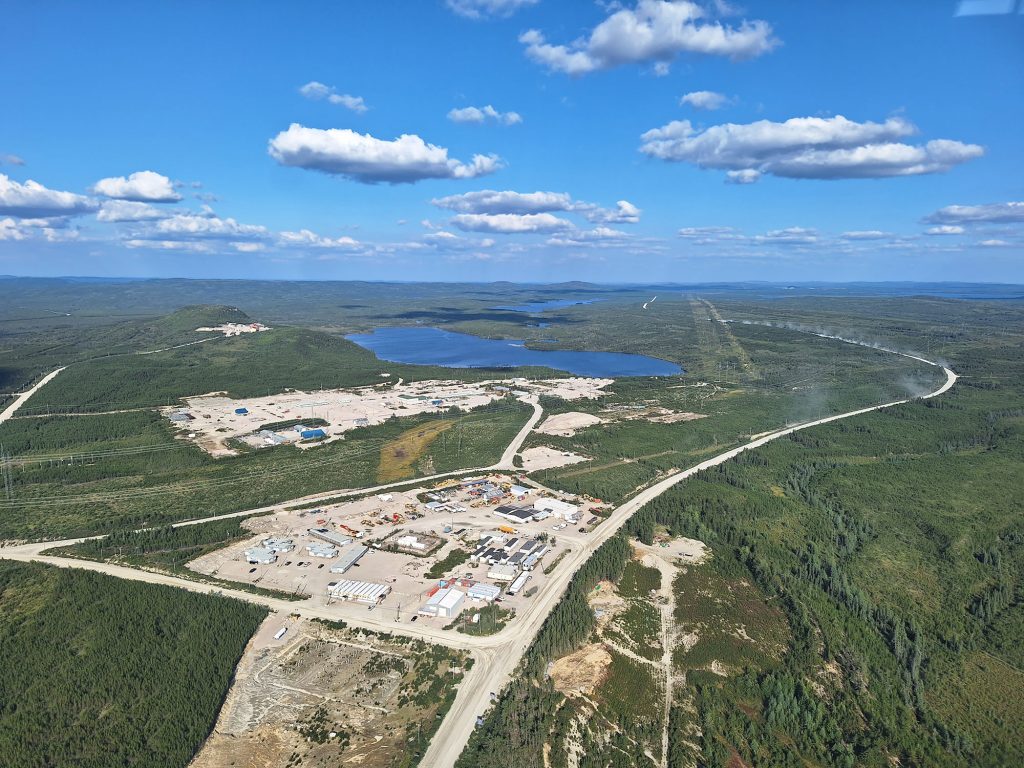
Critical Elements Lithium Corp. [TSXV: CRE; OTCQX: CRECF; FSE: F12] reported the details of its Phase 2: Summer 2026 drill program, including 10,000 metres of systematic drilling around the 100%-owned Rose West discovery, located in Eeyou Istchee, Québec.
Critical Elements announces that it has temporarily evacuated the camp at Rose West Project and suspended all drilling and related exploration activities following the development of a forest fire proximal to the project camp and drills and after discussion with SOPFEU (Société de protection des forêts contre le feu) due to increasing wildland fire danger in the area.
“The health and safety of our contractors is our highest priority,” said Jean-Sébastien Lavallée, CEO of Critical Elements. “The corporation will continue to monitor conditions closely and will resume exploration activities when authorities determine it is safe to do so.”
Eric Zaunscherb, chairman, added, “Although we are excited to see the 2026 Summer drill program at Rose West unfold, crew safety and stewardship of the land we work on are paramount. Shareholders should also be aware of the intense hard work and time spent by management over the last week in protecting our investment in equipment and supplies in and around the camp.”
The Winter 2026 drilling program was very successful in expanding the lateral footprint of the known mineralized pegmatites and in identifying new lithium-tantalum bearing pegmatites in both the hanging wall and footwall of the main Pegmatite 3 zone.
Located approximately 10 km to the west of the Rose Lithium-Tantalum Project, Rose West is a near surface lithium-rich pegmatite bearing zone, initially intercepted by drilling over a 450 m x 370 m footprint area in the winter of 2024, now covering an overall footprint of 1,250 m x 800 m, a six-fold increase in surface expression. The lithium-rich pegmatites typically range from 10 to 40 m in thickness and together display a sub-horizontal stacked geometry.
Recent drilling has identified three new spodumene-bearing pegmatitic bodies within the target area. The Phase 2 Summer 2026 drill program is designed to further expand this mineralized footprint, and to better define the geometry and extent of the three new mineralized pegmatites intersected during the Winter 2026 Campaign.
The Summer 2026 drill program is designed to reach three specific goals: expand laterally all around the existing mineralized footprint, Infill drilling along Line C, to confirm grade and thickness continuity of the intersected pegmatites and follow up on both newly discovered mineralized pegmatites (6 and 7) below the current extent of mineralization.
To date, 11 holes were drilled in the NE corner of the Main Target Area for a total of 2,073 metres. These holes are designed to intersect all three principal pegmatites i.e., Pegmatite 5 (new), 3 (Main) and Pegmatite 2.
The company intends to deploy two drill rigs to optimize the duration of the program. The drilling strategy is straightforward: based on our current geological model and interpretation, apply a 100-metre grid approach to grow the known mineralized volume from its current boundary outward. The program targets the expansion of the mineralized footprint to a potential of approximately 1,250 x 2,000 metres and could confirm the addition of at least two more mineralized pegmatite bodies within the system. The 2026 summer drilling assays for lithium and tantalum are pending.
As previously discussed, the stacked nature of the mineralized system allows for intersecting multiple Pegmatite bodies along a given drillhole. While keeping the same “grid-based” systematic approach, not all drillholes are anticipated to intersect each pegmatite.
All holes that were drilled on Line G successfully intersected Pegmatite 5. Holes RW-26-56A and -55 on Line H, also intersected Pegmatite 5, although the zone is less strongly expressed. Holes RW-25-58 and -57 appear to have intersected either a new stacked zone, or they could have intersected an offset equivalent of Pegmatite 5 or 3; interpretation of this sector is underway.
Most of the holes intersected the Main pegmatite, confirming its continuity across Lines G and H. However, a major fault has also been intersected in holes RW-26-53 and -55, likely explaining the absence of Pegmatite 3 on Line I in holes RW-26-57 and -58.
Pegmatite 2 is confirmed to be present towards the central core of the mineralized area, and as predicted by our 3D model, it appears to get cut-off or merge into Pegmatite 3 towards the north. As a result, Pegmatite 2 was only intersected in holes RW-26-35A to -37.
“So far, the Summer 2026 drilling program is well engaged to providing the data needed to optimize the growth potential of the various mineralized zones and increase the level of confidence in our 3D geological model. Given the success of the current drilling, we will therefore continue to further test the extent of the zones in all directions. We are hopeful that the program will demonstrate the continuity of not just one, but several lithium- and tantalum-rich pegmatites that are confirmed to date. Lastly, we hope that the forest fires situation calms down quickly, and that all nearby communities are safe and can get back to normality at the earliest,” commented Kenneth Williamson, Director of Exploration.
Critical Elements aspires to become a large, responsible supplier of lithium to the flourishing electric vehicle and energy storage system industries. To this end, the company is advancing the wholly-owned, high-purity Rose Lithium-Tantalum project in Québec, the corporation’s first lithium project to be advanced within a land portfolio of over 1,016 km2.
On August 29, 2023, the company reported results of a new Feasibility Study on Rose for the production of spodumene concentrate. The after-tax internal rate of return for the Project is estimated at 65.7%, with an estimated after-tax net present value of US$2.2B at an 8% discount rate.
In the corporation’s view, Québec is strategically well-positioned for US and EU markets and boasts good infrastructure including a low-cost, low-carbon power grid featuring 94% hydroelectricity. The project has received approval from the Federal Minister of Environment and Climate Change on the recommendation of the Joint Assessment Committee, comprised of representatives from the Impact Assessment Agency of Canada and the Cree Nation Government, received the Certificate of Authorization under the Environment Quality Act from the Québec Minister of the Environment, the Fight against Climate Change, Wildlife and Parks, and the project mining lease from the Québec Minister of Natural Resources and Forests under the Québec Mining Act.