
Fitzroy Minerals drills 64 metres of 2.00% copper, including 41.0 metres of 3.05% copper from 133 metres, at the Buen Retiro Copper Project, Chile
Fitzroy Minerals Inc. [TSXV: FTZ; OTCQX: FTZFF; FSE: C3Y] reported ongoing drilling results and provide an update for its advanced Buen Retiro Copper Project, Copiapó, Chile. Fitzroy has completed 25,634 metres of diamond drilling and 5,555 metres of RC drilling at Buen Retiro, for a total of 31,189 metres in 2026 as of November 5.
Drilling continues with two diamond drill (DD) rigs focused on infill drilling of copper oxide and mixed copper oxide-sulphide mineralization, and one reverse circulation (RC) drill rig being used for sterilization and to test new targets.
This news release reports results from diamond drill holes BRT-DDH129 to BRT-DDH167 and RC drill holes BRT-RCD020 to BRT-RCD032 for inclusion in the forthcoming maiden Mineral Resource Estimate (MRE). The maiden MRE is expected to form the basis for the company’s planned Preliminary Economic Assessment (PEA). It is anticipated that MRE will incorporate Measured, Indicated and Inferred Resources across the Tenorita, Nativo, and Ortúzar areas.
Fitzroy has also planned a further 3,300 metres of diamond drilling, designed to support the potential conversion of Inferred Resources to Measured and Indicated Resources. The infill drilling is targeting copper oxide and mixed copper mineralization across Tenorita, Nativo, and Ortúzar for inclusion in an updated MRE and the planned Pre-Feasibility Study (PFS) (Q2 2027). A 5,000-metre sulphide exploration program (largely RC drilling) is also underway.
Drilling Highlights: BRT-DDH134: 64 m at 2.00% Cu from 127 m, including 41 m at 3.05% Cu from 133 m.
BRT-DDH146: 107 m at 0.48% Cu from 10 m, including 37 m at 0.96% Cu from 44 m.
BRT-DDH133: 109 m at 0.41% Cu from 20 m, including 13 m at 1.10% Cu from 112 m.
BRT-DDH143: 179 m at 0.26% Cu from 30 m to 209 m, and 86 m at 0.22% Cu from 272 m
Merlin Marr-Johnson, President and CEO of Fitzroy, commented: “More great results from Buen Retiro! Intersections of 64 metres at 2% copper, including 41 metres at 3% copper, are stand-out results, especially given that this overlaps with historical results of 30 metres at 3.5% copper, including 12 metres at 5% copper.
“Furthermore, these results are in near-surface, leachable material that is amenable to low-cost processing. There are also multiple other wide zones of good mineralization in this batch of drill core assay results. We are really looking forward to publishing our maiden mineral resource estimate and associated PEA soon.”
As of November 5, Fitzroy has completed 25,634 metres of diamond drilling and 5,555 metres of RC drilling at Buen Retiro, for a total of 31,189 metres since the start of February 2026. Drilling with three drill rigs at the Project is ongoing.
Core lengths are estimated to be 80-90% of true thickness.
The drill core results reported largely confirm geology that has previously been reported: Copper mineralization at Tenorita strikes north-northwest and dips steeply to the east. Tenorita is consistent along strike and remains open to the southeast.
Mineralization at Nativo strikes north-south and is subvertical. Nativo merges with Tenorita to the south and continues north into the middle of the historical Manto Negro open pit. Copper mineralization at both Tenorita and Nativo is centred on ferric breccias, with a width of approximately 70 metres.
Where the two trends merge, a third ferric breccia is present, and a wide zone of shallow copper mineralization is present. Most of the mineralization intersected in these two areas has been copper oxide and mixed (copper oxide and secondary, leachable sulphide), down to depths of 120-150 metres.
Ortúzar is geologically distinct from Tenorita and Nativo and displays greater variability and complexity. Ortúzar extends southwards as far as the middle of the historical Manto Negro open pit. The dominant mineralization at Ortúzar is disseminated ‘manto-style’ controlled by lithology, dipping at approximately 30 o to the northwest. The mantos have a relatively shallow depth of oxidation (60-80 metres) and chalcopyrite becomes the dominant copper mineral down-dip. The north-south structure that characterizes the Nativo Area appears to continue into the Ortúzar Area, creating an oxidized portion of Ortúzar to the north and east of the historical Manto Negro open pit. Additionally, metasomatic copper mineralization (chalcopyrite) at the contact of dioritic intrusions has been identified.
Drilling continues to intersect significant copper mineralization, including high-grade zones beneath the historical Manto Negro open pit. BRT-DDH134 intersected 64 metres at 2.00% Cu from 127 metres down-hole to 191 metres down-hole, including an exceptional 41 metres at 3.05% Cu from 133 metres to 174 metres. BRT-DDH134 corresponds well with historical drill hole BRT-DDH013 which was drilled from the western side of the historical pit towards the east.
BRT-DDH013 intersected 30 metres at 3.52% Cu from 141 metres, including 12 metres at 5.00% Cu from 155 metres, over-lapping with the high-grade portion of BRT-DDH134. These two drill holes highlight a zone of strong mineralization over a true width of approximately 50 metres in the base of the pit.
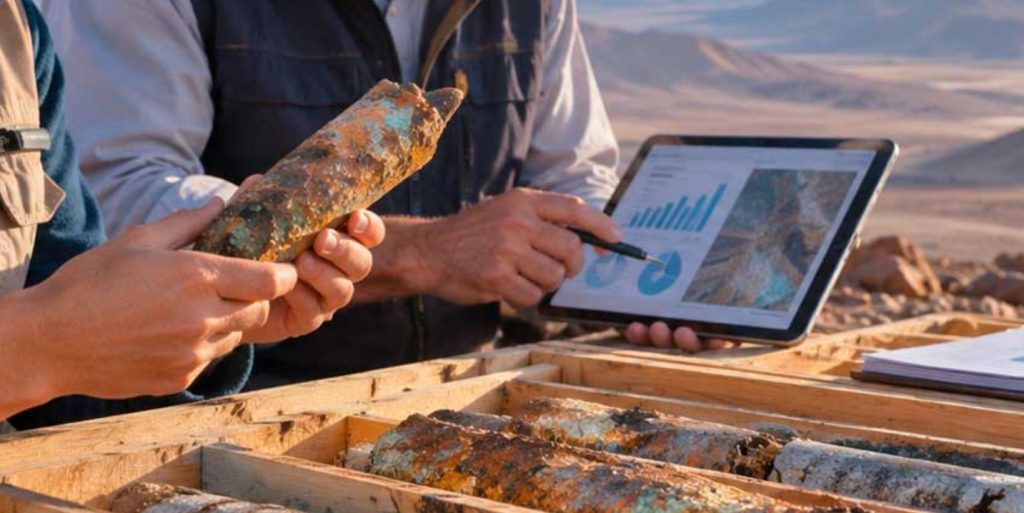
Drill hole BRT-DDH134 features a strong supergene enrichment profile, with abundant native copper in the richest interval from 133 metres to 174 metres. Native copper is extremely soft and malleable and can flatten into thin plates or laminae during conventional sample preparation and pulverization. These particles may not pass efficiently through the preparation sieves, potentially resulting in an under-representation of native copper in the analytical pulp and, consequently, in reported copper assays. Ongoing metallurgical test work using bulk samples will provide an opportunity for the company to calibrate the copper content in the mixed (supergene) zones.
Drill holes BRT-DDH131 and BRT-DDH135 showcase the typical geology of the Ortúzar Area. Drill hole BRT-DDH131 intersected fresh sulphide (chalcopyrite) comprising 59 metres at 0.24% Cu from 161 metres and a further 2 metres at 1.05 % Cu from 308 metres, intersecting the hypogene or primary sulphide zone. Closer to surface, drill hole BRT-DDH135 intersected the same mineralized unit, but in a section that has been oxidized. The drill hole intersected 42 metres at 0.61% Cu, predominantly copper oxide minerals, including malachite, azurite, and chrysocolla.
In the southern part of Ortúzar, right on the edge of the historical open pit, drill hole BRT-DDH146 intersected 107 metres at 0.48% Cu from 10 metres, including 37 metres at 0.96% Cu from 44 metres. Mineralization starts in oxides (tenorite and cuprite in veinlets), followed by a mixed zone from 65 metres to 81 metres comprising chalcocite replacing pyrite and native copper in veins and disseminations. From 81 metres chalcopyrite is present in veins, veinlets and disseminations.
Drill hole BRT-DDH133 is located in the southern part of the Nativo trend and intersected 109 metres at 0.41% Cu from 20 metres, including 13 metres at 1.10% Cu from 112 metres. The mineralization is characterized by a classic oxidation profile, with starting with chrysocolla and tenorite hosted in hydrothermal breccias in the upper metres before transitioning to a supergene-enrichment mixed zone with native copper and chalcocite, and ending in hypogene, fresh disseminated chalcopyrite zone.
Drill hole BRT-DDH143 was drilled in the northern Ortúzar Area, and intersected remarkably continuous mineralization from 30 metres depth, comprising 179 metres at 0.26% Cu in hypogene, fresh sulphides (principally chalcopyrite), and a further 86 metres at 0.22% Cu from 272 metres. Mineralization reflects a classic oxidation profile, starting with disseminations and veinlets of tenorite, atacamite and chrysocolla before entering a mixed zone from 54 metres containing veinlets of native copper and disseminated chalcocite. The hypogene zone starts at 83 metres, comprising veinlets and disseminations of chalcopyrite.
Fitzroy Minerals is focused on exploring and developing copper assets with substantial upside potential in Chile. The company’s two lead properties are the Buen Retiro Copper Project located near Copiapó, Chile, and the Caballos Copper Project, located in Valparaiso, Chile .