
Formation Metals drills 0.98 g/t gold over 95.6 metres at N2 Project, Quebec
Formation Metals Inc. [CSE: FOMO; FSE: VF1; OTCQB: FOMTF], a North American mineral acquisition and exploration company, reported assay results from N2-26-033, drilled north of the A-Zone at its flagship N2 property, Quebec. The hole intersected gold from the first sample below overburden, 7.1 metres below surface, and stayed in mineralization for 95.6 metres, extending the A-Zone’s northern horizon beyond the ground covered by the historical estimate. It is the company’s most significant northward result at the A-Zone to date.
Located 25 km south of Matagami, Quebec, N2 is host to a global historic resource of ~871,000 ounces. The property encompasses both broad, near-surface mineralization across four primary zones and higher-grade underground targets at the RJ zone, providing multiple avenues for further exploration.
N2-26-033 was drilled across strike on the northern horizon of the western core of the A-Zone to test whether mineralization continues beyond the boundary modelled from Phase 1 drilling. It does: the hole returned continuous gold through almost its first 100 metres, extending the mineralized envelope across strike and beyond the historical wireframes. It shows the same mineralization style, alteration and structural controls as the northern horizon in Phase 1 holes N2-25-005, N2-25-010 and N2-25-012.
The main intervals are interpreted as the northern corridor’s auriferous vein system, continuous across the section with the Phase 1 intercepts. Continued northward step-out and extension drilling will be incorporated into the geological model supporting the company’s planned maiden Mineral Resource Estimate.
The results from this drillhole, with the geological interpretation, demonstrate that the main auriferous intervals project to vertical depths consistent with open-pit development parameters and extend mineralization beyond the limits of the ground covered by the historical estimate.
Deepak Varshney, CEO of Formation Metals, stated: “Gold from the first sample below overburden, for almost a hundred metres, is exactly what you want to see in an open-pit setting. The best grades in this hole are at the very top: 3.14 g/t Au over 10 metres starting seven metres below surface. Gold this close to surface, this thick and this consistent is exactly what open-pit investors look for, and in our view it’s what sets N2 apart. This hole sits outside the boundary the historical work drew, the horizon is still open to the north, and we have a fully funded 75,000-metre program to keep chasing it.”
Mr. Varshney continued: “We are drilling mineralized ground the historical estimate never covered, and the horizon is still open to the north. The system is open at depth, along strike and across strike, and every direction we have tested so far has returned gold. All of it feeds the maiden Mineral Resource Estimate we are working towards.”
The company’s drilling campaign has exceeded expectations, confirming geological continuity and delivering robust and continuous gold intercepts including:
N2-25-004: 0.83 g/t Au over 40.4 metres beginning at 180.0 metres downhole, 147.4 metres vertical. Highlight interval includes 1.36 g/t Au over 9.0 metres.
N2-25-005: 0.91 g/t Au over 42.3 metres beginning at 14.0 metres downhole, 9.9 metres vertical. Highlight intervals include 2.04 g/t Au over 8.1 metres and 1.31 g/t Au over 11.4 metres.
N2-25-006: 1.8 g/t Au over 21.9 metres beginning at 154.4 metres downhole, 133.7 metres vertical. Highlight interval includes 3.4 g/t Au over 4.8 metres.
N2-25-007: 1.3 g/t Au over 22.2 metres beginning at 139.9 metres downhole, 121.2 metres vertical. Highlight interval includes 2.36 g/t Au over 10.5 metres.
N2-25-008: 0.95 g/t Au over 61.1 metres beginning at 109 metres downhole, 94.4 metres vertical. Highlight interval includes 1.68 g/t Au over 26.5 metres.
N2-25-009: 1.37 g/t Au over 24.0 metres beginning at 168.9 metres downhole, 146.3 metres vertical. Highlight interval includes 2.05 g/t Au over 13.3 metres.
N2-25-010: 1.43 g/t Au over 19.4 metres beginning at 117.5 metres downhole, 101.8 metres vertical. Highlight interval includes 2.23 g/t Au over 7.0 metres.
N2-25-012: 1.75 g/t Au over 30.4 metres beginning at 64.1 metres downhole, 45.3 metres vertical. Highlight intervals include 3.51 g/t Au over 10.5 metres and 19.2 g/t Au over 0.51 metres.
N2-26-15A: 1.41 g/t Au over 20.6 metres beginning at 499.1 metres downhole, 486.3 metres vertical. Highlight interval includes 2.63 g/t Au over 5.5 metres and 1.78 g/t Au over 7.2 metres.
N2-26-021: 1.05 g/t Au over 31.0 metres beginning at 243.0 metres downhole, 203.8 metres vertical. Highlight interval includes 1.89 g/t Au over 12.0 metres.
Based on these results, the company believes the A-Zone hosts a robust mineralized veining system that fluctuates between 20 and 75 metres, is potentially 300 metres wide, with a potential of up to 8 km in strike. The A-Zone remains open in multiple directions, specifically along strike (E-W) and down-plunge/depth (S).
Situated on the northern edge of the “A” Zone, N2-26-033 is Formation’s most productive northern drill hole to date. It was drilled to test whether the system continues beyond the northern boundary of the A-Zone’s historical estimate, and it returned gold from the first sample to 104 metres downhole.
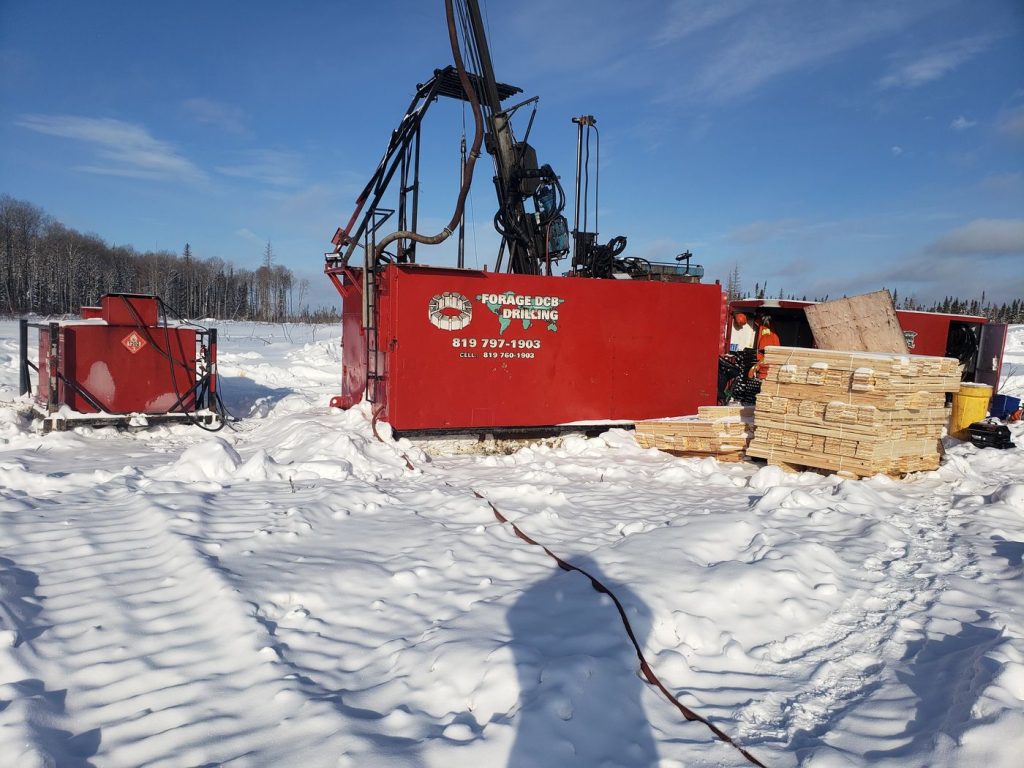
The NQ diamond drill holes drilled by Forage DCB Drilling and the collected drill core have been transferred to the logging facility in Val d’Or, Quebec, where they completed core logging and split the core in half utilizing a water-cooled diamond core saw. Samples were systematically collected in 0.5-metre to 1.5-metre intervals down the holes where geological features identify special intervals of interest and sample length. The collected core samples along with standards and blanks were securely marked up and stored in the logging facility until being dispatched to the AGAT Laboratories Ltd in Val d’Or, Quebec, Canada.
Comprising 87 claims totaling ~4,400 ha within the Abitibi sub province of Northwestern Quebec, Formation’s flagship N2 property is an advanced gold project with a global historic resource of ~871,000 ounces comprised of 18 Mt grading 1.4 g/t Au (~810,000 oz Au) and 243 Kt grading 7.82 g/t Au (~61,000 oz Au).
There are six primary auriferous mineralized zones in total, each open for expansion along strike and at depth. Compilation and geophysical work by Balmoral Resources Ltd. (now Wallbridge Mining) from 2010 to 2018 generated numerous targets that are being investigated for the first time by Formation with diamond drilling.
Historical highlights from the top two priority zones include the A Zone: a shallow, highly continuous, low-variability historic gold deposit with ~522,900 ounces identified at a grade of 1.52 g/t Au. ~15,000 metres have been drilled historically across 1.65 km of strike, with 84% of historical drillholes intersected auriferous intervals including up to 1.7 g/t over 35 metres.
RJ Zone: a high-grade historic gold deposit with ~61,100 ounces identified at a grade of 7.82 g/t Au, with high-grade intercepts from historical drill holes as high as 51 g/t Au over 0.8 metres and 16.5 g/t Au over 3.5 metres2. This zone was the target of the most recently drilling at the property by Agnico-Eagle Mines in 2008, when the price of gold was ~US$800/oz. Only ~900 metres of strike has been drilled, with 4.75+ km of strike remaining to be tested.
The company’s internal view and evaluations suggest that N2 exhibits a strong geological potential possessing favorable characteristics to support a near-surface, open-pit resource development. This optimism is driven by several key factors:
Significant Undrilled Strike Length: The “A” Zone alone has >3.1 km of strike open (only ~35% drilled historically), while the RJ Zone has >4.75 km remaining untested – offering substantial room for lateral expansion of known mineralization.
Open at Depth and Along Strike: All zones remain open, with historical drilling limited to shallow depths (~350 m), leaving considerable vertical upside in a proven gold camp.
Wide, Continuous Near-Surface Intercepts: Recent drilling has confirmed thick zones (100-200+ m) of target mineralization starting near surface, ideal for bulk-tonnage open-pit scenarios with low strip ratios and high tonnage potential.
Regional Analogy and Pedigree: Located in the Casa Berardi trend, which hosts multiple multi-million-ounce deposits (e.g., Casa Berardi >2 Moz produced and 14.3 Mt at 2.75 g/t Au P&P in reserve, Douay >3 Moz in resources (10 Mt at 1.59 g/t Au indicated, and 76.7 Mt at 1.02 g/t Au inferred), N2 shares similar geology and structural controls. Nearby Vezza produced from higher-grade underground mining, but N2’s shallower, wider zones suggest superior open-pit economics.
Untested Targets: Compilation work identified numerous geophysical anomalies (IP, EM, VTEM) that remain undrilled, providing discovery potential beyond known zones.
Rising Gold Prices and Economic Viability: At current gold prices, lower-grade bulk-tonnage deposits become highly attractive, enhancing the project’s upside.
Strategically located 25 km south of the mining town of Matagami, Quebec, the property has year-round access via provincial highway and logging road, proximity to skilled labour, power infrastructure and established mining services, in a district that has produced in excess of 200 million ounces of gold. The Property lies along the Casa Berardi mine trend, which hosts multiple million-ounce gold deposits, and sits approximately 1.5 km east of the former-producing Vezza gold mine, which produced over 100,000 ounces of gold from 2013 to 2019 by underground methods.
The region’s robust infrastructure supports toll milling opportunities, with potential access to nearby processing facilities such as those at Casa Berardi or other Abitibi mills, enabling cost-effective development without the need for on-site mill construction.
The company also believes that N2 has significant base metal potential, where it recently completed a revaluation process which revealed significant copper and zinc intercepts within historic drillholes known to have significant gold grades (>1 g/t Au). Assay results range from 200 to 4,750 ppm and 203 ppm to 6,700 ppm, for copper and zinc, respectively, indicating strong potential for elevated base metal (Cu-Zn) concentrations across the property, specifically at the A and RJ zones.
Property wide geology at N2 features volcanic and sedimentary rocks formed in regional anticlinal and synclinal flexures. Three principal deformation structures, oriented along the known NW-SE to WNW-ESE structural trends typical of VMS deposits in the Matagami region, function as critical geologic controls for mineralization on the property.
Formation Metals is focused on the development of quality properties that are drill-ready with high-upside and expansion potential. Formation’s flagship asset is the N2 property, an advanced gold project with a global historic resource of ~871,000 ounces (18 Mt grading 1.4 g/t Au (~810,000 oz Au) across four zones (A, East, RJ-East, and Central) and 243 Kt grading 7.82 g/t Au (~61,000 oz Au) across the RJ zone) and six mineralized zones, each open for expansion along strike and at depth including the “A” zone, of which only ~35% of strike has been drilled (>3.1 km open), and the “RJ” zone, host to historical high-grade intercepts as high as 51 g/t Au over 0.8 metres.