
Lake Victoria Gold drills 2.75 metres of 28.71 g/t gold at Imwelo Project, Tanzania
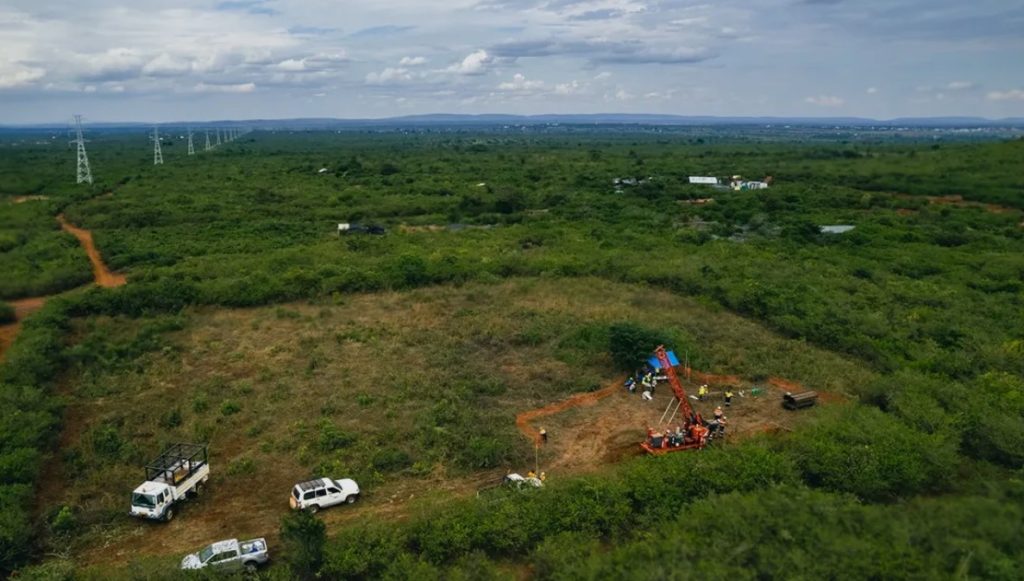
Lake Victoria Gold Ltd. [TSXV: LVG; OTCQB: LVGLF; FSE: E1K] released high-grade, near-surface assay results from recent HQ diamond drilling at its fully permitted Imwelo gold project in Tanzania, including 28.71 g/t gold over 2.75 metres from 21.00 metres in hole IMWDR029 and 12.20 g/t Au over 4.50 metres from 32.00 metres in hole IMWDR028. Individual quartz-vein samples within these intervals returned up to 142.90 g/t Au and 124.83 g/t Au, respectively.
The intercepts occur within the shallow, highly weathered mineralized sequence at Area C, the company’s planned initial open-pit mining area, and provide additional data for detailed mine planning and grade-control work. In parallel, whole-core samples from the eight HQ drill holes have been submitted to independent metallurgical laboratory Nesch Mintech Tanzania Ltd. for a comprehensive test work program that will determine the metallurgical character of the weathered mineralization. In particular, the test work will establish whether clay removal through scrubbing and screening of the weathered ore will be necessary and will characterize the effect of the clay on the processing parameters and flow sheet.
Key highlights: 28.71 g/t Au over 2.75 metres from 21.00 metres in IMWDR029, including 59.77 g/t Au over 1.30 metres from 21.00 metres, with an individual 0.50-metre quartz-vein sample returning 142.90 g/t Au; 12.20 g/t Au over 4.50 metres from 32.00 metres in IMWDR028, including 27.94 g/t Au over 1.90 metres from 33.00 metres, with an individual 0.40-metre quartz-vein sample returning 124.83 g/t Au.
Shallow mineralization within the Area C mining horizon: the two strongest reported intervals commence at only 21 metres and 32 metres downhole, respectively, within weathered saprolitic and quartz-vein material; weathered-ore metallurgical program under way: whole-core test work will define the preferred treatment route for the clay-rich near-surface material, spanning baseline recovery, desliming and attrition scrubbing.
Direct integration into development planning: results will inform the final Area C process flow sheet, treatment-rate assumptions and plant configuration while supporting further grade-control planning, detailed pit design and mine scheduling.
Marc Cernovitch, president and CEO of Lake Victoria Gold, commented: “These results reinforce the high-grade, near-surface character of Area C, and the metallurgical program now under way addresses a key input to our flow sheet design. Confirming how the clay-rich surface mineralized material behaves, alongside the strong recoveries already established for our sulphide and transitional mineralized material, supports sound plant design decisions, and keeps our focus on disciplined capital and execution on the path to first gold.”
The eight holes total 225 metres and span approximately 240 metres of strike at Area C. Four of these holes, IMWDR025, IMWDR026, IMWDR027 and IMWDR030, intersected voids created by historical artisanal mining, where the shallow mineralized zone had been removed. Completing the metallurgical picture at Area C
The current test work is designed to complement the results announced by Lake Victoria Gold on March 18, 2026, under the headline “Lake Victoria Gold Confirms up to approximately 97% gold recovery and free-milling metallurgy at the Imwelo Gold Project.”
That program demonstrated strong metallurgical performance from transitional and fresh sulphide material, including recoveries of up to approximately 96 per cent to 97 per cent using conventional gravity concentration and cyanide leaching and a significant gravity-recoverable gold component.
The new program targets the shallow end of the mining sequence. Previous geotechnical work identified a weathered near-surface zone at Area C extending locally to approximately 40 to 60 metres depth. This material is expected to be amenable to free-dig mining but is characterized by significant weathering and clay content, creating different material-handling and processing considerations from the stronger transitional and fresh rock below.
By testing this material independently, Lake Victoria Gold is seeking to establish the preferred front-end treatment configuration before finalizing the process flow sheet.
Whole-core samples have been submitted to Nesch Mintech Tanzania for a program specifically designed to quantify the effect of clay on material handling, gold liberation and recovery.
Three principal treatment conditions will be evaluated: untreated whole ore to establish a baseline; washing and desliming to determine whether removal of fine clay improves processing performance; and attrition scrubbing followed by desliming to determine whether breaking down clay aggregates improves gold liberation and recovery. Gravity recovery and cyanide leaching will be evaluated across the relevant treatment conditions.
Supporting work will include grind sensitivity at target product sizes of P80 125 micrometres, 106 micrometres and 75 micrometres size-by-assay analysis; gravity separation; bottle-roll cyanidation; slurry rheology and settling tests; density measurements; head-grade determination; and multielement characterization.
The objective is practical: to determine whether additional front-end clay-handling equipment materially improves processing performance and, if so, to define the appropriate configuration before the final plant design is completed. The results will inform recovery assumptions, treatment rate, equipment selection, operating parameters and capital scope for the Area C flow sheet.
The drilling and metallurgical work form part of a broader integrated development program at Imwelo.
Area C is the company’s planned initial mining area, and Lake Victoria Gold is advancing detailed pit design, grade-control planning, process optimization and site development in parallel. Phase 1 earthworks have commenced, including access-road improvements and preparation of the plant-site footprint, while development of the site camp and supporting infrastructure continues.
On completion of the weathered-ore test work, Lake Victoria Gold will select the preferred front-end treatment route for Area C and integrate the results into the final flow sheet and plant design. In parallel, the company will shortly continue grade-control drilling, finalize the Area C pit design and production schedule, and advance site development at Imwelo.
Although Imwelo has been the subject of JORC-compliant (Joint Ore Reserves Committee) PEA (preliminary economic assessment), PFS (prefeasibility study) and updated PFS work, these foreign-code studies are not current under NI 43-101 standards.
The company has not completed a feasibility study on Imwelo that establishes mineral reserves demonstrating economic and technical viability and is not treating the JORC-based estimates or analyses as current under CIM (Canadian Institute of Mining, Metallurgy and Petroleum) definition standards.
Any decision to commence production would not be based on a feasibility study of mineral reserves and would therefore involve increased uncertainty and a higher risk of economic and technical failure. There is no certainty that the planned low-capex open-pit operation will be economically viable or that production will occur as anticipated. Risks include, without limitation, variations in grade and recovery, unexpected geotechnical or metallurgical challenges, cost overruns, financing availability, operational risks, regulatory risks, and permitting risks.
The company has a 100% interest in the Tembo project, which has over 50,000 metres of drilling and is located adjacent to Barrick’s Bulyanhulu mine. The company also holds a 100% interest in the Imwelo project, which is a fully permitted gold project west of AngloGold Ashanti’s Geita gold mine. With historical resource estimates and a JORC-compliant 2021 prefeasibility study, the project is fully permitted for mine construction and production, positioning it as a near-term development opportunity.
Lake Victoria Gold has assembled a highly experienced team with a record of developing, financing and operating mining projects in Africa with management, directors and partners owning more than 60% of the shares. Notably, the company is grateful for the validation that comes with the support and equity investment from Barrick and recent strategic partnership with Taifa Group.
Taifa Group (a diverse group of companies with interests in, amongst others, mining, telecoms, oil and gas, agribusiness, pharmaceuticals, and leather) has entered into an agreement with the company to obtain an equity stake in the company through its wholly owned subsidiary, Taifa Mining (a wholly Tanzanian-owned company) or other nominees.
Taifa Mining will also conduct all the contract mining and civil works for the Imwelo project. Taifa Mining is Tanzania’s largest mining contractor with over 30 years of mining-related experience. Taifa has been the contractor of choice to most mines in Tanzania and has maintained long and successful relationships with companies such as Petra, De Beers, Barrick and AngloGold Ashanti. In addition, Taifa also owns the largest fleet of mining equipment in Tanzania.
Resource World Magazine Inc. has prepared this editorial for general information purposes only and should not be considered a solicitation to buy or sell securities in the companies discussed herein. The information provided has been derived from sources believed to be reliable but cannot be guaranteed. This editorial does not take into account the readers investment criteria, investment expertise, financial condition, or financial goals of individual recipients and other concerns such as jurisdictional and/or legal restrictions that may exist for certain persons. Recipients should rely on their own due diligence and seek their own professional advice before investing.