
NexMetals Mining drills 11.15 metres of 7.65% CuEq (3.10% Cu, 2.21% Ni) at Selebi Main deposit, Botswana
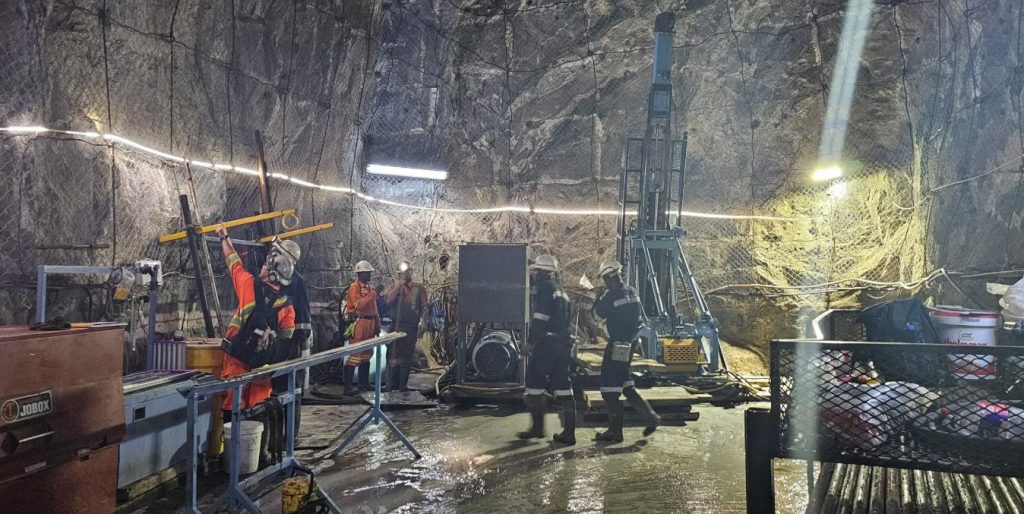
NexMetals Mining Corp. [TSXV: NEXM; NASDAQ: NEXM] report assay results from drill holes SMD-26-210, 212-W1, 213 and 214, part of its 30,000-metre surface drilling program targeting the emerging Flexure Zone within the Selebi Main deposit in Botswana.
The latest results continue to validate the company’s data-driven exploration model, with drilling continuing to intersect thick, high-grade massive sulphides beyond the limits of the 2024 Mineral Resource Estimate (2024 MRE). Together with borehole electromagnetic (BHEM) targeting, these results define a growing kilometre-scale trend that remains open and supports the expansion potential of the Selebi system.
Highlights: Drill hole SMD-26-212-W1 intersected a 11.15-metre interval of massive sulphides grading 7.65% CuEq (3.10% Cu, 2.21% Ni), one of the most significant massive sulphide intercepts drilled at Selebi Main.
The intercept confirms an emerging kilometre-scale trend of thick, high-grade massive sulphides, extending beyond the 2024 MRE. All four drill holes intersected sulphide mineralization, including multiple intervals of massive sulphides.
The Flexure Zone is now defined by widely spaced drill holes approximately 200-300 metres apart, demonstrating significant lateral extent and continuity.
Modeled BHEM anomalies show continuation north of drilling, indicating the system remains open for expansion.
Drilling at a nominal 200-metre spacing continues to intersect thick, high-grade massive sulphides demonstrating the growing scale of the Selebi Main deposit.
SMD-26-212-W1 closely replicates SMD-25-205 (11.05 metres of 7.31% CuEq) and correlates with historic hole sd119 (26.1m of 8.29% CuEq, 3.39%Cu, 2.38% Ni), demonstrating that the Flexure Zone contains multiple thick, high-grade massive sulphide intersections.
These results now outline a mineralized trend exceeding one kilometre in strike length, representing a compelling growth opportunity at Selebi Main.
The close correlation between drill hole results and the strongest BHEM conductors validates the company’s data-driven exploration approach and provides confidence in additional high-priority targets along strike.
Next Steps: The 2026 Mineral Resource Estimate (2026 MRE) remains on track for completion in the third quarter of 2026. The company has engaged TECT Geological Consulting to develop an integrated three-dimensional geological and structural model for Selebi North and Selebi Main. The model is expected to enhance the Company’s understanding of the geological controls of mineralization across the mining license, support future resource growth and improve drill targeting of thicker, higher-grade zones, and identify potential regional exploration targets.
Sean Whiteford, CEO and Director, commented: “The Selebi Main deposit continues to exceed our expectations. Each phase of drilling has expanded our understanding of the system, while continuing to deliver exceptional grades and thicknesses. Historically, sd119 was viewed as a standalone thick, high-grade massive sulphide intersection.
“Today, results from SMD-25-205 and SMD-26-212-W1 demonstrate that even at a 200-metre drill spacing, we continue to intersect thick, high-grade massive sulphides. These results are defining an emerging trend extending for more than one km beyond the 2024 MRE. Importantly, the trend remains open, and we are still refining our understanding of the geological and structural controls responsible for these thicker, higher-grade zones.
“As we continue to define the scale and geometry of the system, understanding the geological and structural controls on mineralization is becoming increasingly important, not only to enhance drill targeting, but also to support future resource modelling and potential mine planning. We look forward to advancing our understanding through the development of an integrated geological and structural model with TECT Geological Consulting.”
SMD-26-210 was completed to 1,716.6 metres and intersected 4.10 metres of mineralization from 1,681.50 to 1686.60 metres corresponding to the Main Zone. The zone includes a total of 3.65 metres of massive sulphides in two intervals including a 2.90-metre interval. This hole is a 225-metre northward step-out from SMD-25-205 and is located 190 metres down dip of historic drill hole sd123 and 300 metres up dip of SMD-26-213.
SMD-26-212-W1 was completed to 1,636.2 metres and intersected two zones of mineralization starting at 1,520.10 metres downhole, including a significant 11.15-metre interval of massive sulphides corresponding to the Main Zone. Separated by 7.3 metres of gneiss, is a second zone comprising a 4.45-metre interval of semi-massive, net-textured and disseminated sulphides, followed by 18.3 metres of disseminated sulphides, indicating a broad sulphide system. SMD-26-212-W1 is located 160 metres down-dip of SMD-22-007a, 180 metres up dip of SMD-26-208, 185 metres along strike from SMD-022-008a and 220 metres from SMD-22-006a-W2.
SMD-26-213 was completed to 1,989.3 metres and intersected several 2 to 2.5-metre intervals of massive sulphides alternating with thick intervals of disseminated sulphides, including a 1.75-metre interval of massive sulphides corresponding to the Main Zone and a 20.80-metre zone corresponding to the Lower Zone. SMD-26-213 is located 155 metres down-dip of SMD-25-201 and 150 metres up-dip of SMD-25-203.
SMD-26-214 was completed to 1,815.3 metres and intersected two sulphide units beginning at 1,703.20 metres. The Main Zone is seen as an 0.80-metre interval of stringer sulphides and the Lower Zone is comprised of semi-massive and stringer sulphides over 1.55 metres. SMD-26-214 is located 53 metres southwest of SMD-25-205 and 210 metres northeast of SMD-26-209.
To date, a total of 29,734 metres in 12 completed holes, one hole extension, three pre-collared holes, four abandoned holes and 4 in-progress holes have been completed as part of the surface drilling program.
The BHEM surveys at Selebi utilize the Crone PEM system operated by local Botswana staff. Survey data is collected using a 3-component fluxgate probe collecting full waveform data. Surveys have been collected using timebases between 50 and 1000ms (0.25 Hz to 5 Hz). The data has been processed to a calculated residual step response to better quantify the conductive sources. This added processing has proven to be highly valuable because of the size of the highly conductive mineralized system.
NexMetals Mining is focused on redeveloping the past-producing Selebi and Selkirk copper-nickel-cobalt-platinum group element mines in Botswana. NexMetals has confirmed the scale of mineralization is larger than historical estimates, supported by NI 43-101- and Regulation S-K 1300-compliant resource estimates, with ongoing down-hole geophysics, drilling, and metallurgical programs aimed at expanding resources and supporting future economic studies.