
The New Energy Source Beneath Our Feet
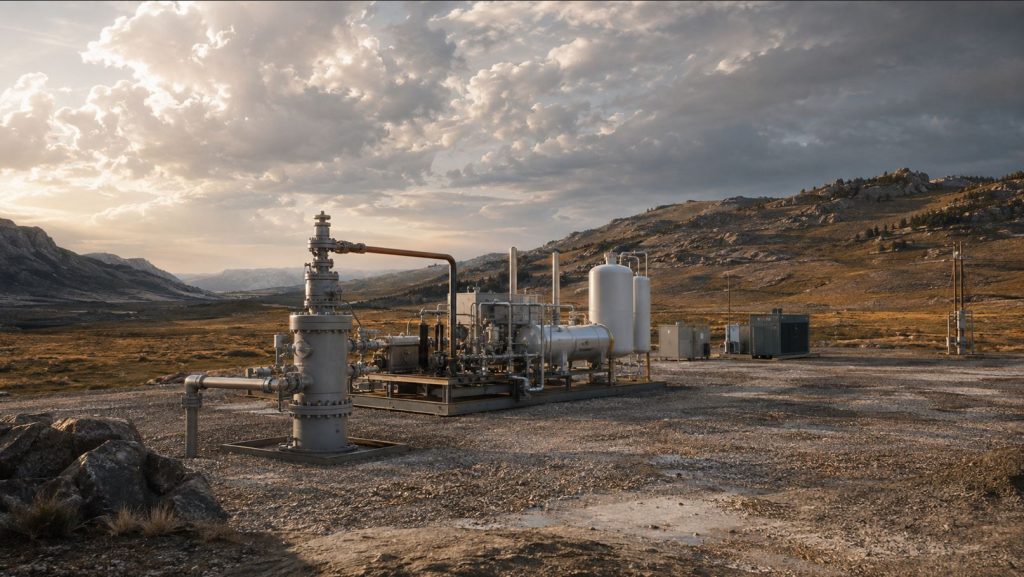
Natural hydrogen exploration is accelerating across Canada, the United States and Australia. If commercial production can be demonstrated, it could open a new category of locally produced, off-grid energy.
By Staff Writer
Most of the world’s hydrogen is manufactured. Conventional hydrogen is commonly produced from natural gas, while green hydrogen is made by using renewable electricity to split water through electrolysis.
Natural hydrogen is different because the molecule already exists underground.
If sufficiently large accumulations can be discovered and produced economically, natural hydrogen could become a primary energy resource rather than simply another way of making an industrial gas. Wells could potentially supply nearby fuel cells, turbines or other generating systems, creating electricity close to the source and reducing reliance on long-distance pipelines or constrained electrical grids.
That possibility has begun to attract serious exploration interest in Canada, the United States and Australia, where companies are applying petroleum geology, geophysics, drilling and reservoir engineering to a resource that until recently received little attention from the mainstream energy industry.
There is already a small but important proof of concept.
At the Bourakébougou hydrogen field in Mali, natural hydrogen discovered during water drilling in 1987 was later used to generate electricity for a nearby village. Gas from the shallow Bougou-1 well has been reported at approximately 98% hydrogen, and electricity generation began in 2012. The project is widely regarded as the world’s first natural-hydrogen-to-electricity development and remains the best-known example of hydrogen produced directly from the subsurface being used for power.
Its significance lies less in its scale than in what it demonstrated: under the right geological conditions, hydrogen can accumulate underground in concentrations capable of being brought to surface and put to practical use.
The larger question is whether similar resources exist at scales that could support industrial development.
The U.S. Geological Survey has provided one reason to investigate. A modelling study published in Science Advances estimated a most probable global in-place geologic hydrogen resource of approximately 5.6 trillion tonnes. The uncertainty around that figure is considerable, and most of the resource will likely never be economically recoverable.
Still, the scale is difficult to ignore. The USGS estimated that an amount equal to roughly 100 billion tonnes, less than 2% of its most probable global figure, would theoretically be sufficient to satisfy projected hydrogen requirements associated with reaching net-zero emissions for about 200 years.
That is not a reserve estimate. It is an indication that the potential resource base is large enough to justify exploration.
For mining and petroleum investors, the process is familiar: identify prospective geology, acquire ground, generate targets, drill, test reservoir performance and determine whether a discovery can support economic development.
Canada is now moving through that process.
In Saskatchewan, MAX Power Mining Corp. [MAXX-CSE, MAXXF-OTC, 89N-Frankfurt] is advancing the Lawson natural hydrogen system near Central Butte. Following its initial discovery well, the company completed 3D seismic work over what it describes as the 28-square-kilometre Lawson Complex and began a multi-well commercial validation program. Additional drilling is intended to define the system and determine whether it can support meaningful production, with independent energy consultancy GLJ Ltd. involved in modelling and evaluation.
The work represents an important transition for the sector. Finding hydrogen establishes geological interest; proving sustained deliverability is what begins to establish economic value.
On Canada’s Atlantic coast, Québec Innovative Materials Corp. [QIMC-CSE, QIMCF-OTCQB, 7FJ-Frankfurt] has reported increasingly strong hydrogen indications from drilling in Nova Scotia.
At Bennett Hill, QIMC reported a company-record mud-gas hydrogen concentration of 27.8% H₂ at a depth of 374 metres, following an earlier peak reading of 24.3% in another hole. The company has also reported hydrogen-bearing intervals from drilling approximately 15 kilometres away and has expanded exploration across a broader regional corridor.
Mud-gas readings are not production tests and do not establish commercial flow rates. They do, however, provide subsurface evidence supporting the presence of hydrogen over a meaningful area and help guide the next phase of reservoir evaluation.
QIMC has also begun assessing potential pathways toward pilot-scale characterization and clean-energy generation.
Nearby activity is increasing. First Atlas Resources Corp. [HHE-CSE, BTKRF-OTC Pink, 0NB0-Frankfurt] is exploring natural hydrogen properties in Nova Scotia’s Cumberland Basin and has engaged QIMC to apply its exploration methodology across First Atlas ground. Field work has included soil-gas sampling and magnetic surveys along regional structural corridors. First Atlas also controls the Matane natural hydrogen property in eastern Quebec.
Primary Hydrogen Corp. [HDRO-TSXV, HNATF-OTCQB, 83W-Frankfurt] is building another Canadian portfolio, with projects in British Columbia, Ontario, Labrador, Newfoundland and Nova Scotia.
The growing concentration of activity suggests that parts of Saskatchewan and Atlantic Canada could begin to develop into recognizable natural hydrogen exploration districts. That is a pattern the resource industry understands well. Successful early drilling tends to attract capital and competitors, improve geological models and accelerate the collection of seismic, geochemical and drilling data.
The United States is seeing a similar buildout.
The Midcontinent Rift, extending through parts of Kansas, Nebraska and neighbouring states, has become one of the most closely watched natural hydrogen regions in North America.
HyTerra Ltd. [HYT-ASX] controls more than 80,000 acres at its Nemaha Project in Kansas and has reported hydrogen concentrations as high as 96.1% from the Sue Duroche-3 well. At its Geneva Project in Nebraska, testing has returned hydrogen concentrations of up to 44%, along with helium concentrations reaching 13%.
Private capital is also entering the sector. Denver-based Koloma has attracted more than US$300 million in funding while developing exploration technology and pursuing natural hydrogen opportunities in the United States. Its investor base includes major institutional and strategic backers, a sign that interest is beginning to extend beyond junior resource markets.
Australia has emerged as another important testing ground.
South Australia amended its legislation in 2021 to permit natural hydrogen exploration, helping trigger a wave of licence applications.
Gold Hydrogen Ltd. [GHY-ASX] drilled Australia’s first wells specifically targeting natural hydrogen at its Ramsay Project on the Yorke Peninsula in 2023. Ramsay 2 reported hydrogen concentrations reaching 86%, and subsequent drilling has continued to evaluate the hydrogen and helium system. The company has since moved into flow-testing work aimed at determining whether the resource can support extraction.
H2EX is also active in South Australia, including on the Eyre Peninsula, while other explorers are assembling positions in areas where historical drilling, surface seepage, rock composition and structural geology suggest hydrogen generation may be occurring.
Despite the growing activity, the industry remains at an early stage.
The critical questions are now practical rather than theoretical: how large are the accumulations, how quickly can wells produce, how does output change over time, what impurities are present, what recovery rates are achievable and what will hydrogen cost at the wellhead?
The issue of geological replenishment also remains unresolved. Hydrogen can continue to form underground through active geological processes, but that does not mean reservoirs will recharge quickly enough to offset production. Generation rates vary by geological setting and will have to be established through field data.
Natural hydrogen does not need to behave like a rapidly renewable resource to become economically important. A sufficiently large accumulation could have value in much the same way as a conventional gas field, provided it can be produced at competitive cost.
Where the concept becomes particularly interesting is in the way the energy could be used.
Remote mining operations frequently face high electricity costs and may rely on diesel generation, long transmission lines or expensive grid extensions. A nearby natural hydrogen resource could potentially provide another source of dispatchable power.
The same model could apply to remote communities, processing facilities and industrial projects, but data centres may become one of the most compelling emerging applications.
Artificial intelligence is driving rapid growth in electricity demand, while access to reliable power is becoming a constraint on new data-centre development in several markets. A productive natural hydrogen field could potentially support an off-grid or grid-assisted power campus, allowing electricity generation to be developed close to the resource.
Instead of forcing a new energy source into an existing national pipeline network, developers could bring selected power users closer to the source or transmit electricity from the field. In some settings, moving electrons may prove simpler than transporting hydrogen over long distances.
Recent research from Britain illustrates the other side of hydrogen’s relationship with geology. Researchers at Durham University estimate that suitable depleted North Sea oil and gas fields could provide up to 3,659 terawatt-hours of hydrogen storage capacity under a high-storage scenario.
The North Sea work is primarily about storing hydrogen that has already been produced. Natural hydrogen exploration asks whether geology can also provide the molecule itself.
Wind and solar capture naturally available energy flows. Nuclear power releases energy through atomic reactions. Oil and natural gas extract energy stored in geological formations. Natural hydrogen could add another geological energy resource to that list, one that can be explored for using many of the techniques developed by the petroleum and mining industries.
Commercial viability still has to be demonstrated field by field. Bourakébougou showed that natural hydrogen can be produced and used to generate electricity. Exploration in Saskatchewan, Nova Scotia, Kansas, Nebraska and South Australia is now testing whether similar systems can be developed at far greater scale.
If that work succeeds, natural hydrogen may prove valuable not simply because it adds another source of hydrogen, but because it could create new sources of dependable power in locations where conventional energy infrastructure is costly, constrained or unavailable.