
Sage Potash drills 3.3 metres of 52.5% KCl at Sage Plain Project, Utah
Sage Potash Corp. [TSXV: SAGE; OTCQB: SGPTF] reported potash assay results from the completion of drilling operations at the Peterson 1 site, located at the company’s flagship Sage Plain Potash Project, Paradox Basin, southeast Utah.
Results from the Saskatchewan Research Council lab assays returned three high-grade potash sections grading better than 50.0% KCl within the Upper and Lower Cycle 18 potash beds. High-grade sections in the Upper Cycle 18 potash horizon include 10.8 feet (3.3 m) of 52.5% KCl and 3.3 feet (1.0 m) of 52.0% KCl within the 26.6-foot (8.1m) thick intersection of the Upper Cycle 18 potash bed grading 36.1% KCl. A high-grade, 10.1-foot (3.1 m) section grading 53.4% KCl in the Lower Cycle 18 potash bed occurs within a 16.4-foot (5.0 m) thick intersection grading 36.4% KCl, confirming the continuity and high-grade tenor of the deposit and making it one of the highest-grade deposits around the world.
Drill Program Highlight: Continuity of high-grade potash and significant bed thicknesses have been confirmed for both Upper and Lower Cycle 18 potash beds.
Outstanding, high-grade tenor confirmed within the Upper and Lower Cycle 18 potash beds.
Combined grade and thickness of 36.3% over 43 feet (13.1 m) for the whole of Cycle 18. The potash intervals and assay results confirm remarkable continuity between the recently completed Peterson 1 hole and the previous Johnson 1 hole, located 0.62 miles (1.0 km) to the south.
Importantly, the company has now also confirmed high-grade potash mineralization in the Lower Bed of Cycle 18.
“Completing the Peterson 1 drilling program and receiving these outstanding analytical results mark a significant, transformational development for the Sage Plain Project,” said Patricio Varas, CEO of Sage Potash. “The continuity, thickness and high grades of the potash beds demonstrate a world-class deposit that can be advanced rapidly toward production.”
Mr. Varas added: “Potash project resources commonly exceed the tonnage required to define reserves and a mine plan. As we advance the project – first with an updated resource estimate, followed by a PFS and further engineering studies, we expect the new resource to support a higher-capacity mine plan contemplating meaningful potash production in the United States. This scale should allow Sage to evaluate various mining methods and optimize a mine plan that leverages the very high-grade mineralization to target a high IRR and rapid payback, while pursuing a development larger than the 300,000 tonnes per year contemplated in the September 8, 2025 PEA.”
Mr. Varas further added: “The Sage Plain Project is advancing as the United States designates potash a critical mineral and global attention to fertilizer-input security remains elevated.”
Results from these analytical assays will now be used to update the project resources. An updated NI 43-101 resource estimate is planned to be delivered in the next 45 days.
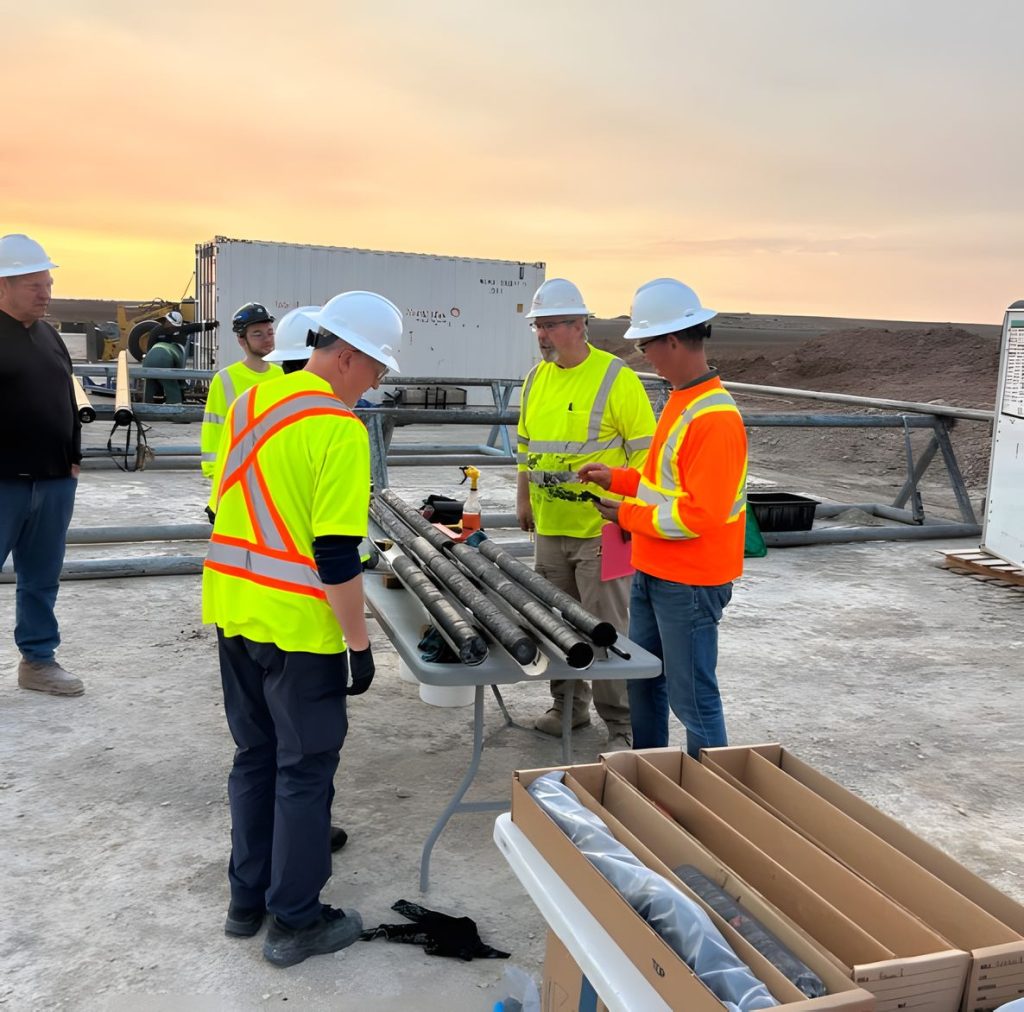
As previously announced, the Peterson 1 stratigraphic exploration hole was successfully completed on August 4, 2026, marking a key operational milestone for the project. During an initial onsite geological assessment of the recovered core, the company confirmed the presence of pure sylvite mineralization within the Cycle 18 potash horizons.
The Peterson 1 hole was sited 0.62 miles (1.0 km) to the north-northeast of the previously drilled Johnson 1 hole to facilitate both a resource expansion and delineation of a portion of the resource that will fall into the measured and indicated categories in a new NI 43-101 resource estimate.
Core from the Cycle 18 Upper and Lower zones was recovered and transported to the Saskatchewan Research Council laboratories in Saskatoon, Saskatchewan (SRC).
The company has engaged RESPEC LLC to perform the NI 43-101 resource calculation based on the inclusion of the Peterson 1 drill hole information. RESPEC previously completed a NI 43-101 resource estimate on Sept 8, 2025.
Peterson 1 assays returned 36.1% KCl over 26.6 feet (8.1 m) in the Upper Bed of Cycle 18 and 36.4% KCl over 16.4 feet (5.0 m) in the Lower Bed of Cycle 18.
1 drill hole; the two holes show excellent continuity. The current drill program recovered an outstanding high-grade interval within the Upper Bed of Cycle 18.
At 7,094.5 feet (2162.4 m) of depth at the Peterson 1 drill site an interval measuring 13.8 feet (4.22 m) grading 45.5% KCl was recovered within an intercept of 19.7 feet (5.99 m) in the Cycle 18 Upper Bed with grades of 39.4% KCl. This correlates to a continuation of the same high-grade interval at Johnson 1 which was 15.0 feet (4.58 m) of 53.5% KCl.
The beginning of the Upper Bed of Cycle 18 was encountered at 7,085.6 feet (2,159 m) at Peterson 1 and correlates well with the Johnson 1 hole, confirming the flat lying nature of the mineralization with a dip of approximately 0.8 degrees. The Upper Bed was followed by a barren halite interval of 42 feet (12.8 m) before entering the Lower Bed, which also correlates well with the 41 feet (12.5 m) of barren halite between the Upper and Lower Cycle 18 beds at the Johnson 1 hole site.
Assay results also indicate that the potash interval at the Peterson 1 well location is also very clean with traces of carnallite and less than 1% insoluble materials, which compares positively with the purity of the deposit in this part of the Paradox Basin as evidenced in the original Johnson 1 hole.
Drill results from the Peterson 1 and Johnson 1 sites, along with regional gamma ray results from historical drill data and previously obtained 2D seismic data, indicate the Cycle 18 potash mineralization is open in all directions.
The Sage Plain Project contains one of the highest-grade potash resources in the world. Sage Potash is dedicated to the development of its flagship Sage Plain Potash Project, located in the Paradox Basin, Utah.
With a large and high-grade resource base, the company is advancing toward its goal of establishing a secure and sustainable domestic potash production platform in the United States.