
0.28% WO₃ in soil at the White Star Tungsten Project as anomalies emerge

Western Star Resources Inc. (CSE: WSR) (OTC: WSRIF) (FRA: 4K2) (the “Company” or “Western Star”) is pleased to announce results from the first ever systematic soil sampling at its White Star Tungsten Project in Elko County, Nevada, USA. The survey has defined two discrete tungsten-in-soil anomalies and elevated tungsten values in soils in areas where the contact between the intrusive and the carbonate units is under cover These results complete the 568-sample programme across both Rowland and White Star.
Blake Morgan, the CEO and President of Western Star, stated, “Deploying the same systematic approach to exploration at White Star as we did at Rowland has defined two excellent anomalous zones. The northern anomaly is particularly exciting as its in an area we there has been no recorded historical activity. This geochemistry points to tungsten-bearing rock sitting at or very near surface. That is exactly the kind of target our sequential approach is built to find, and it takes both Nevada properties into drill planning together.”
Key Highlights:
- 253 soil samples were collected across the White Star Tungsten Project; the highest value returned was 2,230 ppm W (0.28% WO₃) at sample B206.
- Two discrete tungsten-in-soil anomalies defined: the North Zone and the South Zone.
- North Zone: 15 anomalous samples across approximately 215 by 240 metres, peaking at 156 ppm W, developed over the quartz monzonite – tactite contact.
- South Zone: 5 anomalous samples across approximately 135 by 95 metres, peaking at 2,230 ppm W, on ground to the south of the historical Mission Cross mine.
- Both Nevada properties now have defined soil anomalies and will be advanced together into drill target generation.
Soil Geochemical Survey Results
The soil survey at White Star comprises 253 samples collected on a nominal 50 metre station spacing across the property. All samples were analysed by ALS Global by lithium borate fusion and inductively coupled plasma mass spectrometry for 32 elements including tungsten.
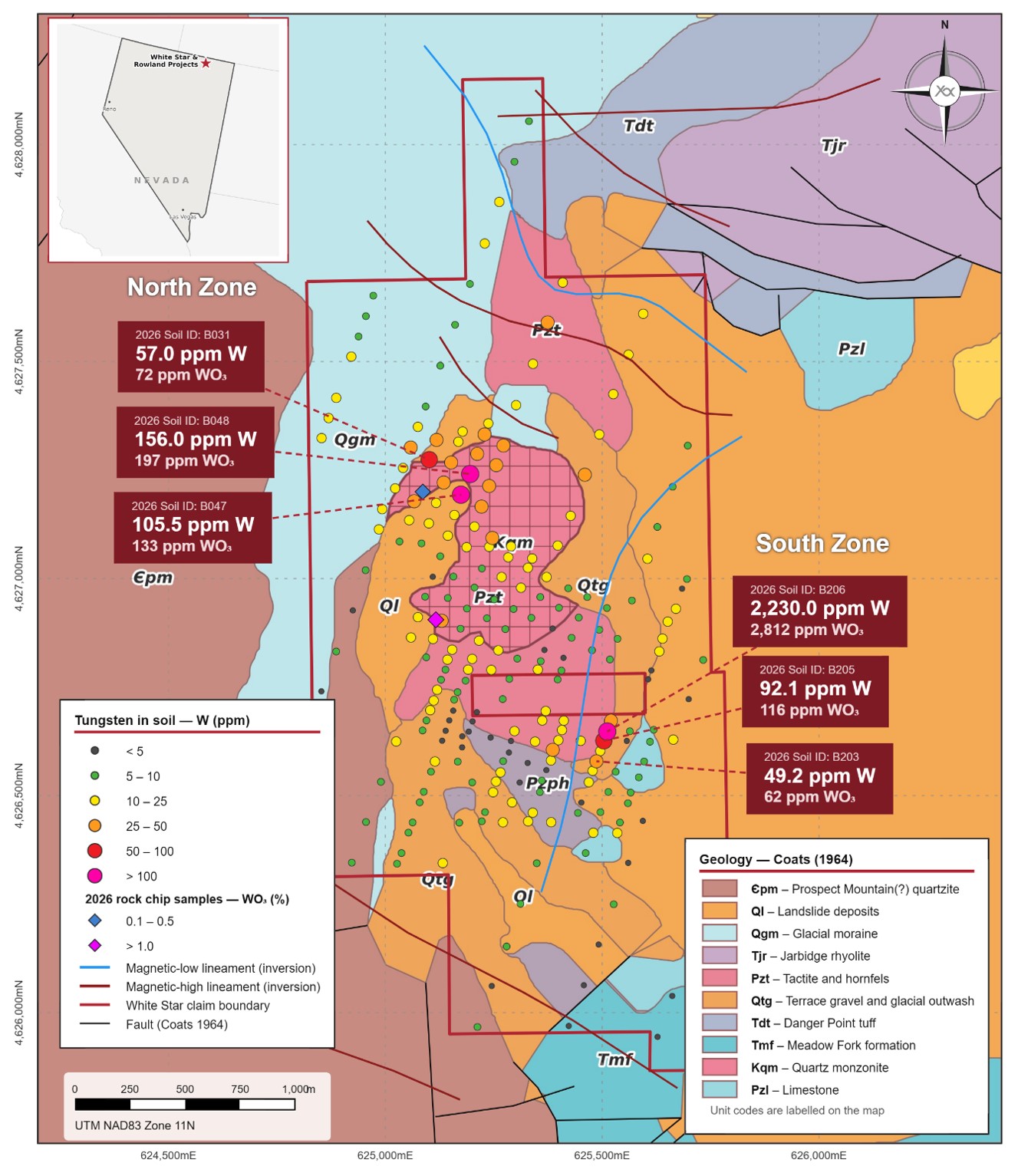
Figure 1: Tungsten-in-soil results across the White Star Tungsten Project, shown over the geological mapping of Coats (1964, USGS Bulletin 1141-M)
North Zone
The larger and better defined of the two anomalies is centred at approximately 625,178 mE / 4,627,244 mN. Fifteen samples define a footprint of approximately 215 metres east–west by 240 metres north–south, elongate west-northwest. The peak value is 156 ppm W at sample B048. The zone is developed across the contact between the Cretaceous quartz monzonite (Kqm) and the tactite and calc-silicate hornfels (Pzt) of Coats (1964). The soil anomaly zone contains the rock-chip sample WS-16-01, which returned 0.126% WO₃.
South Zone
The second anomaly is centred at approximately 625,482 mE / 4,626,626 mN, some 700 metres south of the North Zone. Five samples define a footprint of approximately 135 metres east–west by 95 metres north–south, elongate east-northeast. The peak value is 2,230 ppm W at sample B206. The zone is developed over tactite and calc-silicate hornfels (Pzt), the unit Coats (1964) describes as carrying coarse garnet and diopside tactite with local scheelite. The anomaly occurs along the same geological horizon that hosts the Mission Cross past producing mine just to the north.
Relationship to Geophysics and Rock Sampling
The North Zone is near the modelled intrusive body resolved by the three-dimensional magnetic inversion completed by East Coast Consulting, and an interpreted magnetic-high lineament. The South Zone lies approximately 800 metres outside the modelled intrusive footprint and within an interpreted magnetic-low lineament. Unlike the Northern zone B at Rowland, neither zone at White Star sits within the modelled intrusive.
The soil results also provide strong support that in areas local to outcropping mineralisation, the soil geochemistry is elevated in tungsten. The company will continue to use soil geochemistry to vector to potential mineralised zones and completing infill soil surveys in the areas of lower-level anomalies may uncover further mineralised zones.
District Context
Across the district, the soil programme comprises 568 soil samples across the two Nevada tungsten properties and has defined four tungsten-in-soil anomalies: the Rowland Main and Northern Zone B anomalies at Rowland, announced in September 2026, and the North and South Zones at White Star. Figure 2 shows the compilation of the soil geochemical results, a depth slice from the magnetic inversion, and the outcrop sampling.
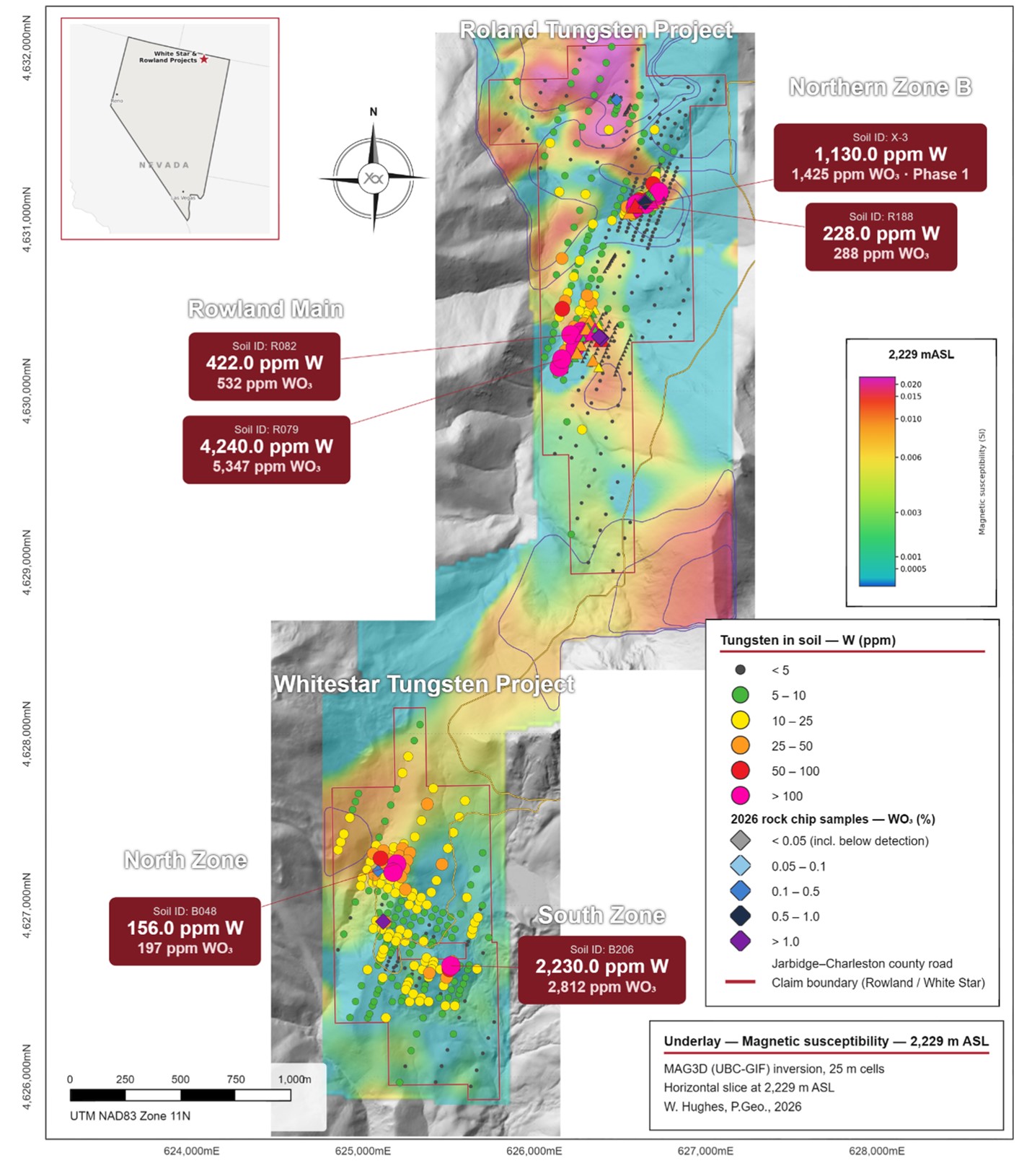
Figure 2: Rowland-White Star District data compilation from the 2026 exploration program. 4 distinct targets are shown. Magnetic inversion depth slice is the coloured background, soil results are shown as circles, and the rock chips are shown as diamonds.
Next Steps
- Infill the key target zones at 25 metre spacing; extending to the east where the anomaly is open.
- Complete additional soil sampling along the prospective horizon.
- Select drill pad locations to test the 4 anomalous zones at depth.
Sample Assay Results
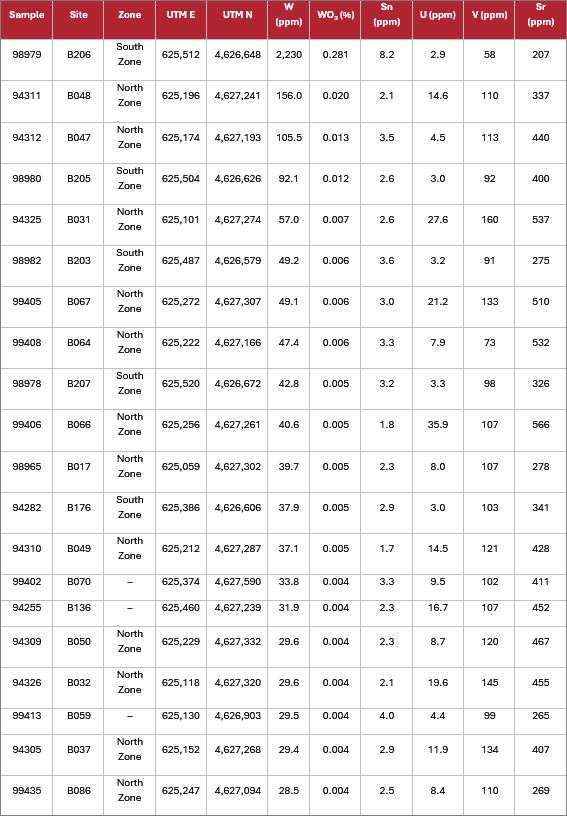
Table 1: Selected tungsten-in-soil results from the survey, White Star Tungsten Project.
Quality Assurance and Quality Control (QA/QC):
Soil samples were collected and submitted to a certified independent laboratory, ALS Global, for preparation and analysis. Samples were dried at a maximum of 60°C and screened to minus 180 microns (preparation code PREP-41), and analysed by lithium borate fusion and inductively coupled plasma mass spectrometry (method ME-MS81) for 32 elements, including tungsten. Lithium borate fusion was selected because tungsten is refractory and partial digestions under-report tungsten hosted in scheelite and wolframite. WO₃ values presented in this news release are calculated from elemental tungsten (W) results using a conversion factor of 1.2611. Chain-of-custody protocols were maintained throughout. Quality control comprised field duplicates inserted at a rate of approximately one in 30 samples, together with the certified reference materials, blanks and duplicates inserted by the laboratory in each analytical batch.
Qualified Person
The scientific and technical information contained in this news release has been reviewed and approved by Jasper Mowatt, MIMMM, and MAusIMM, a consultant to the Company and a Qualified Person as defined by National Instrument 43-101 – Standards of Disclosure for Mineral Projects. Mr. Mowatt is not independent of the Company.
About Western Star Resources
Western Star Resources is a mineral exploration company focused on the acquisition, exploration and advancement of mineral properties, with a growing strategic emphasis on tungsten and critical minerals in the United States. The Company is advancing a portfolio of past-producing tungsten assets in Nevada and New Mexico while maintaining additional exploration exposure through its Western Star property in British Columbia.
Contact Information:
Blake Morgan,
Director, President and CEO
Neither the Canadian Securities Exchange nor its Regulation Services Provider (as that term is defined in the policies of the Canadian Securities Exchange) accepts responsibility for the adequacy or accuracy of this press release.
Certain of the statements made and information contained herein may constitute “forward-looking information”. In particular, references to the acquisition, future work programmes or expectations on the quality or results of such work programmes are subject to risks associated with operations on the property, exploration activity generally, equipment limitations and availability, as well as other risks that the Company may not currently be aware of. Accordingly, readers are advised not to place undue reliance on forward-looking information. Except as required under applicable securities legislation, the Company undertakes no obligation to publicly update or revise forward-looking information, whether as a result of new information, future events or otherwise.