
King Global Critical Minerals Reports Gold And Silver Results From Systematic Sampling Of Golden Turkey Tailings, Arizona

King Global Ventures Inc. (CSE:KING) (OTCQB: KGLDF) (FSE: 5LM1) (the “Company” or “King Global”) is pleased to report results from a systematic near-surface sampling program completed over the historic Golden Turkey tailings at the Company’s Black Canyon Project in Yavapai County, Arizona.
The 2026 program was designed to characterize the lateral distribution of precious and base metals across the exposed near-surface portion of the historic tailings and builds upon an earlier sampling program completed in April 2024 under the supervision of the Company’s independent Qualified Person (“QP”).
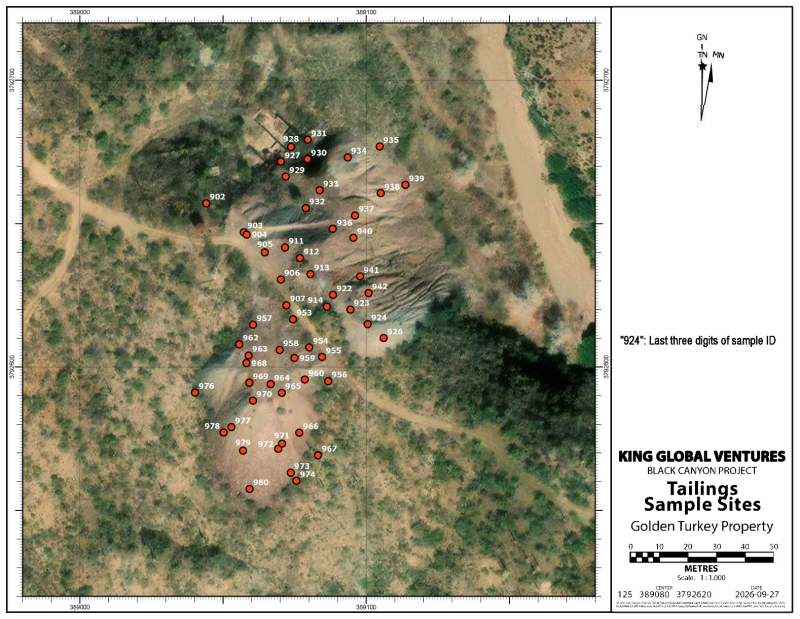
A total of 76 tailings samples were collected on an approximately 30-foot grid. The samples returned arithmetic averages of approximately 3.85 g/t gold (“Au”) and 76.2 g/t silver (“Ag”), with individual results ranging from 0.08 to 22.6 g/t Au and 6 to 601 g/t Ag. The samples also returned average concentrations of approximately 0.44% lead (“Pb”) and 0.42% zinc (“Zn”).
Of the samples, 17 returned greater than 5 g/t Au, including six samples exceeding 10 g/t Au.
Selected Golden Turkey Tailings Results
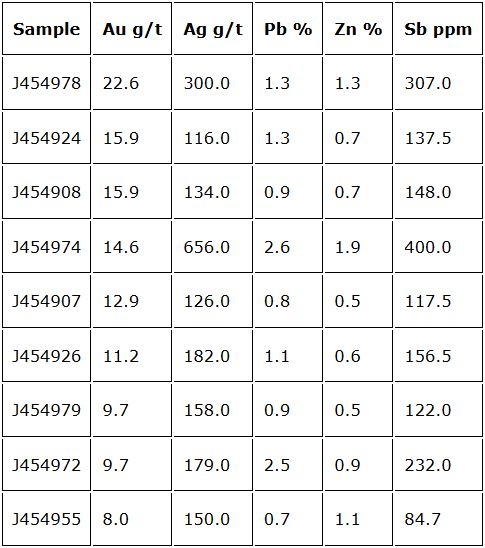
Sample J454978 returned the highest gold value of the current program at 22.6 g/t Au, together with 254 g/t Ag, 1.14% Pb and 1.12% Zn. Sample J454974 returned 14.6 g/t Au, 601 g/t Ag, 2.33% Pb, 1.67% Zn and 400 ppm Sb, illustrating the polymetallic character of portions of the sampled near-surface tailings.
The reported averages are arithmetic averages of the 76 near-surface samples and characterize only the sampled population. They should not be interpreted as the average grade of the entire Golden Turkey tailings deposit and should not be combined with the historical estimate of tailings quantity to calculate contained metal.
Sampling Method, CIM Leading-Practice Considerations and Representativeness
The sampling program was planned and supervised by the QP using principles consistent with the CIM Mineral Exploration Best Practice Guidelines: the sampling method was selected for the stated objective, sample locations were systematically distributed, collection procedures were applied consistently, and the limitations on representativeness are disclosed. CIM guidance emphasizes scientifically established sampling practices designed to produce representative and reliable results, appropriate sample preparation and analysis, sample security and documented QA/QC.
Samples were collected systematically across the exposed Golden Turkey tailings on an approximately 30-foot grid. At each location, the sampler manually broke and loosened the locally hard and cemented tailings using a hand pick and collected the resulting material with a scoop. The samples therefore represent the near-surface tailings at the sampled locations. They were not vertical channels, auger holes or other continuous samples through the tailings profile, and no continuous sampling thickness is assigned to the reported results.
For historic tailings, mine dumps and similar previously mined material, the QP considers representative spatial coverage, recognition of material heterogeneity, verification of the underlying surface and pile geometry, and representative bulk-density measurements to be important before grade and tonnage can be evaluated together. CIM estimation guidance for stockpiled material similarly recognizes the importance of surveying tonnage, sampling to estimate grade, determining density and having adequate original-ground-surface information for volume estimation.
The Golden Turkey tailings have been exposed for many decades in the arid to semi-arid climate of central Arizona. Prolonged oxidation, episodic precipitation, evaporation and repeated wetting and drying can contribute to development of a hardened or cemented near-surface horizon and may redistribute certain soluble metals and secondary minerals. King has not established that such redistribution has occurred at Golden Turkey or whether the sampled near-surface material is enriched or depleted relative to material at depth.
Accordingly, the current results are considered suitable for characterizing the lateral distribution of metals within the sampled near surface tailings but are not considered sufficient to establish representative grades through the complete vertical profile. Additional vertical sampling, together with representative bulk-density measurements, will be required to determine whether the near-surface results are representative of the tailings at depth.
April 2024 Golden Turkey Sampling Program
The current program builds upon an earlier Golden Turkey tailings sampling program completed in April 2024 under the supervision of Andrew Lee Smith, B.Sc., P.Geo., ICD.D., the Company’s independent QP and consulting geologist. The April 2024 program comprised 37 near-surface samples collected using substantially the same manual sampling methodology as the 2026 program. The April 2024 analytical results were not previously publicly disclosed.
The 37 samples returned arithmetic averages of approximately 3.0 g/t Au and 32 g/t Ag. Both the April 2024 and 2026 programs therefore identified gold and silver within sampled near-surface portions of the Golden Turkey tailings. Neither program provides continuous vertical sampling through the tailings profile.
Differences between the arithmetic averages of the two programs may reflect spatial variability, sample locations, analytical procedures, material heterogeneity or other factors and should not be interpreted as demonstrating an increase or decrease in the overall grade of the Golden Turkey tailings. The programs are considered separate sampling campaigns that demonstrate the presence and lateral variability of gold and silver within the sampled near-surface material.
1996 Certified Survey of the Golden Turkey Tailings
King has obtained a historical survey entitled “Estimated Volume of Golden Turkey Tailings,” completed in December 1996 by Leslie D. Irwin, an Arizona Registered Land Surveyor. The survey was undertaken to estimate the physical quantity of tailings present at Golden Turkey and included surveyed two-foot contours across the tailings pile.
The survey documentation states that a test well was drilled to a minimum depth of 50 feet before encountering a rock formation interpreted at the time as the original pit bottom. The survey further assumed that the original ground surface on the north side of the tailings pile had an approximate 3:1 slope and that the original pit extended from approximately Elevation 3086 to Elevation 3080. To accommodate uncertainty associated with the average end area of the pile, the calculation applied a 10% reduction to the calculated volume above Elevation 3086.
Potential Tailings Reprocessing Opportunity
Taken together, the 2026 systematic near-surface sampling, April 2024 sampling, preliminary historical metallurgical information and 1996 survey provide King with a basis for continued technical evaluation of the Golden Turkey tailings.
Because the material has previously been mined, transported and milled, potential reprocessing would differ from development of an undisturbed hard-rock deposit. Significant technical uncertainties nevertheless remain, including representative bulk grade, vertical grade distribution, bulk density, mineralogy, metallurgical recovery, material-handling characteristics, environmental considerations, transportation, processing costs and permitting.
No current Mineral Resource or Mineral Reserve has been established for the Golden Turkey tailings. No preliminary economic assessment, pre-feasibility study or feasibility study has been completed. King is not assigning contained ounces, gross metal value, revenue, cash flow or economic value to the historical tailings quantity. In particular, the Company has not multiplied the arithmetic average grades from the near-surface sampling programs by the historical 1996 tailings quantity because the Company has not demonstrated that those grades are representative of the complete vertical tailings profile.
Permitting and Advancement Strategy
King intends to continue advancing the Golden Turkey tailings opportunity through a staged program of additional sampling, metallurgical testing and permitting activities. Further work is expected to include sampling designed to evaluate vertical as well as lateral variability, representative bulk-density measurements and collection of material appropriate for metallurgical testing. The scope of subsequent work will be adjusted as results are obtained.
In parallel, King will continue discussions with the United States Forest Service (“USFS”) and other applicable regulatory authorities concerning the permitting pathway for removal of the historic tailings, transportation for off-site processing and reclamation of the affected area. The results of the technical, metallurgical and permitting programs will guide the scope and timing of any subsequent engineering and economic evaluation.
Environmental and Reclamation Considerations
King’s current concept contemplates removal of the historic tailings and transportation to an appropriately permitted off-site processing facility rather than construction of a permanent processing facility at Golden Turkey. Subject to technical evaluation and receipt of all required regulatory approvals, removal may provide an opportunity to recover residual metals while facilitating reclamation of an area affected by historical mining and milling.
The Company has not completed the environmental, engineering, metallurgical or permitting studies necessary to determine the feasibility or ultimate scope of such work, and there can be no assurance that required permits will be obtained or that reprocessing will prove technically or economically viable.
Analytical Procedures and Quality Assurance/Quality Control
Samples from both the April 2024 and 2026 Golden Turkey tailings sampling programs were analyzed by ALS Chemex in Tucson, Arizona, an independent commercial analytical laboratory. The April 2024 samples were analyzed for gold and silver by fire assay. For the 2026 program, gold was analyzed using Au-ICP22, with Au-GRA22 gravimetric analysis applied to samples exceeding the applicable analytical range. Silver and multi-element analyses for the 2026 program included ME-MS89L, with appropriate ore-grade over-limit methods applied where required.
Because of the limited size of the April 2024 and 2026 sampling programs, King did not insert independent Company certified reference materials, blanks or duplicates into these sample streams and relied on ALS laboratory QA/QC protocols. The laboratory QA/QC information associated with both programs was reviewed by Andrew Lee Smith, B.Sc., P.Geo., ICD.D., the Company’s independent Qualified Person. Based on that review, the Qualified Person determined that the laboratory QA/QC results passed and that the analytical results are acceptable for the stated purpose of characterizing the sampled near-surface tailings.
The QP considers the sampling procedures, analytical methods and laboratory QA/QC results appropriate for the stated objectives of these programs. The absence of Company-inserted control samples is disclosed as a limitation and will be considered in designing subsequent sampling intended to support more advanced technical evaluation.
Qualified Person and Data Verification
The scientific and technical information contained in this news release has been reviewed and approved by Andrew Lee Smith, B.Sc., P.Geo., ICD.D., an independent Qualified Person as defined by NI 43-101. Mr. Smith acts solely as an independent consulting geologist to King global critical minerals Inc. and is not an employee, officer or director of the Company.
Mr. Smith supervised the April 2024 Golden Turkey tailings sampling program and has reviewed the sampling information, analytical results and associated laboratory QA/QC information for the April 2024 and 2026 programs. He has also reviewed the available historical sampling and metallurgical information and the 1996 survey documentation discussed in this release.
The QP has not independently verified all assumptions underlying the 1996 estimate of physical tailings quantity or all historical metallurgical information. Those limitations are disclosed above. The QP considers the current analytical information suitable for evaluating the near-surface distribution of mineralization, but additional vertical sampling, representative bulk-density measurements and metallurgical testing will be required before the historical tailings quantity can be evaluated together with representative grade information or used to support a Mineral Resource estimate or economic evaluation.
About King Global Critical Minerals Inc.
Black Canyon Property in Arizona
King Globa is focused on the exploration of precious and base metals in North America. The Black Canyon Project in Yavapai County Arizona is comprised of 213 contiguous concessions covering a total area of 4,000 acres encompassing 15 former operating mines including the past producing Golden Turkey and Silver Cord Mines. The Black Canyon Project is situated 100 km (62 miles) north of Phoenix Arizona and represents an early-stage exploration opportunity targeting copper-gold-silver-zinc, Volcanogenic Massive Sulphide (“VMS”) mineralization. The geology of Yavapai County, Arizona is notable due to the presence of a variety of base and precious metal deposit types. The region has a significant history of exploration, discovery and mining operations, including base metals from mining operations like Bagdad, Jerome and Cleopatra. The property is on trend and approximately 13 km (8 miles) N.W. of Arizona Metals Corp. (T:AMC).
The Howard Copper Mine Property is located on 78 acres of patented land. Discovered in the early 1920’s, small scale production and development focused on high-grade copper. Historical reports state that the main shaft was sunk to the 900-foot level, but that no ore was mined below the 500-foot level.
Additional information about King Global Critical Minerals can be viewed at the Company’s website at www.kingglobal.gold or at www.sedarplus.ca.
On behalf of King Global Critical Minerals
Robert Dzisiak
Chief Executive Officer
204-955-4803
Neither the CSE Exchange nor its Regulation Services Provider (as that term is defined in the policies of the CSE Exchange) accepts responsibility for the adequacy or accuracy of this release.
Cautionary Statement Regarding Forward-Looking Information
Certain information in this news release may contain forward-looking statements that involve substantial known and unknown risks and uncertainties. These forward-looking statements are subject to numerous risks and uncertainties, certain of which are beyond the control of the Company, including but not limited to, the uncertainty of the financing, the impact of general economic conditions, industry conditions, dependence upon regulatory approvals. Readers are cautioned that the assumptions used in preparing such information, although considered reasonable at the time of preparation, may prove imprecise and undue reliance should not be placed on forward-looking statements. Forward-looking statements in this press release are expressly qualified by this cautionary statement.
The forward-looking statements in this press release are made as of the date of this press release, and the Company undertakes no obligations to update publicly or to revise any of the included forward-looking statements, whether because of new information, future events or otherwise, except as expressly required by applicable securities law.