
What Canada’s reactor supply chain is missing and why the nuclear question is also a mining question
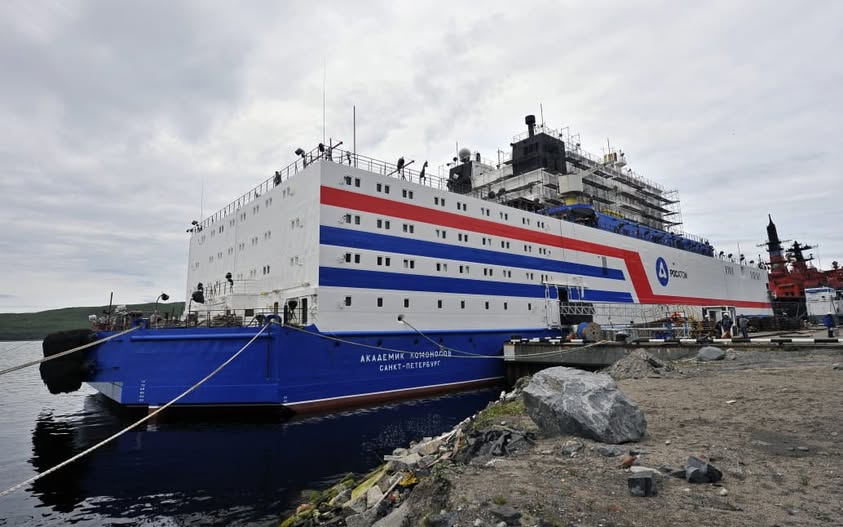
The Akademik Lomonosov is a non-self-propelled power barge that functions as the world's first operational floating nuclear power station.
This is Part 3 of a four-part series on Canada’s Arctic opportunity. Part 1 argued that Canada holds nearly every piece of the Arctic energy puzzle, and Part 2 took inventory of the raw materials. This part looks at technology and operating experience; Part 4 turns to the innovation layer.
Canada can mine, refine and manufacture nearly everything a micro reactor needs, but the United States is building them faster, and the North needs them more than anywhere in America. Whether Canada moves fast enough to stay a player is a question for Mark Carney to answer.
By David Parry
Darlington, east of Toronto, is where Canada’s small nuclear industry stops being a slide in a presentation and starts being concrete. A small modular reactor, or SMR, makes up to about 300 megawatts, enough to power a midsized town. An SMR is built mostly in a factory and then driven to site on a truck. Ontario Power Generation is building four of them there, GE Vernova Hitachi’s BWRX-300 design, for 1,200 megawatts in total. It is the first grid scale SMR project in the G7. The first unit, with its shared infrastructure, will cost about C$7.7 billion and all four about C$20.9 billion.
Part 2 took inventory of what comes out of the ground and ended on a decision nobody has yet to take. This column, , Part 3, follows the material after it leaves the mine. My view, held with moderate confidence, is that Canada could build the rest if the right steps are taken. Cameco’s refinery at Blind River, on Lake Huron, turns uranium concentrate into uranium trioxide. The plant at Port Hope, Ontario, then makes two products from that: uranium hexafluoride, a gas that enrichers prefer, and the ceramic powder used in CANDU reactors, the Canadian design that has run on natural uranium since the 1960s.
Manufacturing is where Canada looks strongest. The federal Nuclear Energy Strategy counts more than 250 companies in a largely domestic supply chain, over 200 of them in Ontario. BWXT Canada has built more than 300 steam generators and is now making the reactor pressure vessel, the thick steel container at the heart of the machine, for the first Darlington unit.
The more interesting work is going on around the reactor instead of inside it. Reactors like to run steadily, but the newest customers, AI data centres above all, draw power in sharp, sudden swings. Canadian company HyprC Systems, the battery subsidiary of Aegis Critical Energy Defence (CSE: QESS), is developing high-response battery storage and control technology intended to manage sudden power fluctuations from AI data centres and other demanding industrial loads. I should declare that I advise Aegis, am chief operating officer of HyprC and am managing partner of Malahat Energy Systems, so weigh this and the next paragraph accordingly.
HyprC Systems builds the controls and software around the battery, including digital twins, which are detailed computer copies of a plant used to test how it behaves before anything physical exists. There are also wo universities involved. McMaster has a four-year programme with the company worth about C$3.71 million, and a C$480,000 Mitacs grant has placed graduate researchers in Ontario Tech’s nuclear engineering department. Their project is a digital twin of ship power that combines SMRs with micro modular reactors, or MMRs.
Others are working on the reactor itself, at the small end. An MMR makes a few megawatts and suits a remote mine or an Arctic village that burns diesel at an exorbitant cost. Prodigy Clean Energy has teamed with Westinghouse to put the eVinci microreactor on a floating platform. Each unit makes 5 megawatts of electricity, is cooled by heat pipes and uses TRISO fuel, which are tiny uranium kernels sealed in ceramic shells. It is designed to run more than eight years between refueling. The target is a first Canadian project by 2030, at a site still under a non-disclosure agreement.
The United States is not waiting for anyone. In May 2025 the White House told the Department of Energy to get at least three advanced test reactors to criticality, the point where a chain reaction sustains itself, by 4 July 2026. Four made it, from Antares, Valar Atomics, Deployable Energy and Aalo Atomics, the last at 12:20 am on 4 July at Idaho National Laboratory. These are test units, not power stations, and the pipeline behind them is moving at a speed Canada has not matched. In California, Bluecore Energy has raised US$60 million, launched two floating barges and begun formal talks with the US Nuclear Regulatory Commission and the Coast Guard, in a state that has barred new fission reactors since 1976. Ottawa’s headline figure for microreactors in the North, as far as I can find, is C$40 million from the Department of National Defence for a feasibility study, with the full nuclear policy framework due late 2026.
Canada needs this more than America does. A micro reactor is a convenience for a data centre in Texas, however for a mine in Nunavut or a village in the Northwest Territories – it can decide whether the project exists at all. This is because diesel arrives by ice road or barge and costs ruinous amounts. Without cheap, reliable power that Part 2 covered, the deposits counted stay in the ground, and the northern communities that Part 1 described keep paying for fuel.
For Canada’s mining industry, the consequences reach far beyond electricity bills. Reliable power could change the economics of northern mineral deposits, extend operating seasons, support on-site processing and reduce dependence on fuel deliveries. A deposit that cannot support the cost of diesel generation may become commercially viable under a different energy model. That is why the nuclear question is also a mining question.
There is also a gap that speed alone will not close, and Part 2 has already named it. Natural uranium contains only 0.7 per cent of the isotope that sustains a chain reaction, uranium 235. CANDU runs on that, so Canada never needed an enrichment plant. Nearly every other SMR design needs enriched fuel, up to 5 per cent, and TRISO designs such as eVinci up to 20 per cent. Canada has no commercial enrichment capacity. Its hexafluoride goes abroad and comes back to be fabricated, which leaves a Canadian reactor exposed to the same foreign policy shifts that make American designs awkward for Canadian operators. Enrichment plants appear where governments decide they should, usually with public money behind them and years of licensing ahead. So the question is political: will Canada be a player in this industry or one piece in somebody else’s? The mines, the refineries and the factories say it could be the first. Being aggressive means two things in practice, a licensed micro reactor in the North with a date attached, and a decision on enrichment. Both fall to the government of Mark Carney, who told Canadians that their country needs to stop relying on a partner whose signature is written in pencil.