
Altamira Gold drills additional mineralized porphyry outside the Maria Bonita mineral resource, Cajueiro District, Brazil
Altamira Gold Corp. [TSXV: ALTA; FSE: T6UP; OTCQB: EQTRF] reported assay results from an exploration diamond drill hole outside the Maria Bonita mineral resource, Cajueiro District, Brazil.
Highlights: Scout drilling below the western edge of the Maria Bonita mineral resource has intersected a wide interval of porphyry mineralization including an interpreted preserved portion of an early phase of the porphyry. This intercept lies 100 metres below and to the west of the previously estimated mineral resource and is a separate body of early-stage porphyry.
Drill hole MBA036 returned 70.6 metres at 0.5 g/t gold from 277 metres downhole to the end of hole, plus 19 metres at 0.5 g/t gold from 239 metres in quartz veined rhyolite porphyry.
The style of mineralization is similar to the early-stage sheeted quartz vein and stockwork mineralization found in the core of the Mara Bonita mineral resource.
This intercept demonstrates continuity of the porphyry complex to the west and preservation of early phases containing consistent gold mineralization.
Mike Bennett, CEO, commented; “The drill results from MBA036 are important because they indicate that the Maria Bonita mineralized porphyry system extends further west than previously known. A surface grab sample 60 metres south of the western limit of the Maria Bonita mineral resource returned an anomalous gold value of 0.6 g/t in altered porphyry and MBA036 was designed to target this surface mineralization at depth. The presence of strong quartz veining and consistent gold mineralization in this hole indicates that the mineralized porphyry system is open to the west. Further drilling will be required to determine the western limit to the mineralization.”
The Cajueiro district is located approximately 75km NW of the town of Alta Floresta in the state of Mato Grosso in central western Brazil. The project is easily accessible by road, lies on open farmland and has grid power and a local water supply. Cajueiro is the most advanced of the key projects that Altamira controls in the region.
The Cajueiro district consists of two independently estimated gold mineral resources at Cajueiro Central and Maria Bonita, plus a series of eight additional untested exploration targets within a radius of 8km of Cajueiro Central.
The Cajueiro Central area has a current open pit resource1 of 5.66Mt at 1.02 g/t gold (185,000 oz) in the Indicated Resource category and 12.66Mt at 1.26 g/t gold (515,000 oz) in the Inferred Resource category (estimated using a cut-off grade of 0.25 g/t Au and a gold price of US$1,500/oz).
The Maria Bonita open-pit resource consists of Indicated Resources of 24.19Mt at 0.46 g/t gold (357,800 oz) and Inferred Resources of 25.64Mt at 0.44 g/t gold (362,400oz). These resources were calculated using a 0.2 g/t gold cut-off grade and a gold price of US$2,780/oz. These resources include near-surface saprolite Indicated Resources of 2.02Mt at 0.59 g/t gold (38,000oz) and Inferred Resources of 0.68Mt at 0.40 g/t gold (8,700 oz).
The Maria Bonita porphyry gold deposit forms part of a district-scale portfolio of prospects that are interpreted as having a similar geological origin. The Cajueiro area is characterized by a 15-km stretch of former alluvial gold workings along the Teles Pires river. The source of some of this alluvial gold is related to a pronounced east-west corridor of gold anomalies in soils and rock chips and a set of sub-cropping intrusions extending east-west over 8km, implying the presence of a long-standing and deep-seated reactivated crustal structure.
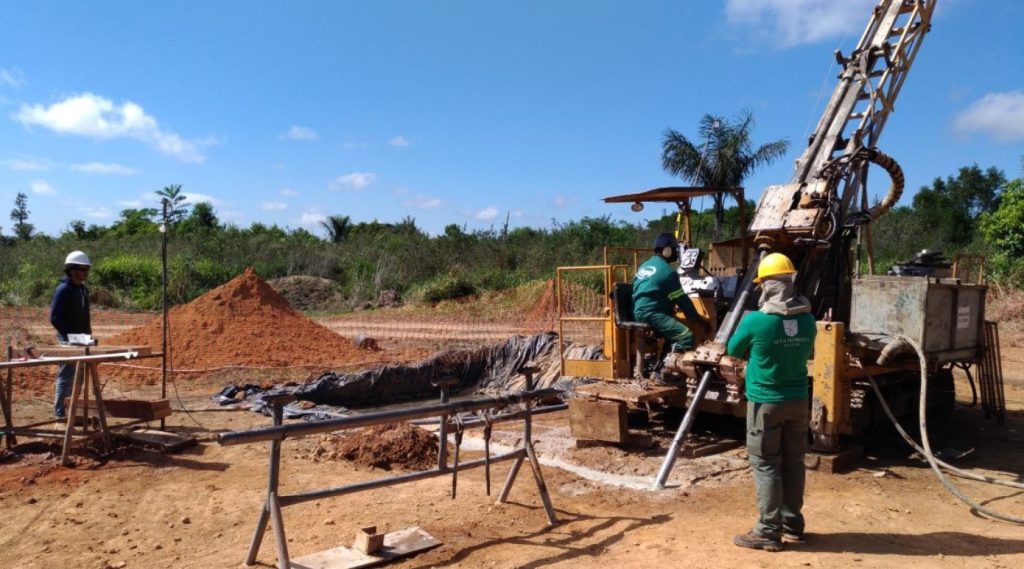
Recent drilling at Maria Bonita has focused on testing the westerly extension of the resource area. Hole MBA036 was collared south of the western end of the optimized pit containing the current mineral resource. A shallow pit excavated in this area to extract local road fill material exposed altered porphyry intrusives. A grab sample from this pit returned a value of 0.6 g/t gold.
The drill hole, with an azimuth of 00° and a dip of 55°, was completed to a depth of 348 metres. The hole transects the Maria Bonita porphyry complex comprising at least three phases of rhyolite porphyry, plus later dykes of felspar porphyry and mafic dolerite.
The evolving geological model for Maria Bonita, infers at least three phases of felsic porphyry intrusion. The wall-rocks to the porphyry complex are tuffs.
The initial porphyry phase is interpreted as the best mineralized and is generally associated with the highest intensity of hydrothermal quartz veins. Where these veins form sheeted veins sets or stockworks, more consistent elevated bulk gold grades are expected, generally in the range 0.7-1 g/t. Early quartz veins may contain accessory magnetite as part of the potassic alteration assemblage.
Subsequent porphyry phases, although broadly similar in chemistry and appearance, have lesser veining and generally carry bulk gold grades that are in the range 0.1-0.5 g/t gold. The intensity of gold mineralization is interpreted to decrease with the evolution of the intrusive system, i.e. successive pulses of rhyolite porphyry.
The later rhyolite porphyry pulses in this section do not contain significant gold above the mineral resource cut-off.
The company plans to extend the scout drilling of the newly discovered porphyry at Maria Bonita in tandem with the ongoing resource infill drilling at the Cajueiro Central mineral resource.
Samples of both oxide and sulphide mineralization from Cajueiro Central have been prepared for further metallurgical test work to refine the earlier results that showed a recovery of 94% using an agitated leach process and up to 96% recovery using a combination of gravity and agitated leach.
The company is focused on the exploration and development of gold projects within western central Brazil, strategically advancing four projects spanning over 100,000 hectares within the prolific Juruena Gold Belt-an area that has historically yielded over 6 million ounces of placer gold. The company’s advanced Cajueiro project contains two gold deposits.
Ongoing exploration and fieldwork at Cajueiro indicate the presence of multiple hard rock gold occurrences, traceable from historical alluvial gold production, highlighting the region’s exceptional gold endowment and potential scalability.
Resource World Magazine Inc. has prepared this editorial for general information purposes only and should not be considered a solicitation to buy or sell securities in the companies discussed herein. The information provided has been derived from sources believed to be reliable but cannot be guaranteed. This editorial does not take into account the readers investment criteria, investment expertise, financial condition, or financial goals of individual recipients and other concerns such as jurisdictional and/or legal restrictions that may exist for certain persons. Recipients should rely on their own due diligence and seek their own professional advice before investing.