
Amaroq drilling discovers significant gold-copper mineralization at Nanoq Project, Greenland
Amaroq Ltd. [AIM, TSXV, NASDAQ Iceland: AMRQ; OTCQX: AMRQF], an independent mine development corporation focused on unlocking Greenland’s mineral potential, reported results from its 2025 exploration program at the Nanoq gold project in South Greenland, on the eastern flank of the Nanortalik gold belt, which also contains the Amaroq operated Nalunaq gold mine.
James Gilbertson, VP Exploration of Amaroq, commented: “I am extremely pleased to announce the results from the 2025 Nanoq drilling program. The outcomes have exceeded our pre-drill expectations and provide us with strong confidence in Nanoq’s potential to host a material gold deposit.
“Our aim for the 2025 program was to build on the encouraging results from previous exploration efforts at Nanoq, enabling a robust understanding of the geological model and subsurface at this outcropping prospect, ahead of larger-scale resource drilling. Not only did we achieve this, but we also succeeded in confirming Nanoq’s significant gold-hosting potential, including shallow high-grade intersections, such as 187.4 g/t Au over 1.5 metres and 19.6 g/t Au over 4.9 metres, as well as broad zones of mineralization approaching 9.0 metres in thickness. The confidence gained from these results will enable us to fast-track resource drilling, with the target of a maiden resource in the near term, accelerating our planned development pathway for Nanoq.
“Further to this, our current drilling only covers a portion of the interpreted system. Our results suggest that mineralization remains open at depth, along strike, and within a number of parallel structures to the west. With shallow, stacked mineralized zones and strong grades, we believe Nanoq could represent a much larger gold system than currently defined.”
Highlights: 4,807 metres of diamond drilling completed across 27 holes, successfully testing ~600 metres of strike length within the Nanoq Central Zone with mineralized intervals averaging approximately 3.3 metres thickness at a grade of 9.98 g/t Au at vertical depth of up to 70 metres.
A total of 63% of holes intersected mineralization including up to 187.4 g/t Au over 1.5 metres and 19.6 g/t Au over 4.9 metres, all at shallow depths; despite the programme being designed primarily to advance subsurface geological understanding.
Core drilling suggests the presence of thick intersections of up to 3.83 g/t Au over 9.0 metres and 6.7 g/t Au over 7.39 meters, in both folded quartz veins and surrounding host rocks, creating significant upside potential and large minable packages; with only the top ~70 metres depths tested.
Detailed mapping has extended the interpreted strike of the Central Zone to 1.5 km (impeded by retreating ice-cap) and identified, previously unrecognized, repeat mineralized structures, with high surface grades of up to 9.5 g/t Au.
Results also continue to confirm that significant copper is present in the system, with up to 0.56% Cu over 2.46m and assay grades of up to 1.12% Cu over 0.5m.
High-grade gold is now confirmed in multiple structural settings, including saddle-reef style fold hinges and vertically extensive fault zones, highlighting multiple pathways for future resource growth.
Results provide a strong technical basis for a significantly expanded follow-up drilling program in 2026, supported by existing camp infrastructure, drill pads and winterized equipment all in place, coupled with Amaroq’s strong liquidity position.
These results strengthen the geological interpretation and compare favourably with early-stage drilling outcomes from well-known orogenic gold systems, reinforcing our confidence in the scale and continuity of the mineralized structures.
The company is exploring infrastructure solutions, including a short 3km access road from site to a potential harbour, that would allow us to move material efficiently, facilitating a potential bulk sample.
These results confirm the Nanoq Project as one of Amaroq’s most significant emerging gold discoveries in South Greenland. First identified in the 1990s but never systematically explored, Nanoq hosts a large zone of gold-bearing quartz veining within a folded sequence of volcanic and sedimentary rocks, geological features commonly associated with significant orogenic gold deposits worldwide.
Amaroq began work at Nanoq to test its potential to form a second high-grade gold source to complement production from Nalunaq. Early sampling and scout drilling in 2024, indicated high grades at shallow depths, suggesting that the system could be both meaningful in scale and economically attractive.
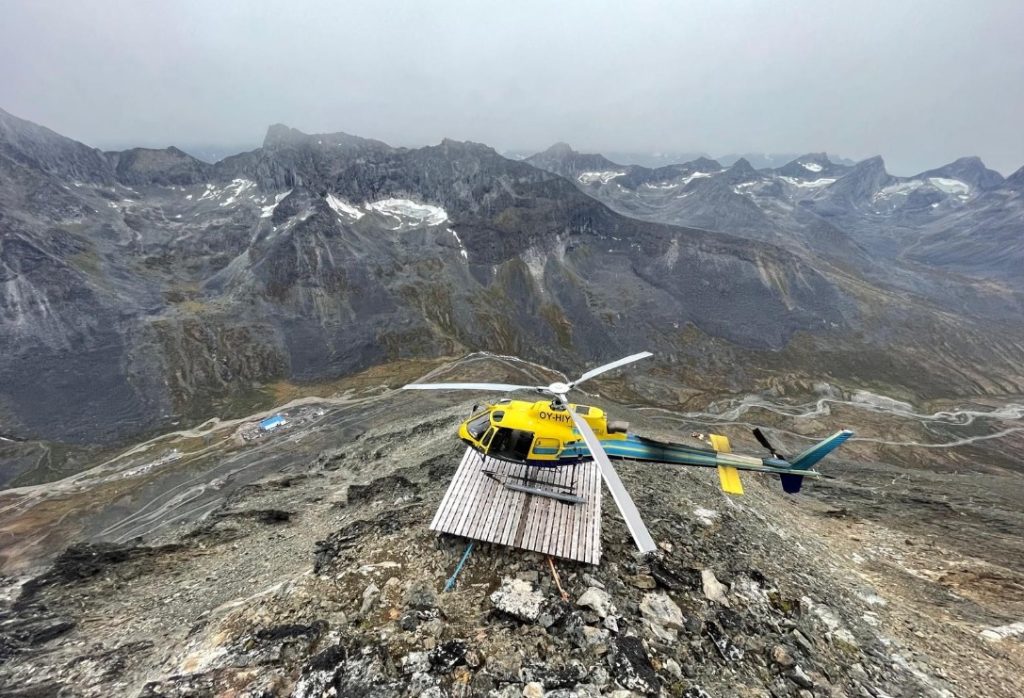
Between July and October 2025, Amaroq conducted the first comprehensive exploration campaign at Nanoq since 1997, including the project’s first major drill program.
Because Nanoq had never been properly mapped or modelled, the 2025 program focused on building a strong geological foundation: understanding the structures that control gold mineralization, how the veins are arranged, and where additional high-grade zones may occur. This work is essential in modern mineral exploration, as it enables future drilling to target gold zones efficiently and cost-effectively.
Mobilization and construction of the 45-person exploration camp were completed in July 2025, followed by detailed geological mapping in early August and drilling from mid-August to late September 2025. The programme was completed ahead of schedule and within budget.
The company is now evaluating the steps required to collect a bulk sample for early metallurgical testing, with a view to assessing how this material may perform within the existing Nalunaq processing flowsheet. Given Nanoq’s proximity to the coastline, the company sees a clear pathway for short-haul transport and ship-based transfer of material to Nalunaq. As part of this, the company are exploring infrastructure solutions, including a short 3km access road from the drill sites to a potential harbour site, that would allow us to move material efficiently.
Mapping was carried out by consultants Warren Pratt and Luca Smeraglia (Specialised Geological Mapping Ltd), alongside Amaroq geologists, taking advantage of near-continuous outcrop exposure across the project.
Gold-bearing quartz veins are hosted within a folded volcano-sedimentary sequence.
Following the completion of this geological interpretation, Amaroq undertook additional prospecting to the south and west of the Central Zone to test predicted strike extensions and the presence of repeat structures identified in earlier geophysical models. This work successfully confirmed a further 500m of gold-anomalous structure immediately south of the drilled area, extending the total interpreted strike length of the Central Zone to approximately 1,500m, with indications that the system may continue beneath the ice cap.
In parallel, prospecting 500m west of the Central Zone led to the discovery of a continuous ~1km long quartz-vein system, now designated the ‘West 1’ Zone. Surface sampling from West 1 returned values of up to 9.5 g/t Au, confirming the zone as a high-priority target for follow-up drilling.
Drilling data has reinforced the geological model and has been integrated with surface mapping, geochemistry and structural observations to build a refined 3D geological and mineralization model. This will continue to be developed with external consultants to support effective targeting for the 2026 drill program and provide the basis for a potential maiden Mineral Resource estimate.
Intersected mineralized widths range from 0.5m up to 9.0m, demonstrating that gold occurs in both narrow veins and broad zones. The presence of coarse gold indicates a high “nugget effect” in the deposit, meaning that individual assay grades can be highly variable.
Importantly, mineralization occurs predominantly at shallow depths and in stacked (nested) structures, supporting the view that the Nanoq gold system may be amenable to open-pit mining. At the same time, deeper extensions are apparent in the saddle-reef fold hinges and vertically extensive shear zones, leaving significant room for further expansion.
Core were also assayed for multielement, particularly copper which was recorded historically and during the 2024 scout drilling. From these assays, while no direct correlation between gold and copper is so far evident, a number of intersections of over 0.3% copper were intersected and up to 0.5m at 1.12% Cu.
This year’s exploration has significantly advanced Amaroq’s understanding of Nanoq’s geology and the controls on gold mineralization, building a strong foundation for future resource drilling.
Initial environmental baseline surveys were launched to collect data required for future feasibility and permitting studies.
A series of small (~100kg) bulk metallurgical samples were collected from both surface outcrop and drill core. Amaroq is now engaging with SGS to conduct the first phase of metallurgical test work. This work will assess potential recovery characteristics and processing behaviour, including how Nanoq material might perform within the Nalunaq processing flowsheet as a possible future supplemental ore source.
Drilling was carried out using three Amaroq-owned rigs operated by Energold Drilling, working from the Nanoq exploration base located approximately 130km northeast of Nalunaq
A series of rock chip samples were collected from the across the Nanoq project and specifically West 1. Rock chip samples were collected from outcrops using geological hammers and placed into calico cotton sample bags with a numbered sample ticket.