
Denison Mines discovers additional high-grade uranium at Gryphon deposit, Saskatchewan
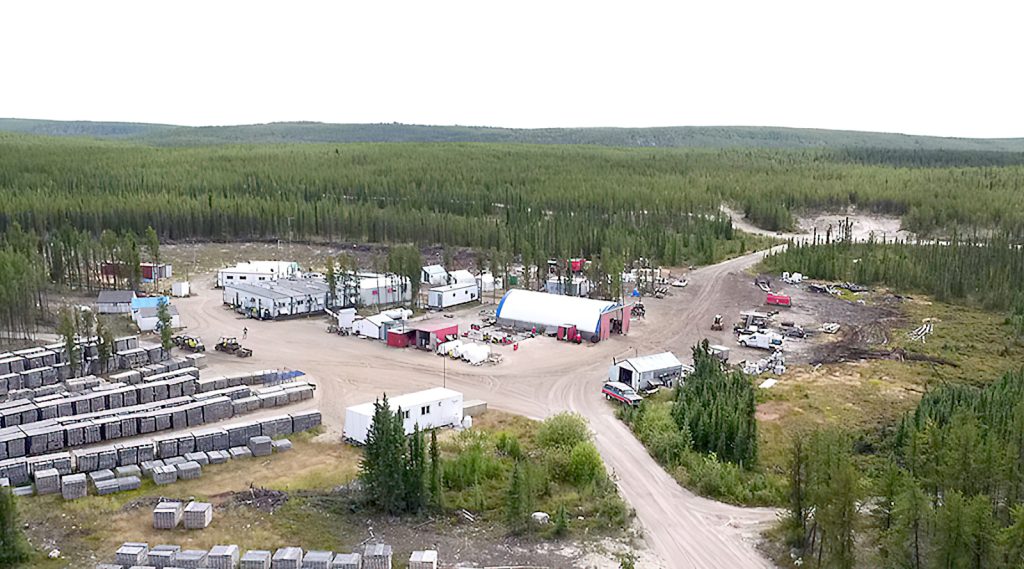
Denison Mines Corp. [TSX: DML; NYSE American: DNN] reported the discovery of additional high-grade mineralization approximately 40 metres outside of the previously estimated mineralized domain associated with the D1 lens of the Gryphon uranium deposit, northern Saskatchewan.
Drill hole WR-837AD2 intersected 2.3 metres at 1.69% eU3O8 including 0.5 metres at 5.48% eU3O8 in the down plunge direction from the previously defined D1 lens. This area remains open down-plunge and along strike to the northeast for further expansion. Gryphon is situated approximately 3 km northwest of the company’s flagship Phoenix In-Situ Recovery (ISR) uranium mine development project, on Denison’s 95%-owned Wheeler River property in northern Saskatchewan.
The discovery was made as part of a highly successful delineation drill program carried out at Gryphon during the first half of 2025. Results from the delineation drilling are expected to add confidence to the previously estimated mineral resources for Gryphon, having confirmed the current geological interpretation of the deposit and intersecting uranium grades in line with expected values.
Denison’s President and CEO, David Cates, commented, “Our 2025 Gryphon delineation program was highly successful and achieved each of the program’s key objectives, including increasing the density of drill testing within the A1 high-grade domain and confirming the geological model, collecting additional geotechnical, metallurgical and hydrogeological samples and information to support future project evaluation efforts, and initial testing of areas identified for possible expansion of mineral resources that are outside of the mine design outlined in the 2023 Pre-Feasibility Study (PFS).
“The delineation results demonstrate that Gryphon is an excellent high-grade basement hosted uranium deposit that justifies further project development evaluation and de-risking. With a focus on confirming the mineralization in the A-series of lenses, a limited number of drill holes were designed to test for possible expansion of the estimated mineral resource. As a result, we are excited that drill hole WR-837AD2 encountered high-grade mineralization outside of the existing mineralized domain in an area that remains wide open for further expansion down-plunge and along strike. We are currently developing plans to follow-up this result and test other expansion targets.”
Gryphon Uranium Deposit was discovered by Denison in 2014 and is estimated to contain Indicated Mineral Resources of 61.9 million pounds U3O8 (1,643,000 tonnes an average grade of 1.7% U3O8), plus Indicated Mineral Resources of 1.9 million pounds U3O8 (73,000 tonnes at an average grade of 1.2% U3O8), with an effective date of August 7, 2018.
Gryphon is comprised of 24 primarily basement-hosted stacked lenses referred to as the A-series, B-series, C-series, D-series and E-series lenses, which are interpreted to be stacked to form a zone of mineralization measuring approximately 280 metres long by 113 metres wide, with each lens having variable thicknesses and generally plunging to the northeast and dipping to the southeast.
Four high-grade domains have been established within the A1 and D1 lenses. The A1 high-grade domain represents 40% of the total Indicated Mineral Resources estimated for the deposit; whereas the combination of the three D1 high-grade domains represent approximately 10% of the total Indicated Mineral Resources.
Potential future development of the Gryphon deposit has been assessed as an underground mining operation at a PFS level in 2018 with a cost update completed in 2023. The outcomes of the study highlight robust economics with an estimated after-tax base-case Net Present Value (NPV) of $864.2 million and internal rate of return (IRR) of 37.6%, based on estimated Probable Reserves of 49.7 million pounds U3O8 (1,275,000 tonnes at 1.8% U3O8), a uranium selling price of USD$75/lb U3O8 ($101.25/lb U3O8), and an 8% discount rate.
Gryphon’s cash operating costs are estimated to be USD$12.75/lb U3O8, and its all-in cost of production (including initial capital costs of CAD$737.4 million) is estimated to be US$25.47/lb U3O8. Accordingly, Gryphon has the potential to be competitive with the lowest cost uranium mining operations in the world.
The D series lenses were targeted for potential mineral resource expansion in 2025 given their high-grade, structurally controlled nature, and that previous drilling left the mineralization partially open in the down-plunge and along-strike directions. Prior to this program, no significant expansion drilling has occurred proximal to Gryphon since 2018.
The last drill hole of the 2025 program (WR-837AD2) encountered high-grade uranium mineralization, which is interpreted to expand the extent of the D1 zone by ~40 metres in the down-plunge direction. This drill hole tested a 100-metre gap in the previous drill hole spacing and justifies further follow-up drilling to test to additional down-plunge extension as well as the potential for along strike continuation. Drill hole WR-836 was also completed in the expansion area and also encountered notable uranium mineralization, which indicates the system is open along strike to the north.
Denison reports its initial drilling results as radiometric equivalent uranium (%eU3O8) from a calibrated, triple gamma, down-hole probe. All mineralized intersections have been sampled for chemical U3O8 assay and final results will be compiled following receipt of the data.
A total of ~12,500 metres of diamond drilling was completed in 17 drill holes and multiple off cuts during the 2025 delineation program at Gryphon. Overall, the delineation program confirmed the current geological interpretation of the deposit and supported the grade-thickness (GT) assumptions in the resource block model.
The A1 lens was the primary focus of the drill program as the high-grade and low-grade domains contain approximately 50% of the estimated Indicated Mineral Resource for Gryphon. Several drill holes intersected the A1 high-grade domain and established additional continuity within the A-series lenses.
The B and C series lenses are located below the A series within the center of the deposit and were also intersected as part of the 2025 delineation program. Together the B and C series lenses account for approximately 20% of the total estimated Indicated Mineral Resources.
Several drill holes encountered significant results, demonstrating the high-grade nature of Gryphon, including the following results from WR-831D1D2, which tested the primary lenses and returned the best mineralized intercepts from the delineation program. Hole WR-831D1D2 returned 1.8 metres of 3.85%eU3O8.
Approximately 250 kg of whole-core samples were collected for metallurgical test work. Metallurgical test programs are being developed to assess uranium recoveries to advance the evaluation work completed to support the 2018 and 2023 PFS.
Geotechnical logging was completed on all drill holes and hydrogeological information was collected from two of the drill holes which were outfitted with vibrating wire piezometers (VWPs).
This work adds to the extensive database of geological, hydrogeological, geotechnical, and metallurgical data for Gryphon. This site-specific data is expected to be used to validate certain key assumptions in potential future technical studies further evaluating the Gryphon deposit for underground mining.
Wheeler River is the largest undeveloped uranium project in the infrastructure-rich eastern portion of the Athabasca Basin region, northern Saskatchewan. The project is host to the high-grade Phoenix and Gryphon uranium deposits, discovered by Denison in 2008 and 2014, respectively, and is a joint venture between Denison (90% and operator) and JCU (Canada) Exploration Company Limited (JCU 10%).
In August 2023, Denison filed a technical report summarizing the results of the feasibility study completed for ISR mining of the high-grade Phoenix uranium deposit and a cost update to the 2018 Pre-Feasibility Study for conventional underground mining of the basement-hosted Gryphon uranium deposit.
Based on the respective studies, both deposits have the potential to be competitive with the lowest cost uranium mining operations in the world. Permitting efforts for the planned Phoenix ISR operation commenced in 2019 and several notable milestones were achieved in 2024 with the submission of federal licensing documents and the acceptance of the final form of the project’s Environmental Impact Statement by the Province of Saskatchewan and the Canadian Nuclear Safety Commission.