
Eskay Mining posts high-grade gold assays from final batch of surface samples from Consolidated Eskay Project, Golden Triangle, BC
Eskay Mining Corp. [TSXV: ESK; OTC PINK: ESKYF; FSE: KN7; WKN: A0YDPM] provided additional assay results from its prospecting and sampling program at its 100% controlled Consolidated Eskay Project (CEP) in the Golden Triangle, northwest British Columbia.
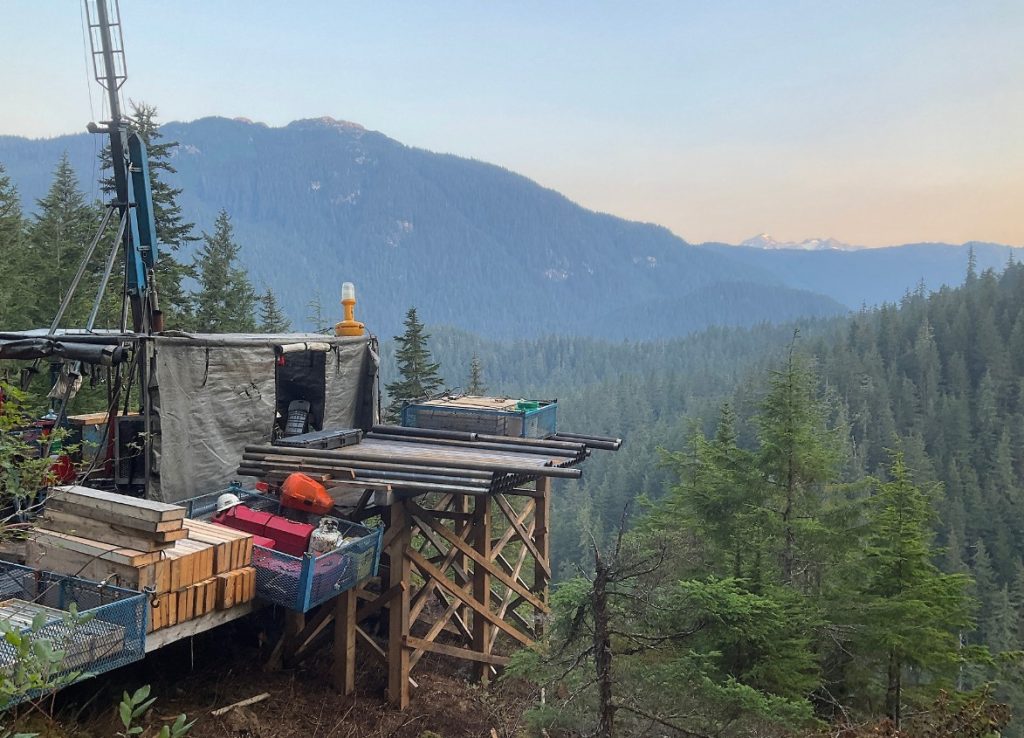
Over the summer months of 2025, the company’s geological team systematically prospected and sampled the Vermillion, TM, Red Lightning, and Big Red zones surrounding Unuk Finger Mountain in the southern extent of CEP where high grade gold veins were initially discovered in 2024.
Highlights: This most recent batch of 121 spot rock chip and channel results includes eleven samples assaying over 20 g/t Au and 31 samples assaying over 1 g/t Au.
The highest grade spot rock chip assays include 297 g/t Au and 790 g/t Ag collected from a quartz-sulfide vein at TM zone; 217 g/t Au and 0.44% Cu collected from a quartz-sulfide vein at Vermillion zone; 106 g/t Au and 54.9 g/t Ag collected from a quartz-sulfide vein at TM zone, and 65.7 g/t Au, 31.5 g/t Ag, and 0.31% collected from a quartz-sulfide vein at Vermillion zone.
A channel sample assay at the TM Zone returned 165 g/t Au and 285 g/t Ag over 0.40 m within 45.5 g/t Au and 75.2 g/t Ag over 1.55m.
A new gold-silver target, the Sultan zone, discovered in the southeastern corner of the claim package returned an initial assay of 11.2 g/t Au and 181 g/t Ag.
“Further expansion of the high-grade vein discovery in the southern portion of our Consolidated Eskay Project now fully explain the robust, large-scale BLEG stream sediment anomaly we identified around Unuk Finger Mountain in recent years,” commented Quinton Hennigh, director and technical advisor to Eskay Mining.
“High-grade veins display a pattern of commonly being low-angle and stacked a few tens of metres apart. Veins are comprised of quartz and varying contents of sulfides including base metal sulfides, especially chalcopyrite. We are now seeing broad distribution of these veins, and they appear to display a spatial relation with a nearby Lee Brant Eocene intrusion not unlike those observed at both Goliath Resources’ Surebet project and Juggernaut Exploration’s Big One project. This new target style is generating a lot of excitement in the GT, and we think we may have a similar such exploration target emerging at CEP. We can see a path to inaugural drilling of these veins in 2026.”
The 2025 field exploration program at the Consolidated Eskay Project included extensive surficial sampling, reconnaissance geological mapping, and channel sampling across target areas around the Unuk Finger Mountain and additional target areas across the property. The focus of the program was to identify and advance early-stage gold-silver prospects into drill ready targets for the 2026 exploration season. All assays have now been received for the 2025 season and this release covers the remaining 95 rock and 26 channel samples collected for a season total of 310 spot rock chip samples and 55 channel samples.
In addition, Worldview 3 high-resolution satellite imagery survey has been collected across the property with results expected later this month. Hyperspectral imaging and detailed orthophotos will help support focused exploration efforts across Eskay’s 200 km2 southern target area.
Exploration conducted across the Vermillion and TM targets has identified significant vein-hosted gold and silver mineralization that share many characteristics with reduced intrusion-related gold systems (RIRGS). Prospecting and reconnaissance mapping have discovered flat-lying, sheeted and planar shear quartz vein zones spanning over 600 metres vertically and 500 by 2000 metres laterally with further areas to assess moving forward.
Veining is spatially related to a biotite-hornblende quartz monzonite intrusion of the Lee Brant intrusive stock believed to be of Eocene age which covers a 40 sq/km area south of the vein zones.
In-situ visible gold and electrum mineralization have been identified over a 2km strike length occurring in multiple planar and sheeted quartz-carbonate veins at both the Vermillion and TM zone to the east. Veins hosting accessory pyrrhotite, chalcopyrite, bismuthinite, and rarely wolframite and gold show strong correlations with copper, bismuth and silver with anomalous tellurium. Lead and zinc (+/- silver) veins have also been sampled and may represent distal expressions of the mineralizing system. Mineralized veins are primarily hosted in metavolcanic and volcaniclastic sequences of the Lower to Middle Jurassic Hazelton Group and have also been observed in float boulders of the Lee Brant Stock quartz monzonite.
A remaining total of 95 rock sample assays have been received from follow-up sampling at the TM (Figure 2) and Vermillion zones. Further sampling across the targets has continued to expand upon the surface footprint of vein-hosted gold and silver mineralization and recent sampling has returned the highest gold grades to date in the area with sample A0519920 assaying 297 g/t Au and 790 g/t Ag. Of the 95 rocks collected in the last phase of sampling, 5 rock samples assayed over 20 g/t Au, 8 samples assayed over 10 g/t Au, 14 samples assayed over 5 g/t Au, and 21 samples assayed over 1 g/t Au.
Select assay highlights from TM & Vermillion include: A0519920 assayed 297 g/t Au and 790 g/t Ag. A0518360 assayed 217 g/t Au and 0.44% Cu. A0518357 assayed 106 g/t Au and 54.9 g/t Ag. A0518363 assayed 65.7 g/t Au, 31.5 g/t Ag, and 0.31% Cu.
A total of 41.77 etres of channel sampling has been completed to date at the Vermillion and TM zones. TM channel samples are reported herein, see previous release dated September 17, 2025 for Vermillion channel sample results.
A total of 16.86 metres across 9 channel series were completed at TM testing various vein generations for gold mineralization. Due to terrain limitations channel sampling widths were limited in their extents as the TM area is characterized by steeply sloping topography. Channels were completed at a minimum width of 1.5 metres to reflect minimum underground mining widths and were sampled both across veins with known gold mineralization as well veins that had not previously been sampled.
All channels were successful in intersecting gold and silver mineralization with significant gold intersections, including 165 g/t Au and 285 g/t Ag over 0.40 m within 45.5 g/t Au and 75.2 g/t Ag over 1.55m from Channel V7 and 46.6 g/t Au and 16.7 g/t Ag over 0.25m within 6.67 g/t Au and 2.53 g/t Ag over 1.7m from Channel V4. See original press release for weighted average intervals.
One day was spent conducting reconnaissance sampling on previously unexplored areas 7km southeast of the TM Zone at the end of the 2025 season. Prospecting returned promising initial results from base metal veins hosted in broad quartz-sericite-pyrite alteration zones within Upper Triassic rocks of the Stuhini Group with one assay of 11.2 g/t Au and 181 g/t Ag. The recent discovery of additional gold-silver mineralization in the southern extents of the claims support the need for further exploration in the area and attest to the district scale precious and base metal potential across the property.
Eskay Mining is focused on the exploration and development of precious and base metals along the Eskay rift in a prolific region of northwest British Columbia known as the Golden Triangle, 70km northwest of Stewart, BC. The company currently holds mineral tenures in this area comprised of 177 claims (52,600 hectares).
Resource World Magazine Inc. has prepared this editorial for general information purposes only and should not be considered a solicitation to buy or sell securities in the companies discussed herein. The information provided has been derived from sources believed to be reliable but cannot be guaranteed. This editorial does not take into account the readers investment criteria, investment expertise, financial condition, or financial goals of individual recipients and other concerns such as jurisdictional and/or legal restrictions that may exist for certain persons. Recipients should rely on their own due diligence and seek their own professional advice before investing.