
First Nordic Metals drills 1.94 g/t gold over 21.5 metres at Paubacken Project, Sweden
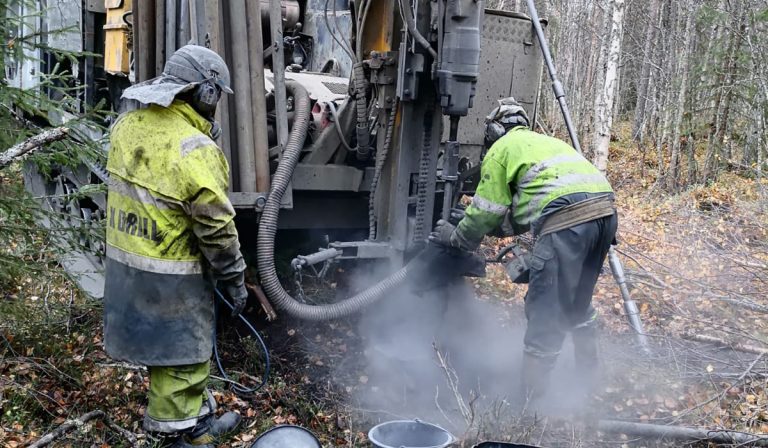
First Nordic Metals Corp. [TSXV: FNM; OTCQB: FNMCF, FRA: HEG0] released the results to date (14 of 39 holes) from its 2025 diamond drill program at the Aida target, located within the 100%-owned Paubacken Project, Vasterbotten County, northern Sweden.
Key highlights: Multiple strong gold intercepts returned, including: 1.94 g/t gold over 21.5 metres (2025-AID-038), 5.45 g/t Au over 4.6 metres (2025-AID-030) and 1.17 g/t Au over 17.5 metrres (2025-AID-027).
Gold-mineralized strike of Aida corridor extended from 0.5 km to over 2.1 km, remaining open in all directions. Several new gold-bearing structures identified, including the blind to surface Pharao zone and the Northern Mafic zone.
Gold-bearing structures intercepted in 12 of 14 drill holes to date with visible gold identified in five drill holes. Follow-up drill program being planned for Q4 2025.
Taj Singh, CEO, commented: “We are encouraged by this first batch of results, with notable grade-width combinations seen in many of the gold intercepts. The identification of multiple parallel mineralized zones adjacent to the Central zone (original discovery) is particularly compelling; not only does it build on cumulative strike length, but any future development could potentially be shared across the zones.
“The area around the Central zone remains the only part of Aida with meaningful drill density; significant potential exists to both the north and south, and even with wide-spaced stepouts of up to 500 metres apart, we intercepted gold mineralization in every hole along the main corridor. With assays pending from 25 additional holes, we are only beginning to outline the scale of this system.”
The 2025 Aida drill program was designed to systematically expand known mineralization within the Aida structural corridor along strike to the north and south, and at depth. The program comprised 39 diamond drill holes totalling 10,304 metres. Due to delays at the preparation and assay laboratories, results from 14 of the 39 drill holes have been received to date. Gold-bearing structures have been intercepted in 12 of the 14 drill holes (using a 0.1 g/t cut-off to define mineralized structures, not for reporting significant intercepts), with visible gold identified in five drill holes.
Widely spaced drill fences were designed to test the southern extent of the target corridor, where thick glacial till cover prevented base-of-till drilling to reach bedrock, and the northern extent of the structural corridor. In the central area, deeper drill holes were designed to test the down dip extension of previously identified mineralization. The 2025 drill program has successfully extended mineralization along the Aida structural corridor four times to over 2.1 km in strike, up to 250 m deep in the central area and discovered a previously unknown blind to surface zone (Pharao zone), east of the Central zone.
Three new zones of mineralization have been identified within the structural corridor: two new parallel zones to the east of the Central zone (including the Pharao zone) and one in the northern extension area (Northern Mafic zone). The Pharao zone is blind to surface, has a true width of 40 metres and has been traced for 250 metres in drilling. The new zones are open in all directions and will be targeted in follow up drill campaigns.
Results continue to demonstrate the potential of the Aida target as a set of several significant gold-bearing structures spanning multiple kilometres. All zones identified to date remain open in all directions and more than two km of the structural corridor target remain untested by drilling. Once the complete 2025 drill results have been received and modelled, follow-up work programs will be designed.
The Aida target is located 40 km south of the company’s resource-stage Barsele project (in joint venture with Agnico Eagle Mines Ltd.) and four km northeast of the operating Svartliden mill that is currently processing ore from Sweden’s newest gold mine, Fabodtjarn (owned and operated by Botnia Exploration AB).
The Paubacken Project consists of four licences covering 19,737 hectares that cover the central part of an emerging district in north-central Sweden known as the Gold Line belt. The Gold Line belt is host to several significant gold deposits, including the company’s Barsele project, as well as the Svartliden gold mine and mill complex and Faboliden development project (both operated by Dragon Mining Ltd.). The Svartliden mill is currently processing gold ores from the Fabodtjarn gold mine, which started mining operations in 2024.
First Nordic Metals is consolidating assets in Sweden and Finland, with a vision to create Europe’s next gold camp. The company’s flagship asset is the Barsele gold project in northern Sweden, a joint venture project with senior gold producer Agnico Eagle Mines Ltd. Immediately surrounding the Barsele project, First Nordic is 100% owner of a district-scale licence position comprised of two additional projects (Paubacken, Storjuktan), which combined with Barsele, total approximately 80,000 hectares on the Gold Line greenstone belt.
Additionally, in Northern Finland, First Nordic is the 100% owner of a district-scale position covering the entire underexplored Oijarvi greenstone belt, including the Kylmakangas deposit, the largest known gold occurrence on this belt.