
Fitzroy Minerals updates exploration at Caballos Copper Project and confirms the Buen Retiro Copper Project is analogous to Candelaria, Chile
Fitzroy Minerals Inc. [TSXV: FTZ, OTCQB: FTZFF] provided an update on exploration progress at its Buen Retiro and Caballos copper projects in northern Chile.
Highlights: Drill hole CAB-DDH004A intersected 176 metres at 0.31% Cu, 249 ppm Mo, 0.04 g/t Au (0.47% CuEq) from 156 metres at the Caballos Copper Project, Chile.
Airborne MobileMT, 716 line-km geophysical survey commissioned for Q1 2026, at the Caballos Copper Project, Chile.
SEG Visiting Lecturer Dr. Irene del Real Contreras considers that “the structural setting, the geology and the mineralization seen at Buen Retiro is analogous to that of Candelaria, with minor differences.”
Merlin Marr-Johnson, President and CEO of Fitzroy Minerals, commented: “Fitzroy is intersecting copper mineralization in two projects with scale in the world’s leading copper-producing country, as copper prices reach record highs. I am confident that 2026 will be a transformative and hugely exciting year for the company as we meet our discovery and de-risking goals.
“The latest results from Caballos show that we are onto a robust copper-molybdenum-gold system with multiple phases of mineralization and many of the signature features of classic Chilean porphyry copper deposits. The sulphides seen in drill hole 9, and the results from drill holes 1 and 4A show that the mineralized trend is more than 600 metres long, and we are still in the very early stages of exploration. I am looking forward to the results of the deep-penetrating airborne geophysics scheduled for Q1.
“Separately, drilling at Buen Retiro continues to intersect sulphide mineralization and a site visit by Dr. Irene del Real Contreras provided valuable insight. Dr. Real considers that the intersections seen in drill holes 40 to 45 include mineralization preferentially hosted in an ‘Upper Pucobre Formation’ volcanic breccia layer 20 to 50 metres thick that dips to the northwest and is open to the northeast.
“This is important because the shallower portions of Candelaria mineralization are also hosted in the Upper Pucobre Formation. It is yet another similarity with Candelaria which makes us even more optimistic about the overall potential at Buen Retiro, and we plan to initiate deeper drilling for mineralization in the Lower Pucobre Formation once the geophysics is completed and interpreted. We look forward to receiving all of the assays from the recent sulphide drill holes as soon as they are delivered.
“Finally, a decision to upgrade the Technical Report on the Heap Leach Joint Venture with Pucobre 2 to a Pre-Feasibility Study underscores our confidence in the Project. I hope to be able to bring you more detail on this Fitzroy-Pucobre Joint Venture plan in the coming weeks.”
At Caballos, Phase 1 drilling was completed with a total of 3,154 metres of diamond drill core across nine holes. An airborne geophysical survey (MobileMT) has been commissioned and is scheduled for completion in Q1 2026. Mapping is continuing ahead of the airborne geophysical survey. Phase 2 drilling is scheduled for later in the year once the geophysical data is integrated into our geological model.
The results show that while both Chincolco and Mule Hill have many of the features of established porphyry copper deposits, better grades are being intersected in Chincolco. Recent mapping identified strongly altered hydrothermal breccia sub-crop (intermittent exposure in cross-cutting gullies) extending several hundred metres to the south of the main Chincolco surface anomaly.
Fitzroy has signed a contract with Expert Geophysics to complete an airborne MobileMT (Mobile MagnetoTellurics) geophysical survey. The survey aims to map sub-surface resistivity to a depth of approximately 1km to 2km, dependent on the conductivity distribution of the local geology. Complementary VLF (very low frequency) data, which provides near surface EM (electromagnetic) information, will also be collected, when available and dependent on VLF signal strength.
The plan is to fly approximately 716 line-km spaced every 400 m and 4,000 m spaced tie lines within the Caballos Project area. There is scope to add an additional 250 line-km of infill, to bring the total to approximately 966 line-km.
Together the MMT and VLF-EM data should help to map subsurface geology, especially conductive features like faults, fractures, and concentrations of sulphide mineralization. The next availability for helicopters is likely to be in February, and it is anticipated that the survey can be completed in Q1 2026.
At Buen Retiro, Phase 2 drilling is almost complete with approximately 8,000 metres of diamond drill core across 29 holes. Assays are pending for drill holes 40 to 45, with delays reported from the laboratory due to high demand. An 11,000-metre reverse circulation (RC) drilling campaign is also nearing completion, which includes some condemnation drill holes (2,050 m) and testing of proposed pad and lay-out areas. A ground geophysical survey is planned, to assist with sulphide drill-targeting at depth.
In the northern area of the Buen Retiro Project, drilling has identified a copper-mineralized trend extending for approximately 1 km north of the historical Manto Negro pit hosted within a volcanic sequence dominated by andesitic rocks interbedded with volcanic breccias and tuffs.
Copper mineralization clearly shows a stratigraphic control and is preferentially developed within the more permeable volcanic breccias and tuffs, which act as favourable host horizons. Assays are pending for drill holes 40 to 45 where intersections of 150 metres to 250 metres of disseminated chalcopyrite were previously reported.
Results from earlier drilling highlight the way different stratigraphic units affect copper-gold grade. For example, drill hole 3 returned 110 metres of disseminated chalcopyrite mostly within the andesitic units (returning 110 m at 0.23% Cu), but where the drill hole cut the volcanic breccia and tuffs the grade was 21 metres at 0.41% Cu and 0.11 g/t Au.
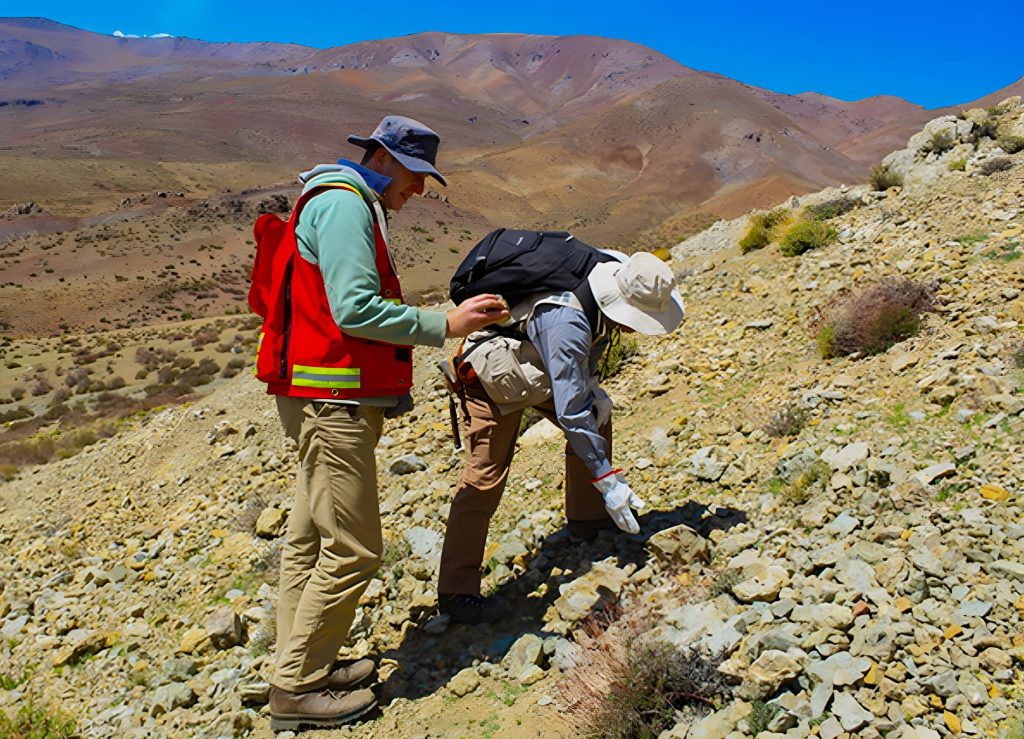
Renowned IOCG geologist and SEG Visiting Lecturer 2026 Dr. Irene del Real Contreras completed a two-day site visit at Buen Retiro in December focused on reviewing the drill core from the northern area.
Dr. Real’s key observations were: Host lithologies can be assigned to the Upper Pucobre Formation ; higher quantity of chalcopyrite is seen in the sequence of hematitic breccias and tuffs, a key feature at Candelaria; interaction between mineralizing fluids and lithologies with high primary permeability appears to have been a key factor in localizing mineralization, giving rise to tabular (manto) or lenticular bodies controlled by both stratigraphy and structure.
Primary regional controls are NNW-oriented structures and NNE-striking stratigraphy. Structural setting, the geology and the mineralization observed at Buen Retiro is analogous to that of Candelaria, with minor differences New DD and RC drilling contracts for 2026 are being negotiated. The diamond holes will be split between exploration drilling and larger diameter (HQ) infill/metallurgical sampling holes. Existing geophysical data is being re-interpreted, and a deep-penetrating ground survey is being designed.
Discussions regarding a Heap Leach Joint Venture Copper Project with Sociedad Punta del Cobre S.A. continue, and a decision has been made that the associated Technical Report to be completed by Fitzroy will be a Pre-Feasibility level (PFS), meeting the requirements of NI 43-101 disclosure requirements.
The company granted 300,000 stock options to buy up to 300,000 common shares of the company to a director of the Company under the company’s stock option plan.
The Options are exercisable at the price of $0.58 per Common Share until January 13, 2031, subject to any earlier termination in accordance with the Plan.
The company’s current property portfolio includes the Buen Retiro Copper Project located near Copiapó, Chile, the Caballos Copper and Polimet Gold-Copper-Silver projects located in Valparaiso, Chile, the Taquetren Gold Project located in Rio Negro, Argentina, and the Cariboo Project in British Columbia, Canada.