
Goldshore drills additional mineralization beneath conceptual open pit at Southwest Zone, Moss Project, Ontario
Goldshore Resources Inc. [TSXV: GSHR; OTCQB: GSHRF; FSE: 8X00] reported its latest assay results from its recently completed 20,000-metre winter drill program with the final results from the Southwest Zone of the Moss Gold Project in northwest Ontario, Canada. A total of 5,000 metres were drilled targeting the area underneath the conceptual open pit at the Southwest Zone of the Moss deposit with the goal of expanding the resource beneath the current proposed open pit for a future mineral resource estimate.
Michael Henrichsen, CEO of Goldshore, commented, “We are pleased with the results of the program underneath the Southwest pit demonstrating good widths at above average resource grades supported by several parallel marginal shears. The new drilling in conjunction with previous intercepts located beneath the conceptual open pit at the Southwest Zone gives us confidence in adding significant additional ounces in a future resource estimate based on the success of the recently completed winter drill program.”
The latest drilling at the Southwest Zone focused on infilling the sparsely drilled area between the current MRE conceptual open pit and the high-grade intercepts encountered up to 175 metres further below, including previously released mineralized intercepts of 39.75m of 1.18 g/t Au from 440.25m, including 14.60m of 2.65 g/t Au from 462.2m in MMD-22-023, 23.0m of 1.92 g/t Au from 514.0m, including 1.55m of 22.9 g/t Au from 514.0m in MMD-22-25, 20.55m of 2.58 g/t Au from 458.15m, including 14.7m of 3.52 g/t Au in MMD-24-139 and 15.0m of 1.68 g/t Au from 456m, including 3.0m of 3.19 g/t Au from 458.0m in MMD-25-140.
Highlights: Seven drill holes were completed to infill a data gap between shallow and deep intercepts at the Southwest Zone and a consequent gap in the resource model that is treated as waste in the pit optimization process.
Three holes intersected high-grade core shears with best intercepts of 12.3m of 1.11 g/t Au from 556m in MMD-25-183, including 6.3m of 1.94 g/t Au from 562m; 10.0m of 2.76 g/t Au from 314m in MMD-25-185, including 5.0m of 5.06 g/t Au from 314m; 22.0m of 1.30g/t Au from 533m in MMD-25-191, including 3.9m of 3.48 g/t Au from 541.1m.
All seven drill holes intersected multiple parallel shear zones that confirmed the continuity of the shear zone system both laterally and at depth and demonstrate the potential to add to ounces to the existing mineral resource estimate. Highlights from these peripheral shear zones include narrow zones of +1 g/t Au,.
All seven drill holes were drilled to infill a data gap between shallow and deep intercepts at the Southwest Zone and a consequent gap in the resource model that is treated as waste in the pit optimization process.
Holes MMD-25-182, MMD-25-190, and MMD-25-191 were drilled on the eastern side of the Southwest Zone and collared into a generally undeformed porphyritic diorite before transitioning into an alternating sequence of sericite-chlorite altered brecciated dacitic volcanics and weakly mineralized hematite-sericite-silica altered diorite dykes. All three holes intersected the primary diorite complex of the Southwest Zone towards the end of the holes encountering sheared sericite-silica-hematite altered diorites and granodiorites with 2-3% pyrite-chalcopyrite. MMD-25-182 was terminated early into the diorite complex, as it had already intersected its primary target. The mineralized diorites returned wide intercepts of moderate to high grades, including 18.2m of 0.46 g/t Au from 381.8m in MMD-25-182, 10.0m of 0.97 g/t Au from 260.0m, including 2.0m of 2.54 g/t Au from 262.0m, and 24.6m of 0.50 g/t Au from 342.4m in MMD-25-190, and 20.0m of 0.54 g/t Au from 241.0m and 22.0m of 1.30g/t Au from 533m including 3.9m of 3.48 g/t Au from 541.1m in MMD-25-191.
Holes MMD-25-183, MMD-25-185, MMD-25-188, and MMD-25-189 were drilled on the western side of the Southwest Zone and all collared into the northern dacite volcanic package consisting of silica-sericite altered brecciated dacite volcanics with localized meter scaled diorite dykes increasing with frequency at depth. All holes transitioned into the primary Southwest Zone diorite complex of sericite-silica-hematite altered diorites and granodiorites with locally moderately to strongly shears bearing 3-5% pyrite-chalcopyrite. These sheared sections returned low to high grade mineralized intercepts such as 17.0m of 0.48 g/t Au from 371.0m and 12.3m of 1.11 g/t Au from 556m, including 6.3m of 1.94 g/t Au from 562m, in MMD-25-183, 17.0m of 0.67g/t Au from 180m, including 3.0m of 1.67 g/t Au from 183m, 11.6m of 1.06 g/t Au from 286m, and 10.0m of 2.76 g/t Au from 314m, including 5.0m of 5.06 g/t Au from 314m, in MMD-25-185, 17.65m of 0.70 g/t Au from 372.35m and 18.25m of 0.62 g/t Au from 460.0m in MMD-25-188, and 14.3m of 0.68 g/t Au from 310.7m, including 4.25m of 1.67 g/t Au from 314.0m, 22.0m of 0.55 g/t Au from 474.0m, including 3.0m of 1.68 g/t Au from 474.0m, in MMD-25-189.
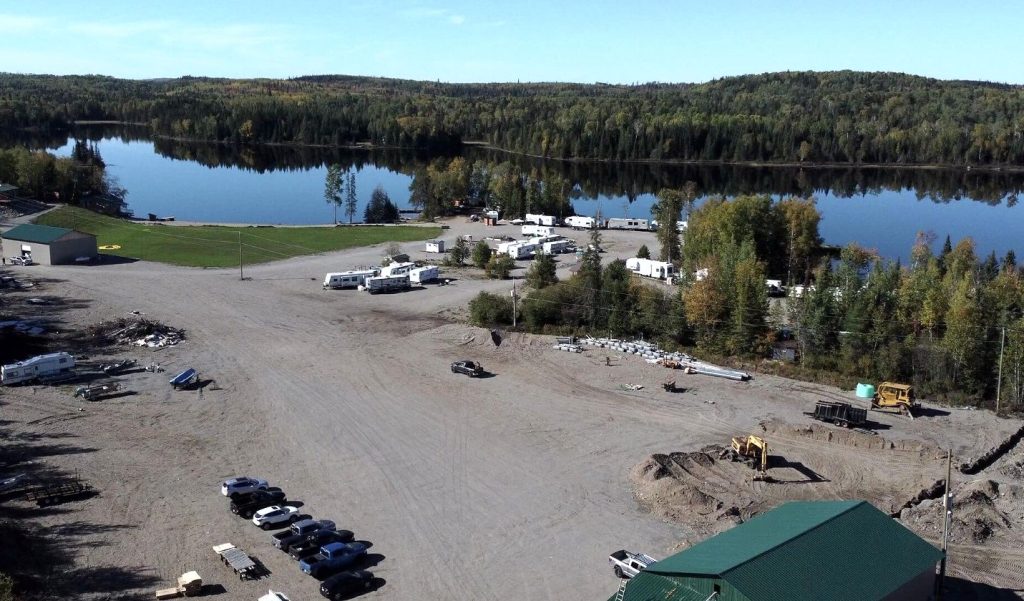
Goldshore’s current focus is the advanced stage 100%-owned Moss Gold Project with direct access from the Trans-Canada Highway, hydroelectric power near site, supportive local communities and skilled workforce. The company has invested over $75 million of new capital and completed approximately 100,000 metres of drilling on the Moss Gold Project, which, in aggregate, has had over 255,000 metres of drilling. The 2024 updated NI 43-101 mineral resource estimate (MRE) has expanded to 1.54 million ounces of Indicated gold resources at 1.23 g/t Au and 5.20 million ounces of Inferred gold resources at 1.11 g/t Au. The MRE only encompasses 3.6 km of the 35+ km mineralized trend, remains open at depth and along strike and is one of the few remaining major Canadian gold deposits positioned for development in this cycle.