
Granada Gold posts a 64% increase In Measured & Indicated Mineral Resources at Granada Gold Project, Quebec
Granada Gold Mine Inc. [TSXV: GGM; OTC: GBBFF; Frankfurt: B6D] provided an updated Mineral Resource Estimate (MRE) for its 100%-owned Granada Gold Project, a past-producing property located adjacent to the prolific Cadillac Break in the Abitibi greenstone belt near Rouyn-Noranda, Quebec, and within trucking distance of several operating gold mines and mills in northwestern Quebec.
The 2026 MRE combines in-pit (open-pit-constrained) and underground Mineral Resources. It re-evaluates the independent SGS Canada Inc. block model that supported the Company’s 2022 estimate, applying updated economic parameters, principally the current gold price, revised cut-off grades, and updated processing and site assumptions, to reflect today’s gold price environment.
Highlights: Measured and Indicated in-pit and underground Mineral Resources of 890,600 ounces of gold (15,982,000 tonnes grading 1.73 g/t Au), a 64% increase over the 2022 estimate of 543,000 ounces (8,220,000 tonnes at 2.05 g/t Au).
Inferred in-pit and underground Mineral Resources of 865,500 ounces of gold (20,096,000 tonnes grading 1.34 g/t Au), a 90% increase over the 2022 estimate of 456,000 ounces (3,010,000 tonnes at 4.71 g/t Au).
The increase is driven primarily by the substantial rise in the gold price since the 2022 estimate, which supports lower economic cut-off grades (0.25 g/t Au in-pit and 1.4 g/t Au underground, versus 0.55 g/t and 2.5 g/t in 2022), together with updated cost and processing assumptions.
The deposit remains open along strike and at depth. Mineral Resources have been delineated over approximately 2 km of an estimated 5.5 km mineralized east-west structure, and roughly 20% of the property has been explored to date.
The company intends to incorporate this estimate into a forthcoming NI 43-101 technical report.
Pit-constrained resources reported at a 0.25 g/t Au cut-off; underground resources at a 1.4 g/t Au cut-off. Measured and Indicated are reported exclusive of Inferred.
Compared with the company’s most recent Mineral Resource Estimate of record, prepared by SGS Canada Inc. (Yann Camus, P.Eng.) with an effective date of June 23, 2022, and reporting 543,000 ounces Measured and Indicated (8,220,000 tonnes at 2.05 g/t Au) and 456,000 ounces Inferred (3,010,000 tonnes at 4.71 g/t Au), the 2026 MRE represents a 64% increase in Measured and Indicated contained gold and a 90% increase in Inferred contained gold.
As expected, when a deposit is re-evaluated at a materially higher gold price, the average grade of the reported resource is lower than in 2022, because lower-grade material that was previously below the cut-off grades applied in 2022 is captured within the reported resource at the lower cut-off grades applied in 2026. The contained-ounce increase reflects the larger tonnage captured at the lower cut-off grades, consistent with how mineral resources across the sector are being re-stated in the current gold-price environment.
“This update re-evaluates the Granada deposit at current prices and reflects the work we have done to refine the geological model. Measured and indicated ounces are up 64 percent and inferred ounces up 90% against our 2022 estimate, and we have achieved that while still reporting only a fraction of the 5.5-km mineralized structure. The deposit remains open along strike and at depth, and roughly 80% of the property is still to be explored,” said Frank J. Basa, P.Eng., President and CEO.
“With the ore-sorting results we reported in April, a 2.7-times grade uplift at 88% gold recovery, and a fully permitted “Rolling Start” pathway, our focus now is on converting this larger resource into a clean, low-footprint operation that processes Granada’s gold,” Mr. Basa added.
The company holds a Certificate of Authorization issued by the Québec Ministère du Développement durable, de l’Environnement et de la Lutte contre les changements climatiques authorizing mining of 550 tonnes per day for a total of approximately 590,000 tonnes, structured as a phased “Rolling Start” bulk-sample pathway.
The independent ore-sorting program completed at the Saskatchewan Research Council demonstrated a 2.7-times gold-grade uplift at 88 percent recovery, with roughly two-thirds of the material rejected as waste before milling. The Company expects these results to enhance the economics of the Rolling Start and of the broader project, and to support on-site processing with a reduced surface and tailings footprint per ounce.
The Granada property includes the former Granada Gold underground mine, which produced more than 50,000 ounces of gold at approximately 10 g/t Au from two shafts in the 1930s before a fire destroyed the surface buildings.
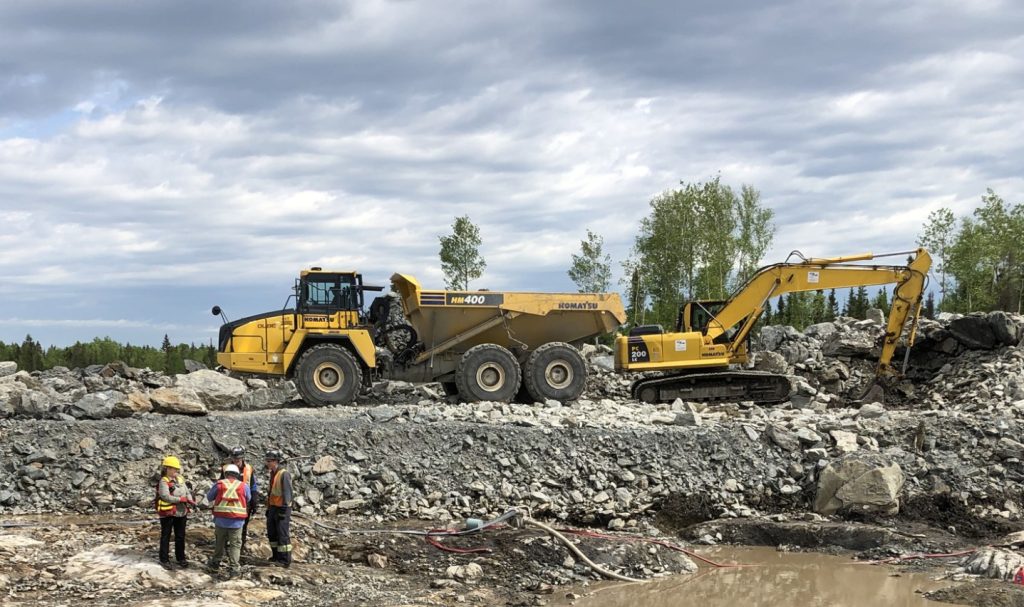
In the 1990s, bulk samples returned open-pit grades of 5.17 g/t Au (Pit #1, 87,311 tonnes) and 3.46 g/t Au (Pit #2, 22,095 tonnes). The Granada Shear Zone and South Shear Zone host up to 22 mineralized structures trending east-west over approximately 5.5 km, three of which were mined historically from four shafts and three open pits. The property remains substantially under-explored, with significant potential along strike to the east toward the historic Aukeko and Austin-Rouyn shafts and at depth to the north of the existing pit.
Granada Gold Mine continues to develop and explore its 100%-owned Granada Gold Property near Rouyn-Noranda, Quebec, and is adjacent to the prolific Cadillac Break. The company owns 14.73 km2 of land in a combination of mining leases and claims.
The company is currently advancing the Granada Gold Project through an updated mineral resource estimate and preliminary economic assessment, with drilling planned to target both lateral extensions and depth expansion of the existing mineral resource.
The Granada Shear Zone and the South Shear Zone contain, based on historical detailed mapping as well as from current and historical drilling, up to twenty-two mineralized structures trending east-west over 5.5 km. Three of these structures were mined historically from four shafts and three open pits. Historical underground grades were 8 to 10 g/t gold from two shafts down to 236 m and 498 m with open pit grades from 3.5 to 5 g/t gold.
The property includes the former Granada Gold underground mine which produced more than 50,000 ounces of gold at 10 g/t gold in the 1930’s from two shafts before a fire destroyed the surface buildings. In the 1990s, Granada Resources extracted a bulk sample (Pit #1) of 87,311 tonnes grading 5.17 g/t Au. They also extracted a bulk sample (Pit #2) of 22,095 tonnes grading 3.46 g/t Au.