
Maple Gold Mines posts multiple high-grade gold intercepts from step-out drilling at Douay/Joutel Project, Québec
Maple Gold Mines Ltd. [TSXV: MGM; OTCQX: MGMLF; FSE: M3G0] reported additional assay results from seven drill holes completed during its ongoing, fully-funded 30,000-metre winter drill campaign at its 100%-owned Douay Gold Project and Joutel Gold Project (together, Douay/Joutel Project) located along the Casa Berardi-Douay Gold Trend in Québec, Canada.
Highlights: Drill hole JO-26-11 returned two high-grade gold intervals including 17.9 g/t gold over 3.9 metres within 8.6 g/t Au over 10.4 metres and 16.9 g/t Au over 3.3 metres within 3.8 g/t Au over 17.1 metres, located approximately 50 metres above the Telbel Mine workings.
JO-26-11 gold intercepts are located approximately 50 meters below previously reported drill hole JO-25-05, which returned 8.5 g/t Au over 8.0 metres.
In the Eagle Mine area, drill hole EM-26-19 returned two intervals including 2.1 g/t Au over 12.9 metres and 1.4 g/t Au over 17.0 metres and drill hole EM-26-20 returned 1.1 g/t Au over 13.7 metres.
Current drilling at Joutel has extended high-grade gold mineralization up to 450 metres beyond the historical Eagle-Telbel underground workings and the system remains open in multiple directions.
Maiden Joutel mineral resource estimate (MRE), excluding current drilling, remains on track for delivery in H1 2026.
Including the seven holes reported today, the company has now reported drill results for a total of 14 holes (~6,800 m) out of 48 holes (~21,800 m) completed to date as part of the program, with additional drilling planned in 2026.
“These latest results continue to build confidence in the scale, continuity and grade of the gold system at Joutel,” stated Kiran Patankar, President and CEO of Maple Gold. “Multiple step-out holes in this first drilling phase have now returned thick, high-grade gold intercepts at shallow depths within the primary stratigraphic target proximal to existing underground infrastructure, highlighting the opportunity for significant near-mine resource additions. Drilling is also delivering key geological insights to validate and expand our model as we look to extend known gold mineralization beyond the historically mined-out stopes from a high-grade, past-producing gold mine complex that has seen limited modern exploration since operations ceased during a low gold price environment in 1993.”
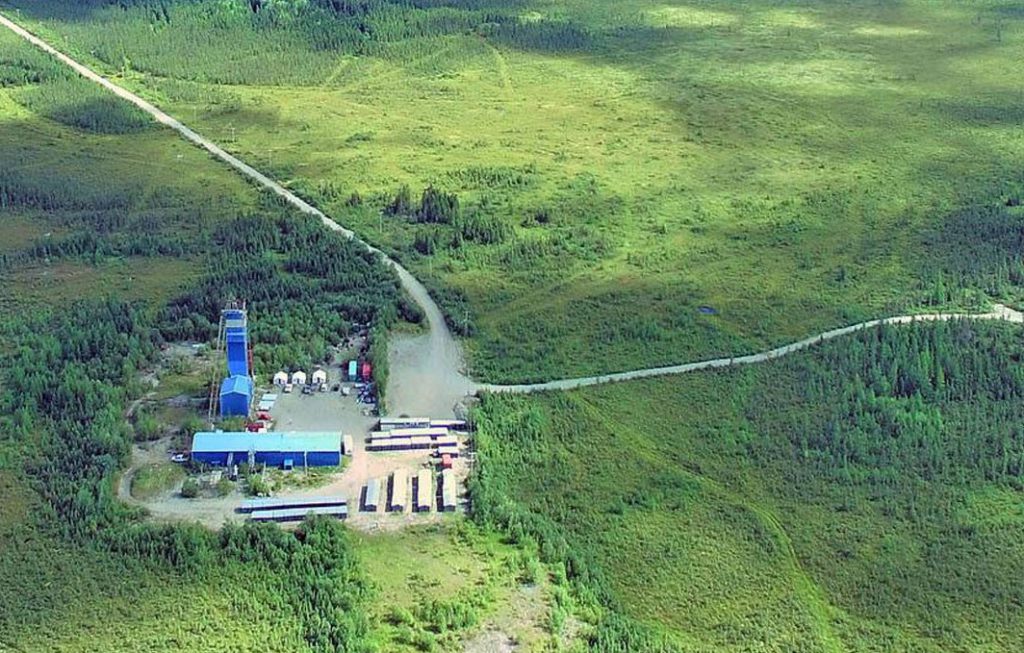
Results reported today include seven additional diamond drill holes (DDH) designed to test shallow areas with limited drilling between, and along strike from, the historical Eagle and Telbel gold mines at Joutel. These holes are part of an ongoing strategy to target interpreted zones of high-grade gold mineralization projected up-plunge and along strike from previously mined-out stopes within a geologically favourable stratigraphic host unit termed the Main Iron Carbonate Horizon (MICH). The Eagle, Eagle West and Telbel gold mines (the Joutel Mine Complex) produced 1.1 million ounces of gold at an average grade of 6.5 g/t Au from the MICH between 1974 and 1993.
The Joutel Mine Complex lies along the southern branch of the regional Casa Berardi Deformation Zone, a major gold-bearing structure in the prolific Abitibi Greenstone Belt.
Details of the seven reported drill holes are further described below.
Telbel Mine area: Four drill holes were completed over a 450-metre strike length (250 m northwest and 200 m southeast of the Telbel Mine shaft) to target the interpreted up-plunge projections of high-grade mineralization into shallower areas of the Telbel Mine with limited drilling.
Drill holes JO-25-08, JO-25-09, and JO-25-10 tested the area northwest of the Telbel Mine, while drill hole JO-26-11 was designed to follow-up 50 m below drill hole JO-25-05 which returned 8.5 g/t Au over 8.0 metres within the MICH horizon, approximately 100 m above the Telbel Mine workings. The results from drill hole JO-26-11 were very encouraging with two zones of sulphide-rich hydrothermal breccia overlying semi-massive pyrite beds with highlights noted: 8.6 g/t Au over 10.4 metres, in DDH JO-26-11, including 17.9 g/t Au over 3.9 metres, and including 25.4 g/t Au over 1.2 metres, and 3.8 g/t Au over 17.1 metres, in DDH JO-26-11, including 16.9 g/t Au over 3.3 metres, including 34.3 g/t Au over 0.5 metres.
The three drill holes, JO-25-08, JO-25-09 and JO-25-10, drilled northwest of the Telbel mine shaft, all intersected the MICH horizon at varying depths and returned 4.1 g/t Au over 3.0 metres, in DDH JO-25-09, including 10.8 g/t Au over 1.0 metre, including 2.9 g/t Au over 3.3 metres, in DDH JO-25-10, including 7.7 g/t Au over 1.2 metres and 1.0 g/t Au over 3.4 metres, in DDH JO-25-08, including 2.1 g/t Au over 0.9 metres.
Eagle Mine area: Three drill holes targeted near-mine extensions immediately northwest of the Eagle mine underground workings in an area of limited drilling. The first hole, EM-25-18, deviated and intersected the underground workings and was abandoned. Two follow-up drill holes, EM-26-19 and EM-26-20, successfully hit the MICH horizon 50 m beyond the mined-out stopes and returned 2.1 g/t Au over 12.9 metres, in DDH EM-26-19, including 4.3 g/t Au over 2.3 metres, and 1.4 g/t Au over 17.0 metres, in DDH EM-26-19, including 2.8 g/t Au over 4.5 metres and 1.1 g/t Au over 13.7 metres, in DDH EM-26-20, including 3.3 g/t Au over 1.7 metres.
Key findings of the Company’s Joutel drilling to date include the successful demonstration that the known MICH-hosted gold mineralization extends well beyond the historic Eagle-Telbel mine underground workings.
Gold mineralization is associated with a zone of hydrothermal breccia hosted by felsic tuff underlain by the MICH and then well bedded, semi-massive pyrite mineralization.
Anomalous gold is present locally within the hanging wall felsic tuff sequence and a continuous microgabbro intrusive within the footwall sequence often carries gold grades > 1 g/t Au.
Four of the drill holes (JO-25-01, JO-25-05, JO-25-07 and JO-26-11) have returned seven individual assays greater than 20.0 g/t Au with a high of 40.8 g/t Au over 0.5 metres in drill hole JO-25-05 and the first occurrence of visible gold in this program in drill hole JO-25-01 (25.4 g/t Au over 1.5 m).
The strength and continuity of the gold mineralization at Joutel is very encouraging and the system remains open in multiple directions with strong potential for expansion through follow-up drilling.
The company has completed 19 drill holes to date at Joutel totaling ~9,700 metres of the approved 10,000-metre Joutel program. Assays have now been reported for 14 drill holes.
2026 Winter Program Update: The company has completed 48 drill holes totaling ~21,800 metres as part of its ongoing 30,000-m Douay/Joutel Program, with approximately 73% of the program now complete. At Douay, drilling has focused on testing of the down-plunge extensions of the higher-grade Nika, 531, Douay West, and Porphyry West Zones. At Joutel, drilling is following-up on encouraging results from drill holes JO-25-01, JO-25-05, JO-25-06 and JO-25-07 with 50-m-spaced step-out drill holes. Additional assay results will be reported as they are received, following QA/QC validation.
Concurrent development initiatives are anticipated throughout 2026 to advance and de-risk the Douay and Joutel Gold Projects, including an updated Douay MRE and an initial Joutel MRE expected in H1 2026 as well as an internal scoping/engineering study.
The company has also approved an inaugural 2,000-metre diamond drill program at its Morris VMS Project, east of Matagami, Quebec, expected to be completed in H1 2026, to evaluate prospective stratigraphy known to host the Matagami VMS deposits and mines.
A total exploration budget of $13.9 million has been approved for 2026, including permitting, 32,000 metres of diamond drilling, regional sonic drilling, assaying, personnel, camp, and site support costs. This work will be fully funded from Maple Gold’s existing $30 million treasury. Planning for expanded 2026 and 2027 exploration programs is currently underway.
The Douay/Joutel Gold Project is located adjacent to Highway 109 in the heart of Québec’s Abitibi greenstone belt, Canada’s premier gold mining jurisdiction. This large, 100%-owned land package includes the company’s flagship Douay Gold Project, which hosts an established mineral resource2containing 511,000 oz gold (Indicated) and 2.53 million oz gold (Inferred), as well as the past-producing, high-grade Joutel Mine Complex.
The property contains ~481 km2 of highly prospective geology within the influence of the major gold-bearing Casa Berardi Deformation Zone. Gold mines in the immediate region include the Casa Berardi Gold Mine, recently acquired by Orezone Gold Corporation from Hecla Mining Company, and the Detour Lake Gold Mine operated by Agnico Eagle Mines Limited.
Maple Gold Mines is focused on advancing its 100%-owned, district-scale Douay/Joutel Gold Project located in Québec’s prolific Abitibi Greenstone Gold Belt. Douay/Joutel benefits from exceptional infrastructure access and boasts ~481 km2 of highly prospective ground including an established gold mineral resource at Douay with significant expansion potential as well as the past-producing Telbel and Eagle West mines at Joutel.
In addition, the company holds an exclusive option to acquire 100% of the Eagle Mine Property, a key part of the historical Joutel Mining Complex.
Maple Gold’s property package also hosts a significant number of regional exploration targets along a 55-km strike length of the Casa Berardi Deformation Zone that have yet to be tested through drilling, making the property ripe for new gold and VMS discoveries.
Resource World Magazine Inc. has prepared this editorial for general information purposes only and should not be considered a solicitation to buy or sell securities in the companies discussed herein. The information provided has been derived from sources believed to be reliable but cannot be guaranteed. This editorial does not take into account the readers investment criteria, investment expertise, financial condition, or financial goals of individual recipients and other concerns such as jurisdictional and/or legal restrictions that may exist for certain persons. Recipients should rely on their own due diligence and seek their own professional advice before investing.