
Prospector Metals drills new discovery at ML Project, Yukon
Prospector Metals Corp. [TSXV: PPP; OTCQB: PMCOF; FSE: 1ET] reported final assay results for drill hole ML25-31. This hole was drilled in the North Vein region of the ML Project, Yukon Territory, and is the first ever hole in this area designed to test for multiple stacked or parallel gold-bearing structures co-incident with favourable surface geochemistry, LiDAR and World View datasets.
The hole discovered a previously unknown high-grade gold and copper zone, now known as the TESS Zone, from 62 – 106m downhole. The hole also intersected the historic North Vein zone from 138-145.36 metres.
Rob Carpenter, Ph.D., PGeo., President, CEO and Co-Chairman of Prospector, stated: “This discovery represents an exciting new style of gold mineralization for the ML Project. The high-grade and near surface intercept occurs within a distinct zone that is coincident with a diagnostic surface geochemical signature. Our team has successfully traced this trend on surface for at least 500m. Moreover, analyses of project wide datasets reveal the presence of numerous similar structural features that have not previously been drill tested.”
Jodie Gibson P.Geo., Vice President of Exploration, added “The high grade gold and copper mineralization on the Tess is a new and very unique style of reduced intrusion related gold mineralization (RIRGS) and demonstrates the potential for very high-grade mineralization on the margins of these systems outside of ‘typical’ intrusive host rocks. At ML, our exploration to date, combined with assessment of historic data, indicate multiple target areas with a similar geologic, structural, and geochemical setting as the Tess-North Vein area.”
Drill hole ML25-31 represents the first ever hole in the newly identified TESS Zone. Results include a wide 44-metre intercept averaging 13.79 g/t Au, 1.84% Cu. and 38.08 g/t Ag starting at 62 metres downhole. This interval includes a higher-grade intercept of 21.94 g/t Au over 24.65 metres starting at 81.35 metres downhole. Mineralization rema”ns open at depth and along trend.
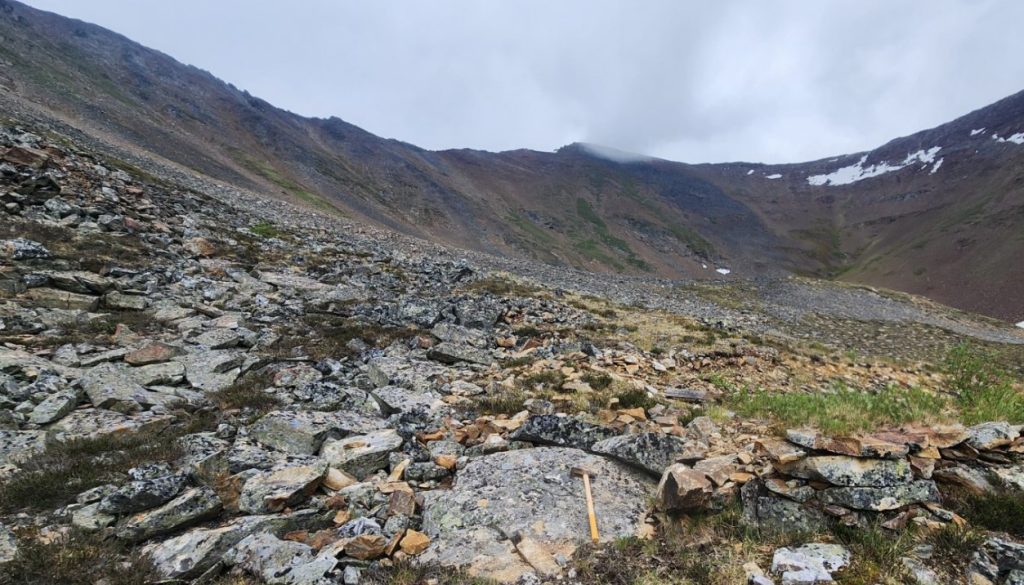
The Tess Zone is a “blind discovery” due to the presence of a thin layer of erratic talus above the surface projection of mineralization. However, geological mapping and prospecting in early 2025 revealed a regionally significant footprint worthy of drill follow up. Drill hole ML25-31 was subsequently drilled to test an interpreted structural zone defined by geological mapping, prospecting as well as satellite imagery. The resultant discovery represents the widest intercept of high-grade gold drilled to date on the ML Project.
Follow up mapping and prospecting after hole ML25-31 was drilled subsequently identified numerous altered and mineralized surface occurrences along the projected trace of several mineralized corridors, suggesting the exploration potential for additional TESS Zone discoveries remains very high.
Significant values of Copper (Cu), Silver (Ag), Bismuth (Bi), and Tellerium (Te) accompany high-grade gold at the TESS Zone; including values up to 11.7% Cu, 283 g/t Ag, 0.98% Bi, and 246 ppm Te. The gold values are strongly correlated with Bi and Te.
High-grade gold mineralization at the TESS Zone is associated with abundant coarse-grained Bi-Te minerals and local fine grained visible gold at the base of an up to 50m zone of strong sulfide mineralization with disseminated to massive arsenopyrite-chalcopyrite-pyrite-pyrrhotite within calc-silicate to vuggy, silicified and clay altered clastic sedimentary units.
ML25-031 was drilled at a 160o azimuth and -60o dip and was designed to test an interpreted NE trending structural zone defined by geological mapping, prospecting, and satellite imagery that was coincident with the strongest mineralization intercepted in historic North Vein drilling. ML25-031 intercepted a new zone (Tess Zone) of strong sulfide mineralization with disseminated to massive arsenopyrite-chalcopyrite-pyrite-pyrrhotite within calc-silicate to vuggy, silicified and clay altered rocks from 54-106 metres depth, with multiple instances of visible gold (VG) from approximately 104-105 metres depth. This is the first occurrence of VG ever noted on the ML property, and the visible gold mineralization is associated with abundant coarse-grained Bi-Te minerals.
Assays for the zone returned 44 metres of 13.79 g/t Au, 1.84% Cu, and 38.08 g/t Ag from 62 metres depth and include an upper zone of 14 metres of 4.60 g/t Au, 3.76% Cu, and 74.23 g/t Ag from 62 metres associated with semi-massive to massive pyrite-arsenopyrite-chalcopyrite mineralization within strong calc-silicate to silicified rocks with, local, zones of pervasive clay alteration.
The lower zone returned 24.65 metres of 21.93 g/t Au, 1.14% Cu, and 25.58 g/t Ag, and includes 10 samples >10 g/t Au (up to 379 g/t Au). The mineralization is associated with a strongly calc-silicate altered unit with disseminated arsenopyrite-chalcopyrite-pyrrhotite-BiTe minerals, and, locally, visible gold with abundant cross-cutting, black, sulfidic fractures.
In general, the gold grade increases down the hole returning 13 metres of 37.88 g/t Au from 92 metres depth; including the interval with VG from 104-105m which averaged 288 g/t Au over 1 metre.
The historic North Vein occurrence was also intercepted from 138-145.36 metres depth in ML25-031 and consisted of disseminated to semi-massive arsenopyrite-chalcopyrite mineralization within a silicified to calc-silicate altered quartz grit unit.
The zone returned 7.38 metres of 5.69 g/t Au, 1.16% Cu, & 22.21 g/t Ag from 138 metres depth; including 1 metre of 10 g/t Au, 2.02% Cu, and 44.2 g/t Ag from 138 metres and 1.36 metres of 21.3 g/t Au, 2.48% Cu, and 44.5 g/t Ag from 144 metres. Based on available data and the current interpretation of the Tess and North Vein the reported intervals are 70-75% true thickness.
ML25-032 was drilled as an over-cut to ML25-031 at a -50o. The hole intersected the Tess Zone at approximately 38m depth and it consists of an approximately 50m zone of strong alteration and fracturing as ML25-031, but the zone is more significantly oxidized and bleached due to proximity to surface. Assays for ML25-032 are currently pending; however, the alteration and mineralization in the two holes indicate the Tess Zone is steeply dipping, subparallel to the North Vein, and is open at depth and along strike.
The Tess Zone occurs north of the historic North Vein occurrence and would not have been tested by historic drilling. At surface the Tess Zone is obscured by a thin layer of talus and is a blind discovery; however, subsequent mapping and prospecting has traced both the Tess and North Vein trends approximately 500 metres, uphill, to the ENE. Both zones are pervasively oxidized at surface and appear to have a strong association with jarosite alteration. This is significant because there are multiple, un/under explored, zones of jarosite alteration associated with interpreted ENE oriented structures within the broader Java-Tess-North Vein area based on LiDAR and satellite imagery and indicates strong potential for additional discoveries.
The 2025 ML drill program on the ML Property has been completed and includes 39 holes over 6648.91 m, testing seven target areas. The program was completed on budget, finishing 1648.91m higher then the originally planned 5,000 program. To date, assays have been received for 12 of the 39 holes and include hole ML25-31 discussed above as well as previously released results on the Skarn Ridge, Bueno, Rubble, and Java target areas (1). Analysis results for individual samples received to date range from trace to 379 g/t Au, from trace to 283 g/t Ag, and from trace to 11.70% Cu.
The 100% owned ML Project is a reduced intrusion related gold system (RIRGS) located in the Tombstone Gold Belt in the Yukon Territory approximately 25km northeast of the former Brewery Creek Mine. The property consists of a contiguous land package covering approximately 10,869 hectares encompassing at least four Tombstone age intrusions and associated dikes and sills.
Multiple high-grade occurrences are known on the project within a variety of geological environments including intrusion-hosted Au-Cu within sheeted veins-breccias; structurally controlled and disseminated Au-Cu within calc-silicate altered calcareous to clastic sedimentary units and mafic sills; high-grade vein hosted Au; and vein hosted Ag-Pb-Zn. Gold mineralization on ML has a distinct As-Bi-Te +/-W association and there is strong evidence for multiple mineralizing events across the property.
Prospector Metals Corp. is a member of Discovery Group. The company is focused on district scale, early-stage exploration of gold and base metal prospects. Prospector establishes and maintains relationships with local and Indigenous rightsholders and seeks to develop partnerships and agreements that are mutually beneficial to all interested parties.