
Puma Exploration exploring Williams Brook Project, New Brunswick
Puma Exploration Inc. [TSXV: PUMA; OTCQB: PUMXF] reported that its ongoing 100% funded 2025 drilling program at its Williams Brook Project in Northern New Brunswick resumed this week and that hole WB25-181 intersected multiple grains of visible gold (VG) at 355 metres downhole depth at the Lynx Gold Zone. The mineralization observed represents the deepest visible gold occurrence drilled to date at Williams Brook, potentially extending the known gold mineralization approximately 100 metres along the favourable contact to a vertical depth of about 250 metres.
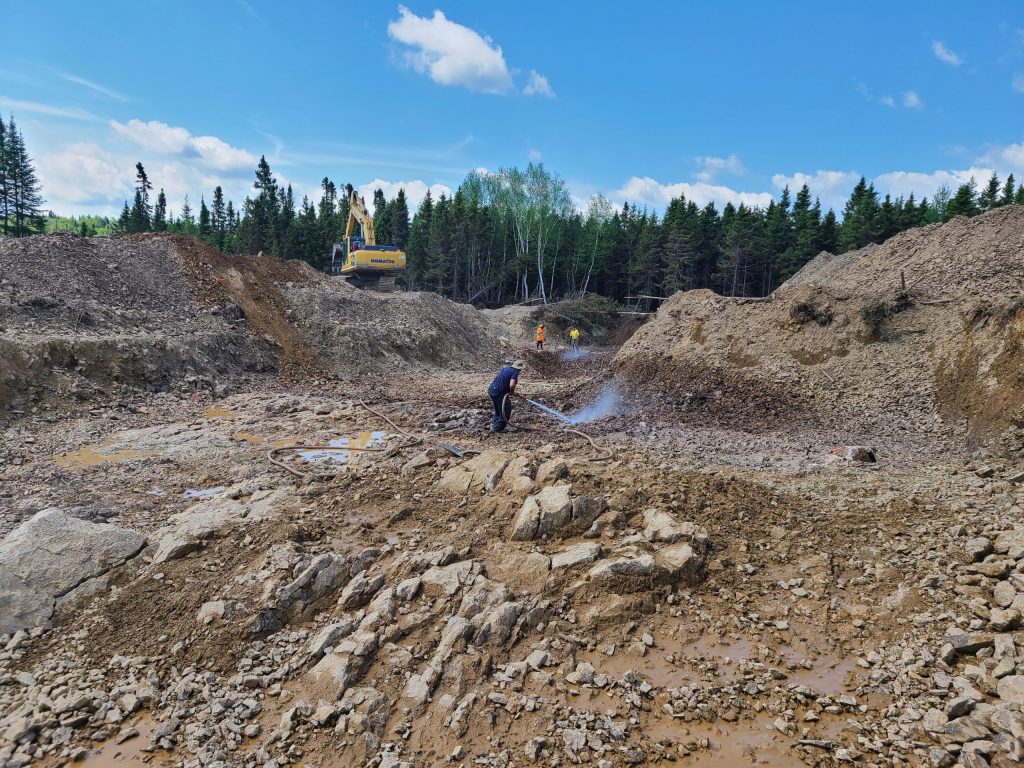
Channelling at Lynx, as well as surface exploration work on the entirety of the property, was also completed. Assay results from drilling and exploration work are pending and will be announced when received.
Ongoing drilling program highlights: Six holes completed for a total of 1,343 metres. Visible gold (VG) observed in hole WB25-181 at 355 metres downhole depth. Drilling successfully intersected fresh rock beneath the oxide zone, confirming continuity of the targeted mineralized horizon.
Quartz-carbonate veins with traces of pyrite, sphalerite, chalcopyrite and galena intersected in multiple holes. Fully funded $2M exploration program in collaboration with Kinross Gold is ongoing.
Drilling Program at Lynx Gold Zone: Six holes were completed for 1,343 metres drilled before work was interrupted by a Provincial ban on mineral exploration activities on Crown Land that came into effect on August 10, 2025, in response to increased wildfire hazard. Drilling resumed this week.
In hole WB25-181, fine to very fine VG grains were intersected in a low-angle, brecciated quartz-carbonate vein. This intersection, at a vertical depth of 250 metres, has delineated the deepest known extent of mineralization along the favourable contact to date.
Drilling targeted the hanging wall (HW), the favourable horizon, and successfully intersected fresh rock with vein sets beneath the oxide zone. In general, the mineralized contact is composed of irregular and discontinuous quartz-carbonate veins, exhibiting a stockwork texture with traces of sulphides: pyrite-sphalerite-chalcopyrite-galena.
A total of 3,500 metres of drilling is planned this year at the Lynx Gold Zone as part of the fully funded $2M exploration program devised in collaboration with Kinross Gold. The program aims to intersect new gold mineralization, delineate lithological contacts and provide more insights on structural patterns.
Channelling at Lynx: A total of 410 samples were collected to analyze and contrast the various vein systems at the Lynx Gold Zone. Assays are pending and will be announced when received.
The Joint Technical Committee is planning an upcoming 1,500-metre drilling program at the Jaguar Gold Zone (JGZ), located about 5 km northeast of the Lynx Gold Zone. Historical drilling results from 2008 at the JGZ reported 0.52 g/t Au over 55 metres, 0.68 g/t Au over 42 metres, and 0.21 g/t Au over 64 metres.
Puma’s trenching and stripping of the JGZ in 2022 returned much higher gold grades than those reported historically, with up to 34.70 g/t gold in grab samples. A total of 306 samples were collected at the JGZ with an average grade of 1.72 g/t gold. Ninety-five samples assayed above 1.00 g/t Au (31%).
The gold-enrichment zone at the JGZ currently spans 80 metres by 50 metres and remains open in all directions.
A total of 570 samples from prospecting, trenching, and excavating over the entire Williams Brook Project were collected and sent to the lab. A total of 2,265 metres of trenching was completed in specific areas, which covered priority targets defined by the technical committee. Exploration at the Jonpol/Portage properties has started.
The Williams Brook Project (40,225 ha), optioned to Kinross Gold Corp. [TSX:K; NYSE: KGC], comprises the Williams Brook, Jonpol and the Portage Properties. To earn a 65% interest in the project, Kinross will finance a minimum of $16.75 M in exploration expenditures over the next five years (including a firm commitment of $2 M with at least 5,000 metres of drilling in the first 18 months (2025-2026).
Puma has accumulated a portfolio of prospective gold landholdings strategically located close to roads and infrastructure in Northern New Brunswick, including the Williams Brook Project and the new McKenzie Gold Project. Both are located near the Rocky Brook Millstream Fault, a major regional structure formed during the Appalachian Orogeny and a significant control for gold deposition in the region. Puma’s work to date has focused on the Williams Brook property, but prospecting and surface exploration work on its other properties have confirmed their potential for significant gold mineralization.
Puma has a long history in Northern New Brunswick, having worked on regional projects for over 15 years. Puma’s successful exploration methodology, which combines traditional prospecting methods with detailed trenching and cutting-edge technologies such as Artificial Intelligence, has been instrumental in facilitating an understanding of the region’s geology and associated mineralized systems.