
Standard Uranium confirms anomalous Uranium and high-grade Rare Earths at surface on the Rocas Project, Saskatchewan
Standard Uranium Ltd. [TSXV: STND; OTCQB: STTDF; FSE: 9SU0] reported final assay results from its 2025 exploration program on the Rocas Uranium Project, Saskatchewan, currently under a three-year earn-in option agreement with Collective Metals Inc. [CSE: COMT].
The company completed a detailed mapping and sampling program across historical uranium showings and other zones of interest on the Project during the fall of 2025. Multiple areas of strong radioactivity were identified, and assay results confirmed anomalous uranium mineralization across the Project. In addition, significant Rare Earth Element (REE) mineralization was identified, with concentrations reaching high-grade Total Rare Earth Element Oxides plus Yttrium (TREO) thresholds.
Highlights: Uranium and High-Grade REE Mineralization at Surface: Significant REE mineralization grades associated with varying uranium concentrations of uranium hosted in outcrop and boulder grab samples has been confirmed across the project, including a newly identified pegmatite outcrop with assay results up to 9.83% TREO and 0.016% U₃O₈ in a grab sample. Uranium assays from outcrop and boulder grab samples range across the Project from 0.007% to 0.409% U₃O₈.
Discovery of New Radioactive Showings: Scintillometer prospecting conducted in the fall of 2025 uncovered previously undocumented radioactive occurrences across the Project in rock types favorable for uranium and REE mineralization.
Ongoing Exploration: The inaugural diamond drill program at the Project is scheduled to commence in March 2026 and will begin testing high-priority zones along the main 7.5-km magnetic low and EM conductive corridor, which coincides with gravity lows, cross-cutting structures, and several uranium and REE occurrences.
“The confirmation of high-grade Rare Earth Elements alongside uranium mineralization throughout the Rocas Project is a significant development that reveals substantial additional critical mineral value,” said Sean Hillacre, President & VP Exploration of Standard Uranium, “These assay results are highly encouraging, and we’ve integrated this data into our targeting models as we finalize preparations for the first-ever diamond drill program on the property.”
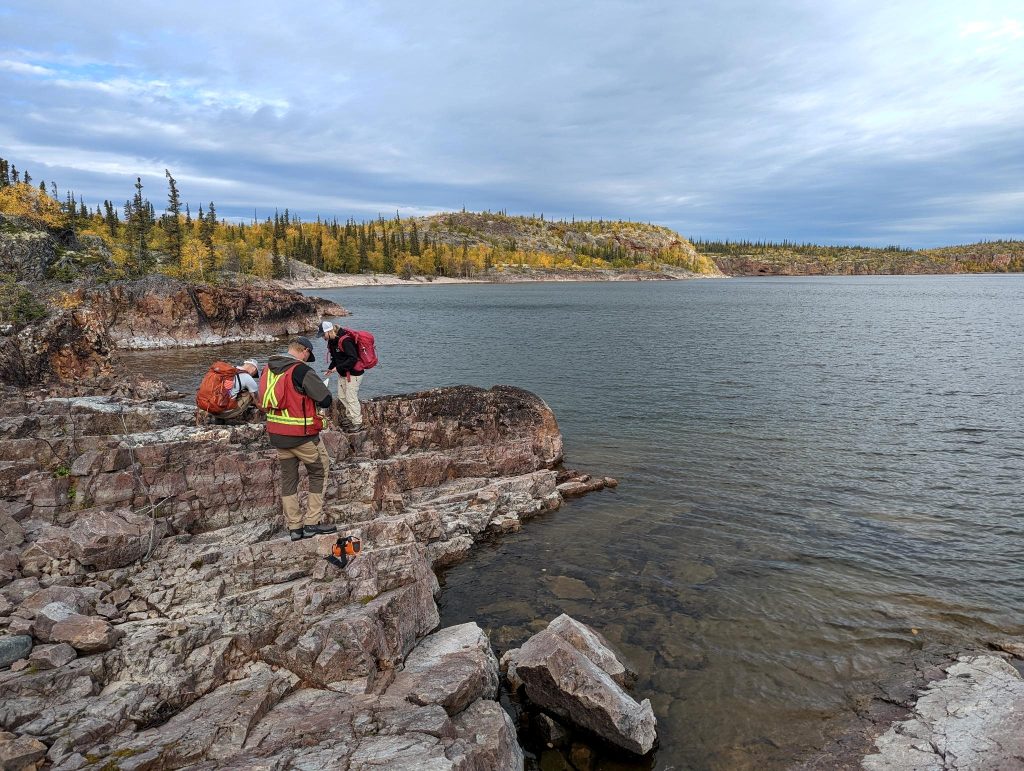
From September 30 to October 8, 2025, the Standard Uranium technical team completed a detailed mapping, prospecting, and sampling program to verify results from historical uranium showings at surface on the project. Prospecting confirmed multiple uraniferous outcrops and boulders across the Project, including areas proximal to historical showing SMDI #5781 (0.195% and 0.054% U₃O₈). Uranium concentrations of up to 0.409% U₃O₈ were obtained from outcrop exposures and boulder surface showings. In addition to discovering previously undocumented radioactive anomalies, the program confirmed significant REE mineralization on the Project in both outcrop and boulders, with several samples returning high grades exceeding 1.0% TREO.
A total of 16 outcrop and boulder grab samples were submitted to Saskatchewan Research Council Geoanalytical Laboratories (SRC) in Saskatoon, Saskatchewan – an ISO/IEC 17025:2017 and Standards Council of Canada certified analytical laboratory – for whole-rock, uranium, and REE geochemical analysis. Oxide TREO values represent the total amount of rare earth element oxides in the lanthanide series plus the chemically similar element yttrium (Y₂O₃). Parts per million (ppm) values were converted to oxide weight percent (wt.%) using the applicable conversion factor for each REE oxide and then summed.
Rocas 2026 Exploration: The company recently announced plans to complete the first ever drill program on the project in March 2026 to begin testing high-priority zones along the main 7.5 km magnetic low/EM conductive corridor, which is host to several uranium showings and has remained un-drill tested to date.
In 2025, the company contracted MWH Geo-Surveys (Canada) Ltd. to carry out a high-resolution ground gravity survey over the Rocas Project, while Convolutions Geoscience Corp. has completed subsequent processing, interpretation, and modelling of the gravity data. The ground gravity survey identified several gravity low anomalies coincident with historical surface mineralization, lakebed geochemical anomalies, and cross-cutting fault zones along the known conductive exploration trends on the Project. Gravity lows in this geological setting are often associated with reduced rock density which may indicate alteration zones associated with uranium.
Airborne EM surveys conducted in 2017 defined conductive trends on the Project west of and sub-parallel to the Key Lake Road shear zone, corresponding with favourable metasedimentary basement lithologies. Multiple parallel conductors indicate structural widening of the trend, and offsets and termination points indicate important subsidiary cross-cutting structures. Additionally, a 2007 field sampling program identified lakebed geochemical anomalies that statistically rank as greater than 95th percentile U, Co, V, and Zn along the conductor corridor, including high U/Th ratios.
The company believes the project is prospective for the discovery of shallow, high-grade basement-hosted uranium mineralization. Positioned proximal to the margin of the Athabasca Basin, Rocas boasts shallow drill targets with bedrock under minimal glacial till cover. Historical mineralized outcrop grab samples along approximately 900 metres of strike length, returned values ranging from 587 ppm U (SN85073) up to 0.498 wt.% U3O8 (SN23901) and have never been drill tested.
Standard Uranium is a uranium exploration company and emerging project generator poised for discovery in one of the world’s premier uranium districts. The company holds interest in over 241,652 acres (97,793 hectares) in the Athabasca Basin in Saskatchewan, Canada. Since its establishment, Standard Uranium has focused on the identification, acquisition, and exploration of Athabasca-style uranium targets with a view to discovery and future development.
Standard Uranium’s Davidson River Project, in the southwest part of the Athabasca Basin, Saskatchewan, comprises 10 mineral claims over 30,737 hectares. Recent intersections of wide, structurally deformed and strongly altered shear zones provide significant confidence in the exploration model and future success is expected.
Standard Uranium’s eastern Athabasca projects comprise over 53,166 hectares of prospective land holdings. The eastern basin projects are prospective for unconformity related and/or basement hosted uranium deposits based on historical uranium occurrences, recently identified geophysical anomalies, and location along trend from several high-grade uranium discoveries.
Standard Uranium’s Sun Dog project, in the northwest part of the Athabasca Basin, Saskatchewan, is comprised of nine mineral claims over 19,603 hectares. The Sun Dog project is highly prospective for basement and unconformity hosted uranium deposits yet remains largely untested by sufficient drilling despite its location proximal to uranium discoveries in the area.