
Tectonic Metals drills 1.46 g/t Au over 26 metres within broader zone of 0.69 g/t Au over 125 metres in first 2025 drill hole at Chicken Mountain, Flat Gold Project, Alaska
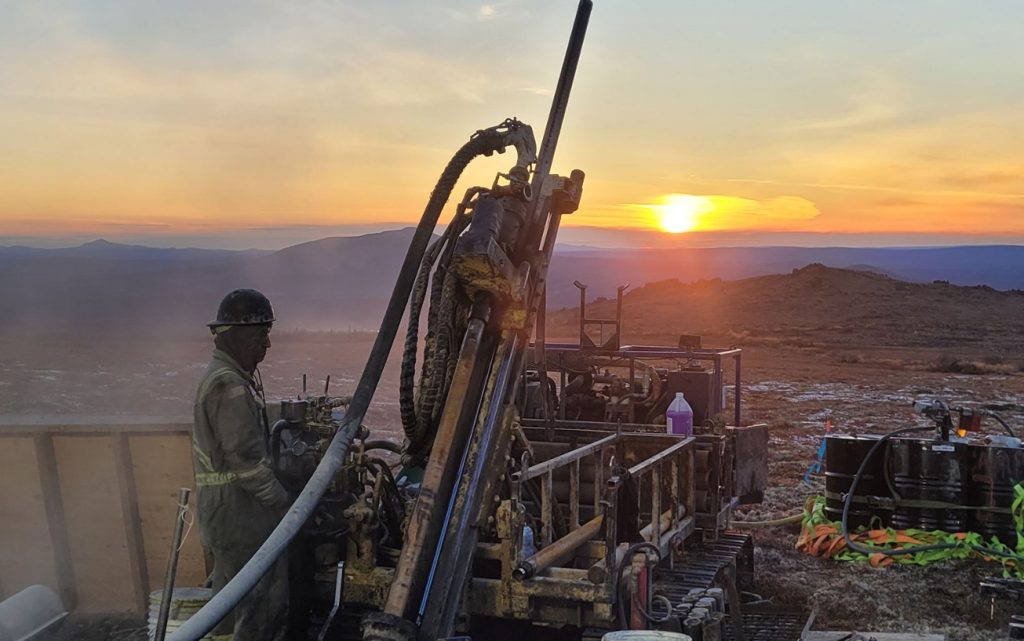
Tectonic Metals Inc. [TSXV: TECT; OTCQB: TETOF] reported the initial assay results from 10 of the 79 holes drilled during the 2025 drill campaign at Chicken Mountain – a bulk-tonnage, open-pit, heap-leachable gold opportunity and one of six km-scale intrusive centres at the company’s flagship ~99,800-acre Flat Gold Project in southwestern Alaska.
The Chicken Mountain intrusion (6.5 x 6.0 km) is the largest and most geologically understood intrusive centre at Flat and widely recognized as the primary lode source of the 1.4 million ounces of placer gold historically mined from the surrounding drainages.
To date, the 2025 drill campaign represents the largest and most comprehensive program ever completed at Flat, totaling 18,373 metres drilled across 125 holes, including 10,780 metres in 79 holes at Chicken Mountain.
The 10 drill holes reported today account for just 1,811 metres – approximately 17% of the total 2025 drilling at Chicken Mountain. Assay results from a further 114 drill holes across Chicken Mountain, Alpha Bowl, and other intrusive centres are pending and will be released as they are received, validated, and incorporated into the Company’s geological model.
The 2025 Phase One and Phase Two drilling programs were strategically designed to accelerate Chicken Mountain toward resource readiness by extending mineralization along strike and at depth, validating historical information, tightening geological and structural controls, generating two-inch coarse-crush metallurgical samples for heap-leach column testing and collecting a comprehensive dataset required for 3D resource modelling and future engineering studies.
Definition of vectors to higher grade mineralized zones will be assisted by data collected and interpreted from orientated drill core measurements, characterization of alteration assemblages, vein geometry, vein density and quantitative assessment of mineralization styles.
Tectonic also utilized reverse-circulation (RC) drilling to rapidly test for shallow, near-surface mineralization and extend mineralization across strike.
Together, these objectives underpin the project’s progression from exploration drilling toward formal resource delineation and future economic assessment.
Drilling highlight from first 10 holes: 1.46 g/t Au over 26.00 m, within 0.91 g/t Au over 52.00 m, within 0.69 g/t Au over 124.97 metres (CMD25-011); 1.10 g/t Au over 34.00 metres, within
0.79 g/t Au over 51.15 m (CMD25-014); 1.08 g/t Au over 18.29 m, within 0.83 g/t Au over 36.58 m, within 0.62 g/t Au over 59.44 m (CMR25-050; reverse circulation); 0.77 g/t Au over 24.38 m, within
0.56 g/t Au over 68.58 m; 1.97 g/t Au over 10.67 m and 12.64 g/t Au over 1.52m (CMR25-049).
Key Takeaways: 100% drill-hit success rate continues; 96 of 96 holes drilled to date and each drill hole has intersected gold mineralization; 53 of 96 holes ended in gold mineralization, mineralization remains open at depth
A bulk-tonnage, open-pit, at surface and vertically extensive gold system is in play: 3 km of mineralized strike length starting at surface; vertical extent now confirmed to >350 m, up from 325 m, and remains open in all directions.
Accelerating toward resource definition: Chicken Mountain continues to establish itself as the primary and fastest path toward a maiden resource estimation at Flat. Extensive, continuous zones of gold mineralization with emerging and clearly defined higher-grade domains; demonstrates the potential for high-margin mining starter-pits warranting targeted follow-up drilling.
Geological characteristics consistent with RIRGS Models: Alteration, geometry, and grade distribution are consistent with Reduced Intrusion-Related Gold System (RIRGS) models, including notable similarities to Kinross Gold’s Fort Knox Mine, Alaska.
Economic heap leaching processing potential – a competitive advantage: Four large-diameter metallurgical holes (PQ core) successfully drilled broad zones of gold mineralization confirming or exceeding expectations and producing high-quality coarse-crush material for two-inch crush heap leach column testing.
Drill holes intersected oxidized to partially oxidized quartz monzonite, consistent with lithologies used in prior metallurgical test work. Previously announced heap-leach column tests on ¾-inch coarse crushed mixed oxide/fresh material yielded excellent gold recoveries of 96% and 91%
For context, heap leaching is one of several gold extraction methods suitable for the mineralization at Chicken Mountain. The average grade of many heap leach mines globally is 0.51 g/t Au, and notably, Kinross Gold’s Fort Knox Mine in Alaska processes 0.30 g/t Au3 profitably.
These metallurgical tests and results support ongoing evaluation of the potential for run-of-mine (ROM) heap-leach processing, a potential catalyst for improved capital efficiency, lower operating costs, and enhanced project economics.
Tony Reda, Co-Founder, President & CEO of Tectonic Metals, commented: “These latest results both justify and motivate our ambitious exploration strategy at Chicken Mountain. Big targets merit big programs, and with over 10,000 metres of drilling at Chicken Mountain alone and assays pending from 69 holes, we are only at the very front edge of what this system can reveal.
“As more assays come in, they will refine grade, continuity, geometry and starter-pit potential – and ultimately form the foundation of Flat’s maiden resource estimate and PEA. What excites me most is that everything we are seeing points to a real opportunity for a future open-pit, heap-leach gold mine in one of Alaska’s great gold districts.”
Resource World Magazine Inc. has prepared this editorial for general information purposes only and should not be considered a solicitation to buy or sell securities in the companies discussed herein. The information provided has been derived from sources believed to be reliable but cannot be guaranteed. This editorial does not take into account the readers investment criteria, investment expertise, financial condition, or financial goals of individual recipients and other concerns such as jurisdictional and/or legal restrictions that may exist for certain persons. Recipients should rely on their own due diligence and seek their own professional advice before investing.