
Titiminas Silver samples high-grade mineralization and identifies new mineralized episodes at Madre Sierra Project, Peru
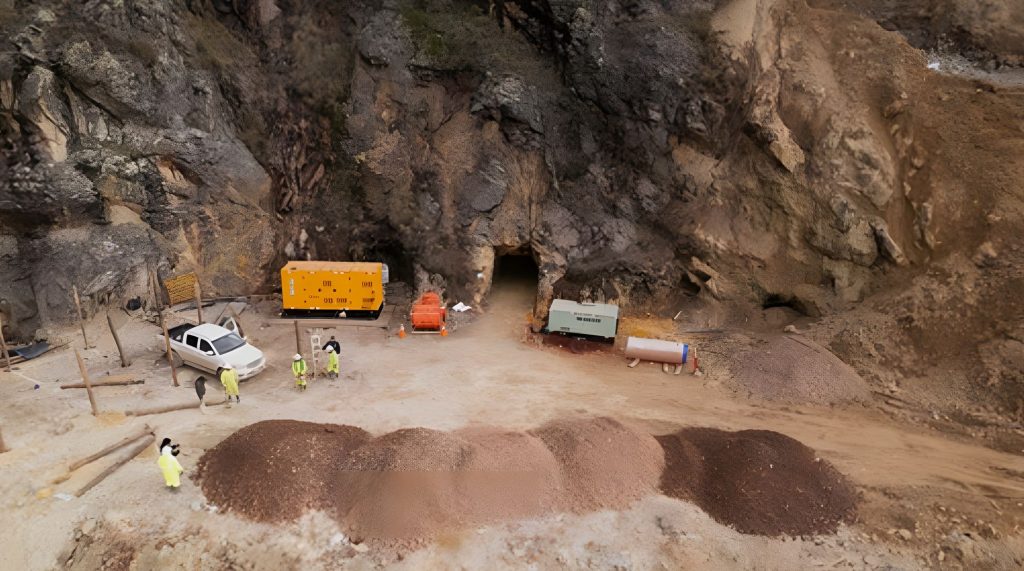
Titiminas Silver Inc. [TSXV: TITI] provided an update on its flagship Madre Sierra Project, central Peru. The company’s geological team has confirmed high-grade Ag–Pb–Zn mineralization at the past-producing Titiminas CRD, a Carbonate Replacement Deposit-style system with over 500 metres of existing underground development located within the Madre Sierra concession block.
Surface and underground channel sampling have validated the continuity and tenor of mineralization at the Titiminas CRD, which the company intends to incorporate into the planned drill program and into the design of a potential future mining operation alongside Madre Sierra.
In parallel, the company has identified a new mineralization episode immediately north of the Madre Sierra mine, herein referred to as the Madre Sierra Norte (North Zone). This newly recognized Ag–Cu–Au vein system is exposed at surface and within historical underground workings and, together with the Titiminas CRD and the Janchiscocha porphyry target to the north, defines a ~5 km contact zone with significant expansion potential and clear vectoring toward a large-scale Cu–Mo porphyry target.
Highlights: The Titiminas CRD is a past-producing high-grade mine with over 500 metres of existing underground development. The ccmpany’s geological team is reviewing historical records and, given its proximity to Madre Sierra, the Titiminas CRD will be incorporated into the planned drill program and potential future mining operation.
High-grade CRD-style mineralization confirmed: a single 8.20-metre channel-sampled trench (Trench 4633) returned 8.20 metres at 7.69 oz/t Ag, 10.18% Pb and 18.46% Zn at the Chambará limestone–dacite contact.
Madre Sierra Norte – A new Ag–Cu–Au vein system identified in the North Zone at ~4,470 metres a.s.l., with surface and underground exposure across 10 distinct structures.
Increasing thickness and grade at depth: at the lower elevation of the valley (~4,315 m a.s.l.), a 7-metre wide geological structure hosts a ~1.3 metres true thickness mineralized zone grading 0.2 g/t Au, 9.97 oz/t Ag, 5.39% Cu, 0.49% Pb, and 0.01% Zn.
High-grade underground channel samples in the Madre Sierra Norte (North Zone) vein system over two mine levels (~250 m of workings), including 0.40 metres at 73.99 oz/t Ag and 0.40 metres at 14.53% Cu; 0.40 metres at 18.92 g/t Au.
Evidence of an integrated porphyry CRD–epithermal system, comprising CRD-style mineralization at Titiminas CRD and epithermal vein systems at Madre Sierra and Madre Sierra Norte, supported by zoned alteration (potassic and propylitic) and a high-grade molybdenum association at the Janchiscocha target.
Approximately 700 metres east of the Madre Sierra veins, the company has identified a Carbonate Replacement Deposit (CRD) style system, referred to as the Titiminas CRD, developed at the contact between the Chambará limestone and the Madre Sierra dacite stock. The contact is traceable along approximately 5 km of strike, defining a major exploration corridor.
The Titiminas CRD is also a past-producing high-grade silver-lead-zinc mine with over 500 metres of existing underground development, providing direct access to the mineralized horizon at multiple elevations. The company’s geological team is currently reviewing historical mine documentation, sections, metallurgical records and underground sampling data to fully integrate this asset into its development pipeline.
Given the proximity of the Titiminas CRD to Madre Sierra and the demonstrated continuity of high-grade Ag–Pb–Zn mineralization, the company intends to incorporate the Titiminas CRD into the planned drill program and into the design of a future potential mining operation alongside Madre Sierra, materially expanding the project’s near-term production potential.
Surface widths of mineralized stratigraphy of up to ~8.2 metres. Over 500 metres of existing underground development on the past-producing Titiminas CRD at the ~4,280 metres a.s.l. level. At the 4,633-metre a.s.l. level, underground development on mineralized ore extends ~40 metres down-dip from Trench 4633.
Economic Ag–Pb–Zn grades confirmed by surface and underground channel sampling.
Trench 4633 is a single 8.20-metre long continuous channel-sampled trench representing the true thickness of one mineralized horizon at the limestone–dacite contact. Nine channel samples were collected sequentially along the trench. The length-weighted average grade across the full 8.20 metres is 7.69 oz/ton Ag, 10.18% Pb and 18.46% Zn, with peak intervals of 1.20 metres at 12.50 oz/t Ag and 1.30 metres at 30.00% Zn.
Underground channel sampling along decline 4633, which extends approximately 40 metres down-dip from Trench 4633, has confirmed the continuity of high-grade Ag–Pb–Zn CRD mineralization. Highlight samples include 0.60 metres at 14.85 oz/ton Ag, 19.55% Pb and 30.00% Zn (sample 6982), 0.80 metres at 28.55 oz/ton Ag and 30.00% Pb (sample 6986), and 1.50 metres at 15.03% Pb and 30.00% Zn (sample 6980).
A new mineralization episode has been identified in Madre Sierra Norte (North Zone), located immediately north of the Madre Sierra mine. The episode is associated with multiple Ag–Cu–Au-bearing quartz veins located at approximately 4,470 metres a.s.l., exposed both at surface and within historical underground workings.
Average vein widths are ~0.50 metres at 4,470 m a.s.l. True width increases to ~1.3 metres average at 4,315 metres a.s.l. within a 7-metre wide geological structure. Tensional vein geometries indicative of a dilatant structural setting. High silver, copper and gold content.
Surface channel samples and an ore stockpile sample from the new Ag–Cu–Au vein system include highlight intervals that include 0.45 metres at 9.29 g/t Au, 13.60 oz/ton Ag, 1.74% Cu, 9.67% Pb and 1.85% Zn (sample 40056), and an ore stockpile sample grading 40.68 oz/ton Ag (sample 40036).
Channel samples from rehabilitated workings on Levels 1 and 2 of the Madre Sierra Norte/North Zone mine notable individual samples of 0.40 metres at 73.99 oz/ton Ag (sample 500100), 0.40 metres at 14.53% Cu (sample 500115), 0.40 metres at 18.92 g/t Au with 5.25% Pb and 1.01% Zn (sample 500135) and 0.70 metres at 7.20% Pb and 18.15% Zn (sample 500157).
The work to date supports an integrated, multi-episodic mineralizing system at Madre Sierra, comprising CRD-style Ag–Pb–Zn replacement bodies at the Chambará limestone–dacite contact (distal expression); polymetallic Ag–Pb–Zn and Ag–Cu–Au veins hosted in the dacite stock (intermediate expression) and a potential Cu–Mo porphyry system at depth, vectored by potassic alteration and high-grade molybdenum at the Janchiscocha target (proximal expression).
This vertical and lateral metal zonation is consistent with classic Cordilleran polymetallic districts of central and southern Peru.
Helmut Herrera, VP of Exploration of Titiminas Silver, commented: “These results confirm what the geology has been telling us since we began systematic work on the property: Madre Sierra is a fully integrated, multi-episodic mineral system. The combination of high-grade CRD-style Ag–Pb–Zn mineralization at the limestone–dacite contact, a brand-new Ag–Cu–Au vein system in Madre Sierra Norte (North Zone), and the potassic–propylitic alteration footprint at Janchiscocha are textbook elements of a Cordilleran polymetallic district with porphyry roots.
“What is particularly compelling is the metal zonation we are now seeing across the property: silver-rich polymetallic veins (Ag–Au–Cu + Pb–Zn at Madre Sierra), quartz veins (Ag–Cu–Au at Madre Sierra Norte / North Zone), the carbonate contact (Ag–Zn–Pb at Titiminas CRD), and the hydrothermal alteration evidence (potassic and propylitic) indicate the location of a Cu–Mo porphyry target at depth. In my experience exploring porphyry and epithermal cordilleran systems in Peru and Chile, this is exactly the architecture you want to see when vectoring toward a large-scale Cu–Mo discovery at depth.
“With a ~5 km contact zone now defined, we have a multi-target pipeline that will support a robust resource delineation drill program and create meaningful news flow for shareholders over the coming quarters.”
Titiminas Silver is a Peru-focused silver developer advancing the high-grade, past-producing Madre Sierra mine in the Ricran District, Jauja Province, Region of Junin, central Peru.
The company is pursuing a phased development strategy designed to fast-track production at Madre Sierra under Peru’s small-mining regime, while concurrently evaluating expansion potential and pursuing strategic acquisitions to build a multi-asset, mid-tier silver producer in one of the world’s most prolific mining jurisdictions.