
Trifecta Gold drills 39.97 metres of 0.28 g/t gold at Rye Project, Yukon
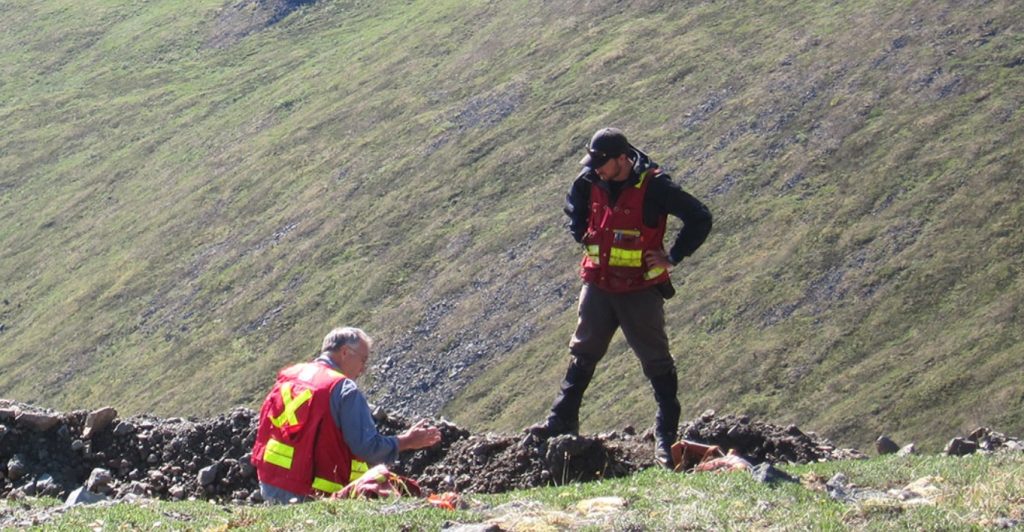
Trifecta Gold Ltd. [TSXV: TG; OTCQB: TRRFF] has received results from its 2026 drill campaign at the Rye Project, one of 11 wholly owned Tombstone Gold belt targets where the company is exploring for reduced intrusion-related gold systems (RIRGS) in a belt that includes current and former producers and major new discoveries such as Snowline Gold’s Valley deposit. Rye is situated 14 km from the North Canol Road in the eastern portion of Yukon Territory’s Tombstone gold belt.
The 2026 program tested the Itsi zone sheeted vein swarm and the Empire fault, a greater-than-one-kilometre-long, north-trending structure with outcropping, vein-hosted tin-silver mineralization. The company completed 1,852 metres in six holes, with highlights detailed below.
Drill hole RY-26-07 returned 25.73 metres at 0.10 g/t gold, 17.4 g/t silver, 0.21% copper, 101 ppm bismuth and 0.05 ppm tellurium as well as 39.97 metres at 0.28 g/t gold, 7.4 g/t silver, 0.08% copper, 236 ppm bismuth and 1.01 ppm tellurium, including 19.93 metres at 0.39 g/t gold, 6.4 g/t silver, 0.07% copper, 317 ppm bismuth and 1.45 ppm tellurium.
RY-26-08 returned 2.23 metres at <0.005 g/t gold, 32.8 g/t silver, 0.01% copper, 0.4 ppm bismuth and 0.03 ppm tellurium. RY-26-11 returned 1.02 metres at 0.19 g/t gold, 7.8 g/t silver, 0.12% copper, 192 ppm bismuth and 1.61 ppm tellurium and 7.39 metres at 0.03 g/t gold, 1.9 g/t silver, 0.01% copper, 15 ppm bismuth and 0.48 ppm tellurium.
“Our systematic exploration process is designed to identify attractive targets and test them for scale in a capital-efficient manner; we will now shift our focus to other exciting prospects within our recently acquired portfolio,” stated Richard Drechsler, president and CEO.
RY-26-07 was collared 300 metres north of RY-25-01 and was directed toward the Itsi zone and the Empire fault but deviated from its planned path and did not reach the fault. It cut a copper-silver zone from 165.19 metres to 190.92 metres and a broader gold zone from 256.03 metres to 296.00 metres, in which every sample returned 0.1 gram per tonne gold or more. The gold zone is associated with elevated bismuth (236 parts per million average) and tellurium (1.01 parts per million average), representing the same gold-bismuth-tellurium association identified in hole RY-25-01.
RY-26-08, RY-26-09 and RY-26-11 tested the Empire fault. RY-26-08 and RY-26-09 were collared 140 metre snortheast of hole RY-25-04, which bottomed in 1.97 metres grading 1,465 g/t silver, 0.22% copper and 0.97% WO3 (tungsten trioxide). RY-26-08 successfully reached the fault, intersecting a zone of intensely broken rock and gouge; however, due to drilling difficulties, it failed to cut fully through it. The last two samples from this hole returned 24.7 g/t and 39.3 g/t silver. RY-26-09 was drilled downdip and did not intersect the target structure nor return any significant results. RY-26-11 successfully drilled through the fault zone, which at this location is approximately 15 metres wide. It cut a 1.02-metre sulphide-rich interval carrying 0.19 g/t gold, 192 parts per million bismuth, 1.61 ppm tellurium and 0.12% copper, immediately followed by 7.39 metres averaging 143 ppm antimony and 202 ppm lead.
Holes RY-26-10 and RY-26-12 returned no significant results.
Extending more than 1,000 km from the Fairbanks district in Alaska eastward across the entire width of Yukon, the Tombstone gold belt hosts many large reduced intrusion-related gold system (RIRGS) mines such as Fort Knox in Alaska (greater than 10 million ounces), Eagle and Olive in Yukon (greater than four million ounces), and the past-producing Brewery Creek mine, also in Yukon.
Since May, 2020, over 20 million additional ounces of gold have been discovered in the Yukon portion of the belt, including Snowline Gold’s Tier 1 Valley discovery, Sitka Gold’s RC deposit, Banyan Gold’s AurMac deposits and Victoria Gold’s Raven deposit.
Tombstone gold belt systems are characterized by sheeted, auriferous quartz veins forming in the carapace zones of Cretaceous-age plutons. They have a characteristic geochemical signature with a gold-bismuth-tellurium-plus-or-minus-tungsten core within a broader gold-arsenic halo. The deposits are found within and surrounding the reduced intrusions and typically exhibit a geophysical signature comprising a magnetic low (that is, reduced) coinciding with a conductivity low. Veining in RIRGS is typically zoned with a core of sheeted veins surrounded by more discrete gold-arsenic veins and more distal silver-lead-zinc veins.
Trifecta is dedicated to increasing shareholder value through the discovery and development of 100-held gold projects in mining-friendly jurisdictions. Trifecta holds a 100% interest in Mount Hinton and 10 other highly prospective, intrusion-related gold projects located in Yukon’s Tombstone gold belt, where over 20 million ounces of gold have been discovered since May, 2020. The company’s Eureka project hosts an eight-km-by-2.5-km belt of surface showings and anomalous gold-in-soil that straddle the headwaters of two of the most productive placer creeks in Yukon’s southern Klondike goldfields.
Trifecta’s Treble project covers a large hydrothermal system, located midway between Western Copper and Gold Corp.’s Casino deposit, the largest copper and gold deposit in Yukon, and Rockhaven Resources Ltd.’s Klaza deposit, a high-grade gold-silver deposit. The company’s Yuge (Pearl gold) project, located in northern Nevada, is under option to Nortec Minerals.