
Wolfden Resources posts Mineral Resources Estimate for Canoe Landing Project, New Brunswick
Wolfden Resources Corp. [TSXV: WLF] reported that it has completed a maiden mineral resource estimate (MRE) for its 100%-owned Canoe Landing polymetallic massive sulphide (VMS) deposit, located in the Bathurst Mining Camp of New Brunswick where the current potential precious metal value accounts for more than 50% of the total in-situ value and represents one of the largest un-developed polymetallic mineral deposits in the camp.
As of February 15, 2026, the Canoe Landing mineral resources were Indicated resources of 3,693,000 tonnes grading 0.52% copper, 0.57% lead, 1.71% zinc, 32.87 g/t silver and 1.04 g/t gold. Inferred resources were 17,133,000 tonnes grading 0.53% copper, 0.61% lead, 1.83% zinc, 33.73 g/t silver and 0.95 g/t gold.
The Mineral Resources in this report were estimated using CIM Standards on Mineral Resources and Reserves, Definitions (2014) and Best Practices Guidelines (2019) prepared by the CIM Standing Committee on Reserve Definitions and adopted by the CIM Council.
The Mineral Resource Estimate was based on 3-year trailing average metal prices of $2,714/oz Gold, $22.59 /oz Silver, $1.33 /lb Zinc, $0.98 /lb Lead, $4.18 /lb Copper and an exchange rate of 1.36.
The estimate accounts for the following metals recovered and payable respectively; Gold 35%, 95%; Silver 53%, 95%; Zinc 85%, 75%; Lead 63%, 75%; Copper 85%, 75%.
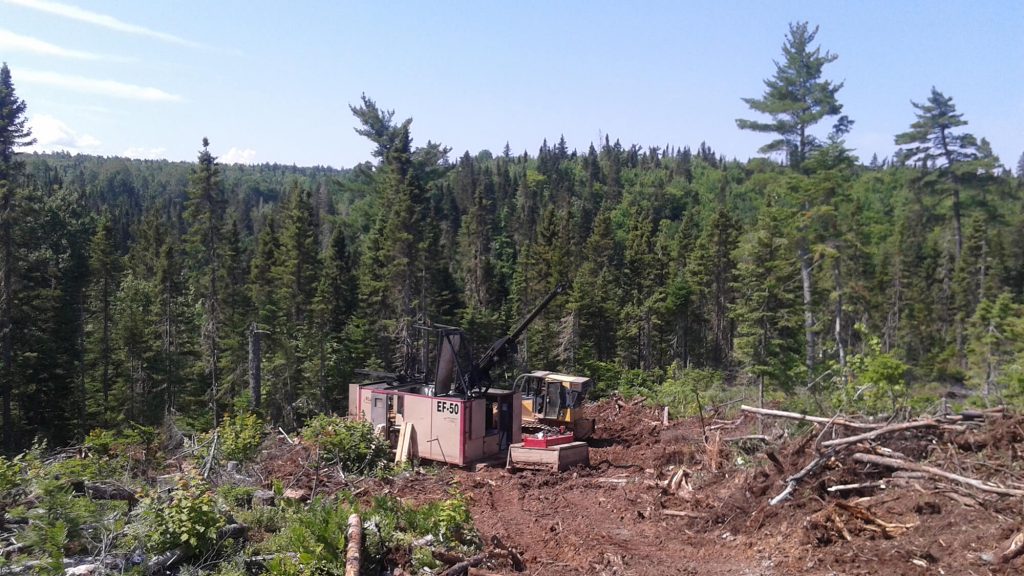
The resource estimate utilized 70 drill hole intersections that span a strike length of approximately 1 km and down to a depth 850 metres with an average true thickness of 7 metres. Indicated resources are estimated from 0 to 30 metres from a drill hole intercepts and Inferred resources from 30 to 150 metres.
The deposit remains open at depth and in part along strike where expansion and infill diamond drilling has the potential to further upgrade and expand the mineral resource.
“We are very pleased this initial mineral resource estimate and particularly the tenor of the precious metal grades and that the deposit remains open at depth and in part along strike,” stated Ron Little, Wolfden CEO. “The project already enjoys the benefit of its size and location close to existing infrastructure and industrial sites, in one of the most supportive and experienced mining jurisdictions in North America. In addition, metallurgical work is underway with the Research and Productivity Council of New Brunswick (RPC), on a program to increase both base metal and precious metal recoveries using a complimentary metallurgical approach. Our goal is to determine if the project has the potential to be more economically robust if processing recoveries can be improved at a reasonable cost.”
The program at RPC is testing a typical sequential flotation circuit resulting in four concentrates: copper, lead, zinc, and pyrite. The pyrite concentrate, which contains a majority of the gold, will be exposed to bio-oxidation, a process that can break down the pyrite and allow the gold grains to be recovered by subsequent cyanide leaching.
If positive, this could significantly increase the gold and silver recoveries from the deposit. In addition, and as cost/recovery comparison, the pyrite concentrate will also be subjected to roasting and pressure oxidation tests as alternative processing paths to improve the precious metal recoveries. Results from the test work are expected during Q2 2026.
Given Wolfden’s interest in testing the functionality of bio-oxidation, the company has gained the support, and a small financial grant, from a well-regarded group that is focused on Genomics research that includes leading scientific experts and access to capital investment.