
Arizona Gold targets high-grade antimony at Nevada project
Arizona Gold & Silver Inc. [AZS-TSXV, AZASF-OTCQB] has launched a 27-hole reverse circulation drill program at its Silverton gold-antimony project in Nye County, Nevada. The project is located along U.S. Highway 6 between Tonopah and Ely.
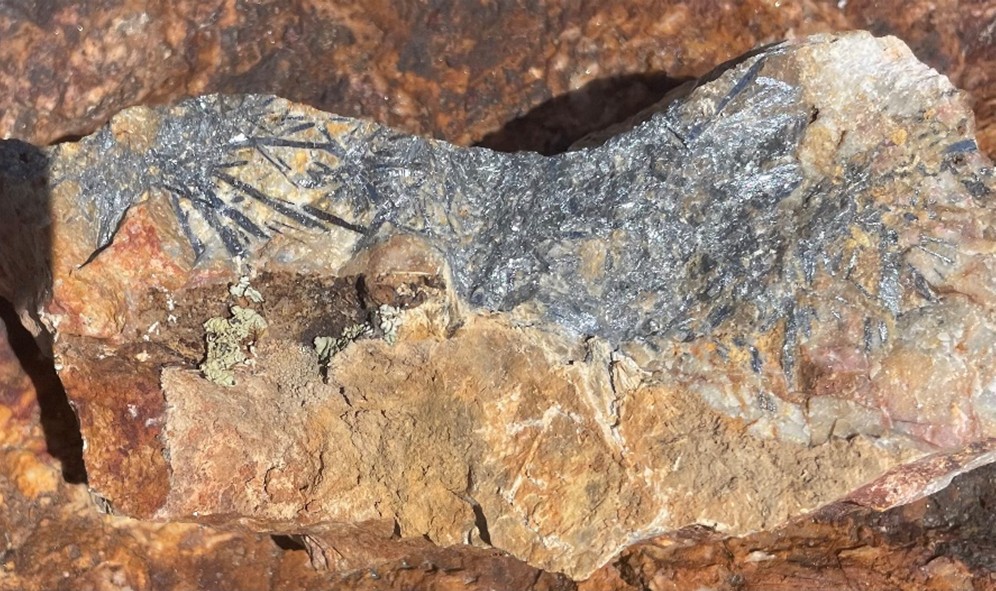
The program is designed to test high-grade antimony-bearing quartz-stibnite veins identified through historic and recent surface sampling, while advancing the company’s interpretation that the antimony mineralization may represent leakage from a deeper concealed carbonate-hosted gold system.
The program will consist of 27 RC holes from 17 drill pads. Most holes will range from 30 to 45 metres deep and are designed to evaluate the potential for near-surface antimony mineralization that could be amenable to open pit mining methods.
Three of the 27 holes are planned to be drilled to depths of approximately 150 metres plus and cased for potential future diamond drill extensions targeting deeper geophysical and geochemical features interpreted to be prospective for Carlin-type gold mineralization.
“Drilling at Silverton marks an important step in advancing a project that combines significant near surface antimony potential with a deeper gold target in one of Nevada’s premier belts,’’ said Arizona Gold President and CEO Mike Stark.
As previously reported by the company in October, 2025, surface sampling returned assays up to 7.95% Sb from quartz-stibnite veins, while historical work identified widespread anomalous antimony values associated with gold-bearing hydrothermal alteration.
Antimony, a silvery-white metalloid that can be used in the production of ammunition, has emerged as a key exploration target following China’s decision to impose export restrictions.
The global antimony market has been dominated by China since the mid 1800s, with the largest producing mine being the Xikuangshan Mine in Hunan Province. In 2022, according to the U.S. Geological Survey, China accounted for 54.5% of total mined antimony production, followed by Russia with 18.2% and Tajikistan with 15.5%
Antimony often combines with sulfur to form antimony sulfide or stibnite. Antimony trioxid (Sb203) is the most commonly used form of antimony in industrial applications. When combined with halogens, such as bromine and chlorine, it acts as a flame retardant, and is widely used in flame retardants, lead-acid batteries, glass manufacturing and as an alloy in ammunition.
The U.S. Department of the Interior has designated antimony a critical mineral because it is also essential for armour-piercing ammunition, infrared sensors and precision optics.
Arizona Gold shares were unchanged at 58 cents on Tuesday and trade in a 52-week range of $1.23 and 27 cents.
Arizona Gold & Silver is focused on precious metals exploration in Arizona and Nevada. Its flagship asset is the Philadelphia gold-silver property in northwestern Arizona, where the company is drilling off an epithermal gold-silver system ahead of an initial resource calculation.
The Philadelphia property was discovered in the 1890s, and mined through the early 1930s producing 40,000 ounces of gold from 80,000 tons.