
Geiger Energy drills 90 metres of near-surface uranium at Aberdeen Project, including high-grade radioactivity on Trend to Orano’s Kiggavik, Nunavut
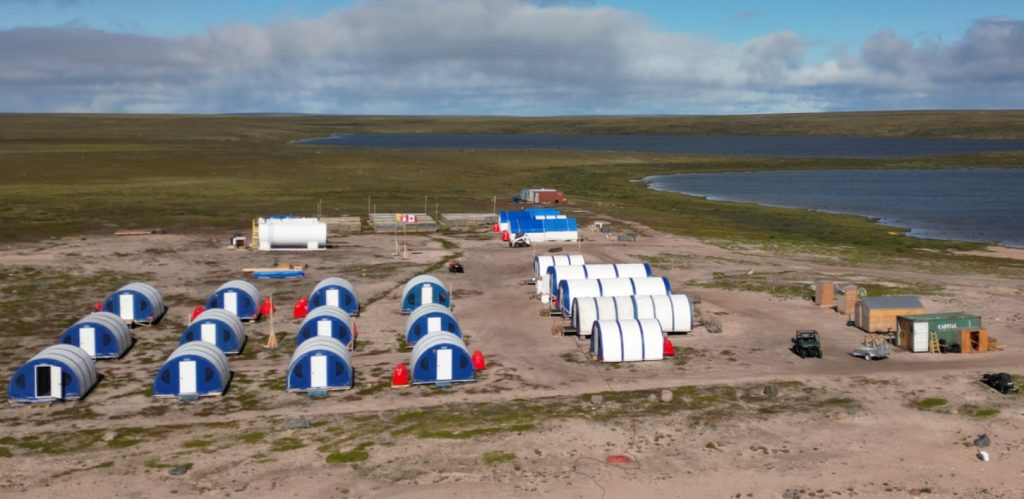
Geiger Energy Corp. [TSXV: BEEP; OTCQB: BSENF] reported that follow-up drilling at the Fox Zone has intersected the strongest radioactivity encountered to date on its Aberdeen Project in the Thelon Basin, Nunavut. Two follow-up holes were completed at Fox after the discovery hole before the 2026 weather window closed.
FOX26-003, stepped 25 metres northwest of the discovery hole, intersected intermittent elevated to high-grade radioactivity over an 89.8-metre interval from 41.0 to 130.8 metres: 6.7 m (high of 7,418 cps) from 41.0 to 47.7 m – Average: 1,639 cps; 5.3 m (high of 15,022 cps) from 56.6 to 61.9 m – Average: 3,417 cps; 7.9 m (high of 1,889 cps) from 70.5 to 78.4 m – Average: 516 cps; 21.8 m (high of 4,108 cps) from 84.5 to 106.3 m – Average: 1,187 cps and 18.0 m (high of 9,512 cps) from 112.8 to 130.8 m – Average: 2,099 cps.
Rebecca Hunter, President and CEO of Geiger Energy, sated: “FOX26-003 is the strongest hole we have drilled at Fox, high-grade radioactivity beginning just 41 metres from surface, in only the third hole ever drilled into this 1.3-km target. Every hole at Fox has hit mineralization or the alteration that surrounds it, and we have tested only a fraction of the target. Just as important is what Fox and Apollo mean together. Two grassroots discoveries in one season, 10 km apart, on the same structure that hosts Orano’s Kiggavik deposits — we are no longer testing isolated targets. We are drilling what we believe is an emerging uranium district, and the corridor gives us a compelling roadmap for systematic drilling in 2027.”
Mineralization is structurally controlled, hosted in altered feldspar porphyry to granite intercalated with psammopelitic gneiss. Uranium occurs primarily as black pitchblende, moderately to locally heavily disseminated along fractures and breccias and into adjacent wall rock, with local pale-yellow secondary minerals. Alteration throughout the hole is extensive and locally intense — strong clay, limonite, sooty pyrite and secondary red hematite — the classic signature of uranium mineralized systems in the region. Assays for all 2026 drill holes are pending and will be reported once received.
FOX26-002, stepped 25 metres southwest, intersected extensive clay, sooty pyrite and hematite alteration similar to the discovery hole, including an elevated zone from 163.2 to 169.7 metres (largely 100-300 cps) followed by a thick, bleached, clay-altered silicified fault zone to 250 metres. The hole was stopped at 404 metres to allow a final hole to be completed in 2026.
Fox lies directly on the Andrew Lake Fault, the major structural corridor associated with Orano’s Kiggavik-area deposits, which host an approximate 127-million pound historical mineral resource. That corridor extends approximately 17 km across Geiger’s Aberdeen Project, and this season Geiger made grassroots discoveries at two points along it: Fox, and Apollo, 10 km to the southwest.
Both targets were generated from Geiger’s interpretation of gravity, magnetic and structural data and were completely untested prior to 2026. At Fox, three holes into a target defined by two conjoined gravity-low anomalies have confirmed a broad, structurally controlled uranium-bearing hydrothermal system — not a single-hole occurrence — with increasingly intense radioactivity and mineralization strengthening toward surface. Numerous analogous gravity anomalies along the corridor remain untested.
These discoveries materially expand the company’s opportunity beyond its established Tatiggaq and Qavvik discoveries and define a clear strategy for 2027: aggressively follow up Fox and Apollo while systematically testing additional targets along the corridor.
Historical Kiggavik Mineral Resource Estimate: Source: Orano, 2025 Annual Activity Report, published 2026. Orano reports for the Kiggavik Project a historical estimate of 10.418 million tonnes grading 0.47% U (approximately 0.55% U₃O₈), containing 48,953 tonnes U (approximately 127.3 million pounds U₃O₈) in the Indicated category, and 0.733 million tonnes grading 0.28% U (approximately 0.33% U₃O₈), containing 2,059 tonnes U (approximately 5.4 million pounds U₃O₈) in the Inferred category.
The historical estimate is considered relevant to Geiger because the Kiggavik deposits occur along the same regional structural trend as the targets discussed in this news release and provide geological context for exploration at Geiger’s Aberdeen Project. Geiger considers the historical estimate sufficiently reliable for this limited contextual purpose because it is reported by Orano, the operator of the Kiggavik Project; however, Geiger has not independently verified the estimate.
The cut-off grades and other assumptions, parameters and methods used to prepare the historical estimate are not known to Geiger. The historical estimate uses the categories “Indicated” and “Inferred”; however, Geiger has not completed sufficient work to determine whether these historical categories are directly comparable to the current CIM Definition Standards for Mineral Resources and Mineral Reserves.
The 2025 Annual Activity Report is the most recent estimate for the Kiggavik Project known to Geiger. To verify the historical estimate as a current mineral resource, a qualified person would need to review and verify the underlying geological, drilling, sampling, analytical and estimation data and assumptions and, if appropriate, prepare a current mineral resource estimate in accordance with NI 43-101 and current CIM Definition Standards.
Geiger controls approximately 338,000 hectares in Saskatchewan’s Athabasca Basin and 95,000 hectares in Nunavut’s Thelon Basin, two of the world’s most prospective uranium districts. The company’s flagship Aberdeen Project (Thelon Basin) hosts the high-grade, basement-hosted Tatiggaq and Qavvik discoveries — both shallow systems open along strike and at depth — together with more than 50 high-priority targets, many showing strong alteration and anomalous uranium from limited historical drilling and several, like Fox, previously untested. In the Athabasca Basin, Geiger is advancing the Hook Project, host to the near-surface ACKIO uranium discovery, which comprises at least nine mineralized pods beginning at 28 metres depth and remains open in multiple directions.
Resource World Magazine Inc. has prepared this editorial for general information purposes only and should not be considered a solicitation to buy or sell securities in the companies discussed herein. The information provided has been derived from sources believed to be reliable but cannot be guaranteed. This editorial does not take into account the readers investment criteria, investment expertise, financial condition, or financial goals of individual recipients and other concerns such as jurisdictional and/or legal restrictions that may exist for certain persons. Recipients should rely on their own due diligence and seek their own professional advice before investing.