
Global Energy Metals discovers near-surface graphite at Millennium Project, Australia
Global Energy Metals Corp. [TSXV: GEMC; OTC: GBLEF; FSE: 5GE2], a multi-jurisdictional, multi-commodity critical mineral exploration, development and project-generating company focused on growth-oriented projects supporting the global transition to the new energy economy, reported significant new Total Graphitic Carbon (TGC) assay results reported by joint venture operating partner Metal Bank Ltd., from four diamond drill holes completed in December 2025 at the Millennium copper-cobalt-gold project near Cloncurry, Queensland, Australia.
The Millennium Project is a cornerstone asset within Global Energy’s battery and critical mineral portfolio, with graphite now emerging as a potential value-enhancing byproduct alongside the existing copper-cobalt-gold resource. Global Energy holds a 49% interest in Millennium and is fully carried on exploration spend as part of Metal Bank’s earn-in for 80% of Millennium.
Highlights – High-grade near-surface graphite intersected in recent drilling. Diamond drill core results include MI25DD03 returned 13.1 meters at 12.23% TGC from 1 metre; 3.7 metres at 18.49% TGC from 38.64 metres; 49.11 metres at 8.44% TGC (including 10.4m at 13.83% TGC and 7.38m at 10.59% TGC).
MI25DD04 returned 14.3 metres at 8.68% TGC from surface (including 3.5m at 15.52% TGC); 3.7 metres at 22.19% TGC from 45.8 metres and 30.85 metres at 14.11% TGC from 60.4 metres.
Millennium holds a JORC 2012 Mineral Resource Estimate (MRE) of 8.4Mt at 0.09% Co, 0.29% Cu and 0.12g/t Au for a 1.23% CuEq on an Inferred basis covering five granted mining leases near Cloncurry, NW Queensland.
Drill results provide additional strong support for thick continuous graphite mineralisation along 2km strike located ~50m west of and parallel to Millennium Co-Cu-Au resource.
Drilling and assaying were majority funded under a Queensland Government Collaborative Exploration Initiative (CEI) grant, demonstrating strong government support. Preliminary metallurgical work on graphite samples is now underway.
Drilling has confirmed thick, near-surface graphite mineralization, highlighted by 13.1 metres at 12.23% TGC from 1 metre in MI25DD03 and 30.85 mteres 14.11% TGC from 60.4 metres in MI25DD04. The graphite zones occur adjacent to the existing Millennium pit design for the existing Co-Cu-Au Inferred Resource and, when combined with drilling completed in 2024, support the interpretation of laterally continuous mineralisation extending over more than 2km of strike.
Mineralization remains open in all directions and, given its shallow position, presents potential low-strip ratio development opportunities, subject to further drilling and metallurgical assessment.
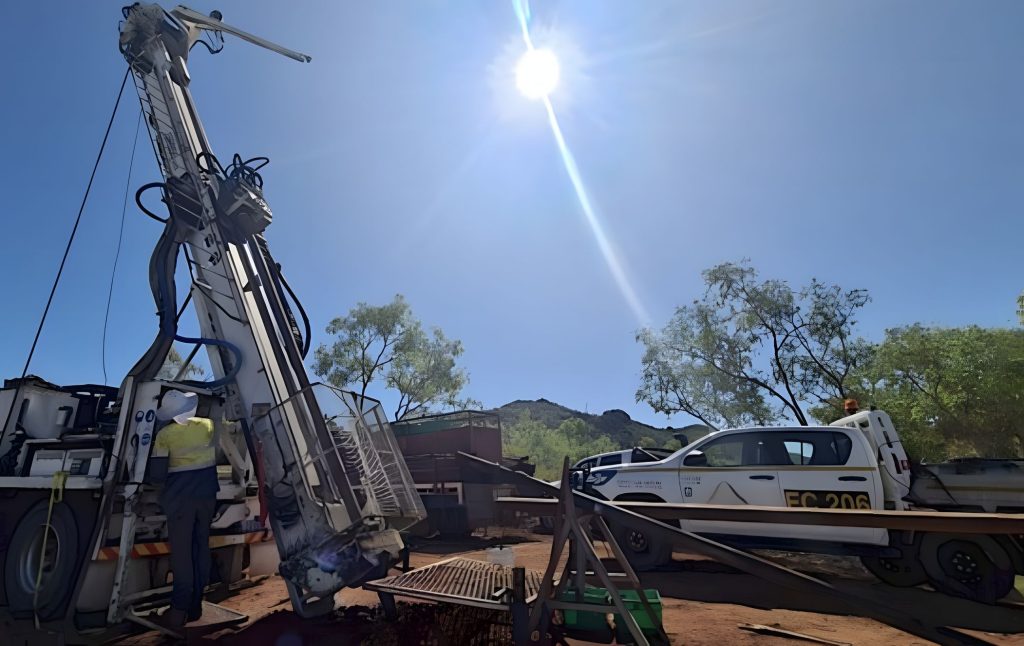
Four HQ diamond drill holes (MI25DD01–04) for a total of 462.8 meters were completed in December 2025 following the 2024 identification of substantial hanging wall graphite mineralization extending over approximately 2km of strike adjacent to the Millennium Co-Cu-Au JORC 2012 Mineral Resource Estimate (MRE) of 8.4Mt at 1.23% CuEq on an Inferred basis.
Drilling targeted a 750-metre strike of limited prior work within the graphite mineralized zone directly adjacent to the 2023 optimised pit shell models of the Co-Cu-Au MRE. All holes were oriented west–east and drilled perpendicular to the dominant stratigraphy, to maximize true width intersections.
The program was majority funded under a Queensland Government CEI grant (up to $275,000 including GST), with the key objectives to better define the distribution, continuity and characteristics of graphite mineralization, together with resampling of historical core related to the Co-Cu-Au deposit for graphite and preliminary metallurgical assessment.
MI25DD01 intersected predominantly mafic to ultramafic units, with only a narrow graphitic interval returning 1.1 metres at 6.22% TGC from 99.4 metres. MI25DD02 intersected multiple carbonaceous to graphitic metasedimentary units interbedded with mafic and calc-silicate lithologies, returning 12.1 metres at 8.19% TGC from 83.9 metres within broader lower-grade graphitic intervals.
MI25DD03 intersected several thick graphitic units near surface, returning 13.1 metres at 12.23% TGC from 1 metre, 3.7 metres at 18.49% TGC from 38.6 metres, and 49.11 metres at 8.44% TGC from 51.27 metres, including 10.4 metres at 13.83% TGC from 55.6 metres and 7.38 metres at 10.59% TGC from 93 metres.
MI25DD04 intersected strongly graphitic units from surface progressing to intercalated graphitic metasediments, quartz veining and minor mafic volcanics before a highly graphitic zone from 45.8 to 49.5 metres corresponding to a strongly graphitic metasedimentary unit between mafic/ultramafic intrusives. Thick graphitic metasediments were also intersected from 60.4 metres to 91.25 metres before calcsilicates, mafic and minor carbonaceous/graphitic units to end of hole.
Results from MI25DD04 included 14.3 metres at 8.68% TGC from surface, including 3.5 metres at 15.52% TGC from surface, 3.7 metres at 22.19% TGC from 45.8 metres and 30.85 metres at 14.11% TGC from 60.4 metres.
Preliminary observations indicate that graphite mineralization at Millennium is fine-grained and interpreted to have formed through metamorphic upgrading of carbonaceous siltstones. The distribution and local enrichment of graphite appear to be influenced by proximity to mafic units, potentially reflecting thermal effects, competency contrasts and structural remobilization.
Subject to metallurgical confirmation, these observations will assist in refining future graphite targeting.
Approximately 2km in strike of prospective lithologies remain open to the west of the Millennium Co-Cu-Au resource, graphite is known within the footwall and core of the Millennium Structure, and graphite mineralization is considered amenable to IP and resistivity geophysical methods in areas of limited surface exposure providing an effective drill targeting tool.
Planned work programs include: ongoing preliminary metallurgical testing of graphite mineralization, resampling of historical core for graphite analysis, additional drilling to define continuity and scale, advancement of mining lease applications and continued development planning for integrated multi-commodity production.
Through its copper, nickel, cobalt, silver, lithium and uranium projects in Canada, Australia, Norway and the United States, Global Energy Metals is investing in, exploring and developing prospective, scalable assets located in established mining and processing jurisdictions, often in close proximity to end-use markets. The company prioritizes projects with low logistical and processing risk, positioning them for accelerated development and potential entry into the battery supply chain within the current cycle.