
Gold at Record Highs Sparks Revival Across Historic Arizona Camps
By Peter Kennedy
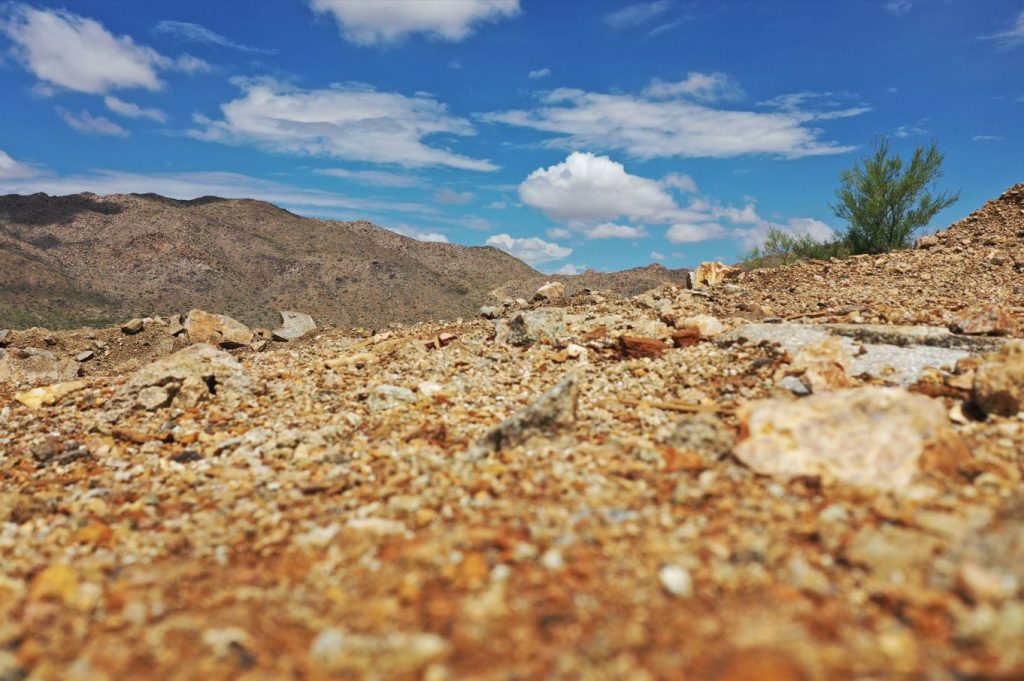
The reddish-coloured mountains of waste rock that dominate the landscape in southern Arizona are a testament to the role that copper mining has played in the state that often ranks among the top jurisdictions for mineral investment.
But in some areas of Arizona, copper is taking a back seat as mining companies move to revive shuttered gold mines that could once again be viable thanks to the surge in precious metal prices.
Darren Koningen, CEO of Minera Alamos Inc. [MAI-TSXV] recently said the impact of the current gold prices on the overall economics of the company’s Copperstone mine “cannot be overstated.”
Located in Western Arizona, along the Walker Lane Belt near the town of Quartzsite, Copperstone is a historically productive high-grade gold mine, which produced around 500,000 ounces of gold from an open pit operation between 1987 and 1993.
A 450 tonne per day flotation mill was built on the site and in 2022 underground mining commenced from two declines that were previously developed at the bottom of the open pit. Production resumed in January 2012 and continued until July 2013 when operations were suspended in a declining gold market. At the end of 2013, gold was trading at US$1,323.10 an ounce.
Now that gold is trading around US$4,784.60 an ounce Konigen said he sees an opportunity for Copperstone to significantly increase the company’s gold production and free cash flow, well beyond the previously published preliminary economic assessment (PEA) expectations. His comments are backed by a PEA which outlines an underground mining and onsite milling scenario, producing 240,500 ounces of gold and sustaining a project lifespan of 6.9 years.
Meanwhile, Arizona Eagle Mining Corp. [AZEM-TSXV], which recently began trading on the TSX Venture Exchange, is working to advance exploration at the company’s flagship Eagle Project in Arizona’s prolific Yavapai County.
Arizona Eagle holds a 100% interest in the Eagle project, which is anchored by the past-producing gold and silver McCabe Mine, situated on 300 acres of private land. In 1984, Stan West Mining published an historic estimate of approximately 878,000 ounces of gold and five million ounces of silver, defined to a depth of approximately 440 metres and open in all directions. In the first quarter of 2026, Arizona Eagle launched a fully funded Phase 1 drill program covering 4,500 metres. The drill program is designed to confirm the historic resource estimates in addition to potentially expand upon it. Drilling is expected to conclude in June 2026. A second core drill rig is scheduled to mobilize to the Eagle Project in July 2026 for further drilling.
Arizona Gold & Silver Inc. [AZS-TSXV, AZASF-OTCQB] is focused on exploring gold-silver properties in western Arizona and Nevada. Its flagship asset is the Philadelphia gold-silver property where the company is drilling off a significant epithermal gold-silver system.
The 100%-owned Philadelphia project is a high-grade gold and silver vein target located in Mohave County, northwestern Arizona. The Philadelphia property was discovered in the 1890s and mined through the early 1930s, producing 40,000 ounces of gold from 80,000 tons.
 Casa Minerals Inc.’s [CASA-TSXV, CASXF-OTCQB, 0CM-FSE] 90%-owned Congress Mine was Arizona’s largest gold producer until the 1930s and operated up to 1992 when gold was trading at around US$360 an ounce.
Casa says the fact that historic exploration was conducted during a period when gold market conditions were materially lower than they are today directly influenced the selection criteria and cut-off grades used by previous operators. As a result, historic programs focused predominantly on higher grade gold intersections, and many lower grade vein intercepts that may be economically significant at current gold prices were not assigned the same level of analytical priority.
In an interview with Resource World, Casa President and CEO Farshad Shirvani said he believes this creates an opportunity to reinterpret the mineralization system with a lower economic threshold, logically expanding the dimensions of the mineralization envelope that will be targeted during the 2026 drilling campaign
In 2022, Casa commenced drilling to confirm a substantial gold resource of 365,000 to 455,000 tonnes grading 9.33 g/t that were reported in 1989 by Echo Bay Mines. Republic Goldfields Inc. subsequently reported production of 28,500 ounces of gold from 125,000 tonnes of 0.23 opt. Over the course of its history, the Congress mine has produced 400,000 to 500,000 ounces of gold from underground workings and once supported a full ore processing plant, complete with a small frontier-style town.
 Shirvani said Casa recently took a key step towards bringing the Congress Mine back into production by obtaining a large dataset of historic drill hole information from the mine. Comprehensive desktop technical studies integrating this data with the company’s own 2022 drilling campaign have resulted in the identification and delineation of three distinct porphyry exploration zones that will form the basis of the 2026 field and drilling program.
Three distinct exploration zones have been classified as follows: Echo Bay Exploration Zone (750 metres x 1,000 metres), Malartic Exploration Zone (450 metres by 1,150 metres) and New Congress Niagara Exploration Zone (800 metres by 1,000 metres).
 The Echo Bay Exploration Zone has been designated as the highest priority target based on historic drill density and potential for an expanded and mineralization envelope. Historic drill intercepts include highlights such as 1.2 metres at 43.88 g/t gold, 2.0 metres at 21.88 g/t gold, 3.3 metres at 27.13 g/t gold, and 11.4 metres at 4.81 g/t gold within the Echo Bay Zone.
“For the first time, we now have a comprehensive view of the full scope of historic exploration at Congress, and what we see is highly encouraging,’’ Shirvani said. “The 3D model clearly validates our 2022 findings and demonstrates that the gold system is both continuous and larger than historic estimates suggested.”
It is worth noting that the gold veining system, along with investigations by Casa indicate the presence of porphyry-style copper-gold mineralization. Historically the property was never explored with porphyry potential in mind. Casa says this requires further investigation.
 In its latest press release, Casa said it is mobilizing a team of geologists and field personnel to the Congress mine for initial site preparation, geological review, and the establishment of field infrastructure required for the 2026 drilling program.
Shirvani said the company hopes to complete about 30 drill holes this year, at a cost of about $2.0 million. “I would like to have a NI 43-101-compliant resource estimate by the end of 2026.’’ Casa is currently exploring both the Congress mine and the Arsenault volcanogenic massive sulphide (VMS) copper-gold project in British Columbia.
Casa Minerals shares were trading at 16 cents on April 30, 2026. The shares trade in a 52-week range of 37 cents and $0.04.
¹Historical Estimates
This article contains historical estimates for the Congress Mine and Eagle Project. These estimates were prepared before the implementation of NI 43-101 and use categories other than those prescribed by NI 43-101. A qualified person has not done sufficient work to classify the historical estimates as current mineral resources or mineral reserves, and Casa Minerals Inc is not treating the historical estimates as current mineral resources or mineral reserves.