
Great Pacific Gold updates Kesar Gold Project, Papua New Guinea
Great Pacific Gold Corp. [TSXV: GPAC; OTCQX: GPGCF; FSE: V3H] reported that it expects to file an updated NI 43-101 compliant technical report for its Kesar Project, Papua New Guinea. Kesar is located immediately adjacent and along strike from the Kainantu Mine, operated by K92 Mining. The updated report contains complete results and analysis of the results from the Phase 1 exploration program completed in May 2025 and makes recommendations for a Phase 2 exploration program in 2026.
Highlights from the Kesar Technical Report include multiple high-grade intercepts in 13 holes/3,700 metres diamond drilling: Anteruno target: 3.13 metres at 3.67 g/t gold, including 0.71 metres at 13.5 g/t Au (KDH003), and the Hampore target: 0.94 metres at 3.17 g/t gold, including 0.29 metres at 9.08 g/t Au (KDH011).
Mobile MT geophysics analysis highlights numerous high potential targets: Lineament analysis, a third-party proprietary technique, was used to identify multiple targets for both porphyry-style mineralization and intermediate-sulfidation epithermal deposits.
Phase 2 Drilling Program Recommended: Surface exploration work and ground-truthing to confirm MobileMT targets, target/drill-scale mapping, sampling and trenching followed by a 3,000-metre diamond drill program recommended in 2026.
The Kesar exploration licence (EL 2711) was granted to Great Pacific Gold’s subsidiary, Yaendal Minerals, for a two-year period starting October 30, 2023. During the two-year period, the company completed extensive exploration work including soil sampling, mapping, diamond drilling and a helicopter flown Mobile MT geophysics survey.
Total expenditures on the project during this period were approximately $5.8 million, or 16.7 million PNG Kina, making Great Pacific Gold one of the largest active exploration companies in PNG (non-operating companies). The company has applied for a two-year extension of the exploration licence and expects work to continue in 2026 following the renewal.
“While Wild Dog remains our top priority target, Kesar has tremendous potential and is strategically located alongside K92 Mining’s Kainantu Mine,” stated Greg McCunn, CEO of Great Pacific Gold. “We are expecting the bulk of our exploration expenditures in the coming year to be spent at Wild Dog, but we are planning a focused follow-up program at Kesar with the objective of unlocking value that we believe is currently not recognized in our share price.
“With over 16.7 million PNG Kina (C$5.8 million) spent on Kesar over the initial two-year licence period, GPAC is one of the largest active exploration companies in PNG. We look forward to working with the Mineral Resource Authority in PNG and our local stakeholder and landowner groups to renew the exploration licence for a further two years to allow the company to continue to invest in the region and make Kesar a long-term success.“
H&S Consultants Pty is finalizing an updated NI 43-101 technical report for Kesar. The report is expected to be filed on SEDAR+ with an effective date of September 9, 2025. The following is an excerpt from the Executive Summary of the updated technical report.
The Kesar exploration licence, EL2711, is located in the Eastern Highlands Province, Papua New Guinea with the property boundary approximately 6 km west of K92’s Kainantu Mine Plant Site. The property consists of 130 km2 (38 sub-blocks) which cover a Late Miocene to Pliocene hosted gold vein and porphyry district predominantly within Miocene tonalite.
The potential for discovery of structurally-controlled gold deposits within the project area is prompted by the nearby occurrence of the Kainantu gold mine and the Arakompa gold vein system. The nearby Blue Lake porphyry copper/gold deposit lies on an adjacent exploration licence and provides evidence for potential porphyry copper/gold mineralization on EL2711.
The property lies within an area of mostly rugged topography, with transecting rivers forming lower lying areas. Elevations range from 900m to 2,600m above sea level. The property area is accessed by a two-hour drive along the sealed Lae-Madang Highway from Lae, which is the capital city of the Morobe Province and second largest city in PNG.
Yaendal Minerals Ltd. is a PNG company holding the tenement of the Kesar Project. GPAC owns a 90% interest in Yaendal and has additional rights under an option agreement to acquire the remaining 10% upon completion of a Definitive Feasibility Study.
The historic exploration work including mapping, surface geochemistry and Helimag geophysics has identified multiple gold target areas which warrant continued exploration.
The area is covered by one current Exploration Licence (EL) issued by the Papua New Guinea Mineral Resources Authority and held by Yaendal. An EL entitles the holder to carry out exploration work in accordance with an agreed work program filed with the application for the rights. The term of the EL is for two years and may be renewed for a further two years upon expiry.
The Kainantu area, including the Kesar licence, in Papua New Guinea is located in the New Guinea Thrust Belt, which is part of the Papua New Guinea Mobile Belt.
Gold and base metal mineralization occurs in veins and breccia zones hosted by fault/shear structures within the intrusives as well as the meta-sediments.
Proximal to EL2711 is the Kainantu Gold Mine which comprises low sulfidation epithermal lodes of the previously mined Irumafimpa deposit and the currently mined more orogenic/intrusion related gold veins of the Kora and Judd deposits. Mineral Resources for the Kora consolidated area comprise Measured and Indicated Resource of 8.1Mt at 7.83 g/t Au, 20.5 g/t Ag and 1.18% Cu for a total gold equivalent of 2.6Mozs.
Recent work by GPAC has included areas of selective soil sampling based on anomalous stream sediment and rock chip sampling results with follow-up diamond drilling. The main target areas were Anteruno, Hampore and Fufunambi.
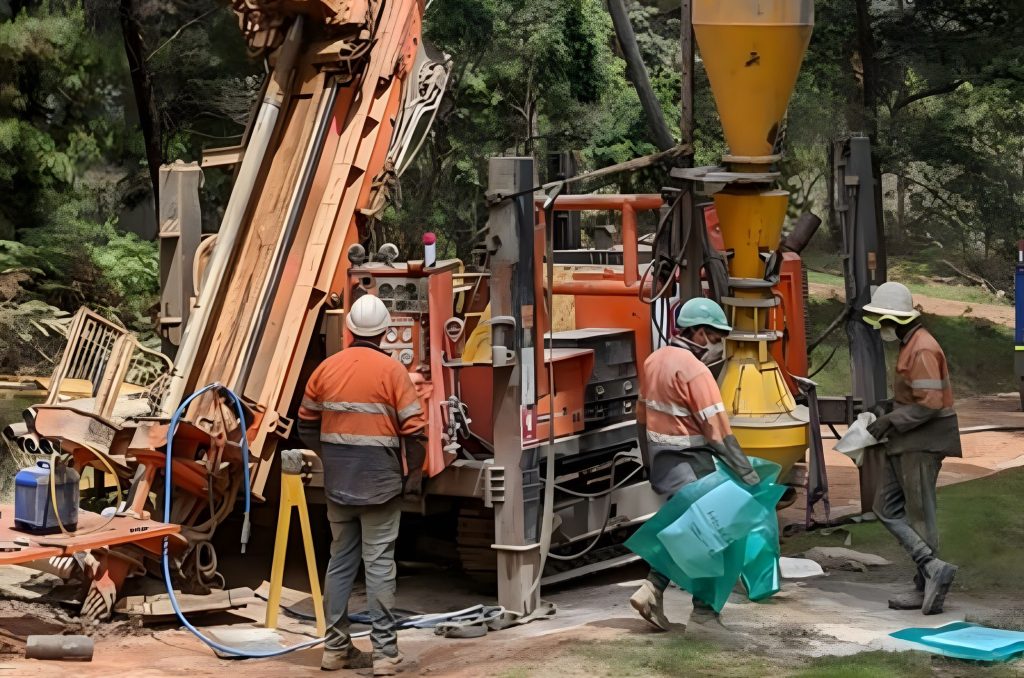
The recent diamond drilling program completed by GPAC on the property comprised 13 holes for a total of 3,714.3 metres. Five holes were completed at the Anteruno prospect and seven holes at the Hampore prospect. One hole was drilled at Fufunambi.
Core recovery is very good (>98%) with only minor core losses associated with the top of hole weathering. All holes were logged with data uploaded to an MSAccess drillhole database.
Best result for Anteruno was 3.13 metres at 3.67 g/t gold, including 0.71 metres at 13.5 g/t Au (KDH003) and for Hampore, the best result was 0.94 metres at 3.17 g/t gold, including 0.29 metres at 9.08 g/t Au (KDH011). In many instances it is interpreted that the narrow to very narrow quartz veins carried significantly high gold grades of >10g/t.
GPAC completed an airborne mobile magneto-telluric survey over the whole tenement. Fifteen production flights were flown to complete 931 line-km of the survey over a 143 km2 area. Assembled datasets include magnetic and electro-magnetic data including measurements for conductivity and resistivity and incorporated 3D inversion modelling. Lineament Analysis, a third-party proprietary technique, was used to identify structural architecture and potential mineral sites. In addition, two sets of external consultants were asked to interpret the data which resulted in a 3D geological interpretation and the generation of multiple targets for both porphyry style mineralization and intermediate-sulfidation epithermal deposits.
Historical surface exploration on EL2711 has been rather limited and more of a general reconnaissance nature but still with anomalous areas for gold and copper identified. The exploration methods have been surface mapping, surface geochemistry via ridge and spur soil sampling, ‘trunk’ stream sediment sampling, rock chip sampling (including some trenching) and panned concentrate sampling.
The licence has also had a recent Helimag survey completed with 100m and 200m line spacing at a 300-metre flight height. The main prospects for gold identified from the historical exploration are drainage areas associated with Kesar Creek, Agrewo Creek, Anteruno Creek, Mirenkeno Creek and Konanke Creek.
The historic work tended to focus on the exploration potential for a porphyry copper/gold mineral system. The last work on the tenement prior to GPAC was Barrick in 2008-2012 which concluded that the potential for such an exploration target was low.
Since that time K92’s work on the Kora Consolidated lode system 5 km east and southeast has resulted in the discovery of a significant gold (and copper and silver) Mineral Resource which has since gone into production at a rate of 1.2Mtpa and an annual gold production of 160,000ozs. Not only that but it has also discovered a significant gold/copper porphyry Inferred Mineral Resource at Blue Lake and has reported significant gold-bearing vein intercepts from diamond drilling at Arakompa. Both of these two deposits are within a 10 km radius of EL2711.
GPAC has completed a data compilation exercise and identified a number of drill targets at Anteruno, Hampore and Fufunambi, which it has tested via diamond drilling.
The available exploration datasets also indicate that the property is also prospective for economic quantities of porphyry and skarn style, bulk tonnage copper-gold mineralization.
The existing database (GIS, surface and sub-surface geochemistry, drilling, geophysics) should be audited and reviewed. Staged exploration recommendations should be prepared for each of the known target areas that warrant additional exploration work.
Specific recommendations for further work include mapping and rock chip sampling further northwest along strike of the known veins at Fufunambi; trenching along known vein areas outcrop/workings to better determine grade distribution along the structure for both Hampore and Anteruno; incorporate the MT survey results, including the EM conductivity and resistivity results, into a 3D geological model; complete items 1 to 3 and look to generate field sampling follow-up programs designed to uncover a Phase 2 set of drill targets with Phase 2 to involve further ground truthing and target definition leading to a substantial drilling program.
Great Pacific Gold’s vision is to become the leading gold-copper development company in Papua New Guinea (PNG). The company has a portfolio of exploration-stage projects in PNG, including the Wild Dog Project, the Kesar Project, the Arau Project and the Tinga Valley Project.