
Puma Exploration samples 16.38 g/t gold south of RIM at McKenzie Project, New Brunswick
Puma Exploration Inc. [TSXV: PUMA; OTCQB: PUMXF] reported new high-grade gold results from its McKenzie Gold Project in northern New Brunswick. Three quartz-vein grab samples collected approximately 450 metres south of the RIM Gold Zone returned 16.38 g/t Au, 7.17 g/t Au and 3.86 g/t Au.
These results add a new exploration target south of RIM Gold Vein, where previous drilling confirmed high-grade gold-bearing quartz veins, and highlight the potential for additional discoveries along strike over significant distance.
New high-grade gold area (RIM SOUTH) identified approximately 450 metres south of the RIM Gold Zone.
Drilling at RIM confirmed high-grade gold-bearing veins, including 42.60 g/t Au over 0.25 metres within 1.64 g/t Au over 7.75 metres.
These newly uncovered veins are similar to those at RIM and support further exploration of a larger, structurally controlled gold system. Continuity has not yet been confirmed.
The Bonanza Gold Zone, approximately 4 km southwest of RIM, has returned grab samples of 362 g/t Au and 267 g/t Au. Bonanza has never been drilled.
RIM and Bonanza exhibit geological features that are similar to the Lynx Gold Zone on Puma’s Williams Brook Gold Project (optioned in 2024 to Kinross Gold Corp.).
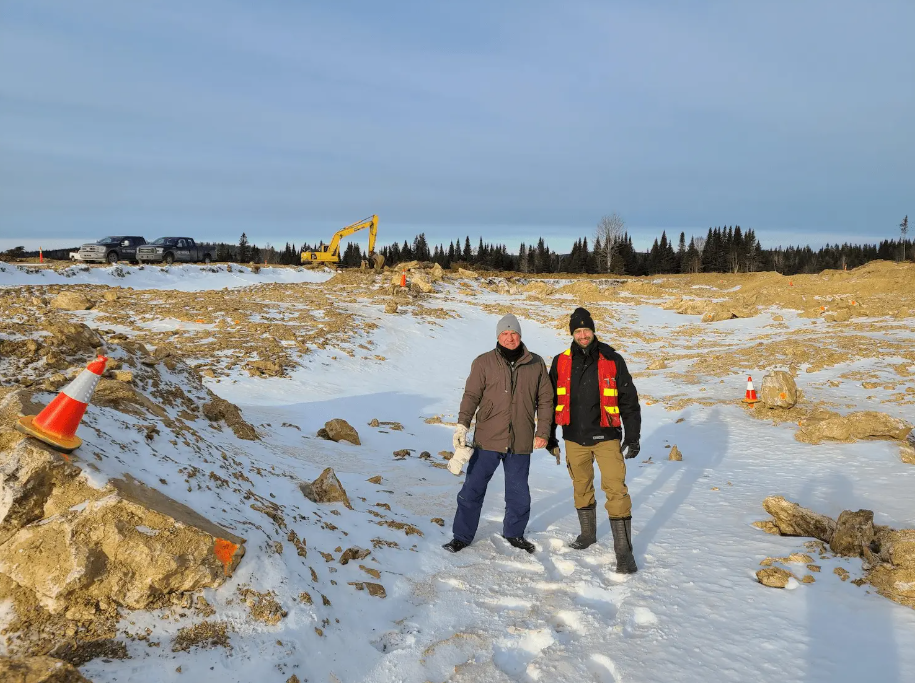
The trenching program announced September 2, 2026 uncovered these quartz veins carrying localized oxidized sulphides, approximately 450 metres south of RIM. They look similar to the gold-bearing quartz veins already mapped at RIM and add an important exploration target outside and along strike of the main area tested by Puma’s first drilling program. More exploration work is needed to determine whether the newly discovered veins and the RIM veins are connected.
At RIM, consulting geologist Scott Anderson, PhD., PGeo., identified gold-bearing quartz veins associated with shear zones and extension veins. His work indicates that gold-bearing structures may continue beyond the areas already explored. At Bonanza, he observed similar quartz veins and geological structures. Puma’s trenching has followed the broader vein system for more than 500 metres, although it has not established the continuity of individual veins.
These observations are consistent with an orogenic-style gold model and share vein-style similarities with the Lynx Gold Zone (LGZ) at Puma’s nearby Williams Brook Gold Project, which is optioned to Kinross Gold Corp. Williams Brook’s potential is underscored by Kinross’ recent announcement that it plans to fund a third year of exploration there. The similarities between mineralization observed to date at McKenzie and the LGZ at Williams Brook support continued exploration of high-grade gold occurrences at McKenzie.
A drone magnetic survey covering both the RIM and Bonanza gold zones shows geological structures that, combined with surface gold results and the geological mapping completed this summer, are helping Puma identify structures and select areas for 2027 exploration work.
Puma’s 42,053 ha McKenzie Gold Project is easily accessible via paved highways and gravel roads. It lies just 7 km west of the company’s Williams Brook Project, which is optioned to Kinross Gold Corp. The project straddles the McKenzie Fault, a prominent regional structure associated with numerous occurrences of high-grade gold quartz veins, stockworks and breccias. Puma has confirmed two significant gold systems at McKenzie: the RIM Gold Vein and the Grog Area, approximately 30 km apart, and has identified more than 75 surface targets across the large land
Puma Exploration is focused on identifying and developing a pipeline of precious metals projects in New Brunswick, near the Bathurst Mining Camp.
Puma has a long history in northern New Brunswick and has developed a strong understanding of the region’s geology and mineralized systems through a combination of traditional prospecting, trenching, geophysics, geochemistry and advanced exploration techniques.