
The Gold Between the Veins: A Second Look at Robinson Creek
By Editorial Assistant
Searchlight Resources is revisiting gold mineralization near Flin Flon, Saskatchewan, to investigate whether exploration focused on higher-grade veins may have overlooked a broader gold-bearing system.
In the oil and gas industry, drilling often encounters several potentially productive geological formations before reaching the primary target. Some intervals are left undeveloped because of technical limitations, economic conditions or the operator’s priorities. Years later, these overlooked formations may attract renewed interest as technology improves or economics change. The oil industry calls this bypassed pay.
The concept offers an interesting parallel in mineral exploration, particularly in established mining districts where historic drilling programs were conducted with objectives quite different from those of today’s explorers.
At the Robinson Creek gold project, Searchlight Resources Inc. [SCLT-TSXV, SCLTF-OTC] is investigating whether gold mineralization may have been overlooked between the higher-grade veins that originally attracted attention.
Located approximately 16 kilometres west of Creighton, Saskatchewan, and Flin Flon, Manitoba, within the Flin Flon Greenstone Belt, Robinson Creek has an exploration history extending back more than a century. Much of the drilling took place during the 1940s and 1980s, when the emphasis was on identifying relatively narrow, high-grade gold veins suitable for underground mining.
Thick quartz veins, conspicuous sulphides and visibly altered rock were natural targets for sampling. The less remarkable material between these intervals did not necessarily receive the same attention. Yet gold is not always visually apparent. It can occur in narrow veinlets, finely disseminated sulphides or surrounding host rock that gives little indication of its mineral content.
This distinction underpins Searchlight’s approach to Robinson Creek. When the company announced its acquisition of the property in May 2021, it outlined plans to evaluate both higher-grade underground targets and the potential for broader, lower-grade mineralization that might support open-pit development.
Searchlight has compiled records from 70 drill holes totalling approximately 9,618 metres, completed during the 1940s and 1980s. The compilation identified gold intersections exceeding 1.0 gram per tonne in 60 holes, including 45 intersections grading more than 2.0 grams per tonne over at least one metre.
Notable results include drill hole 81-2, which returned 2.46 grams of gold per tonne over 57.60 metres. Other reported intersections include 7.59 grams per tonne over 10.94 metres in hole HB-6 and 2.15 grams per tonne over 32 metres in hole 81-1.
Searchlight has not independently verified these historical results. The intervals represent drill-hole lengths rather than established true widths, but they provide a starting point for investigating the extent of mineralization.
Three principal gold zones, known as the Vein, Bleiler and Quartz zones, have been identified along approximately one kilometre of the Mosher Lake Shear Zone, providing a structural framework for further exploration.
This photograph of Robinson Creek drill core from the current drill program illustrates why the company is taking a fresh look at the property’s geology. Light-coloured, apparently quartz-rich veins and bands repeatedly cut through darker host rock. Some are relatively thick, while others are narrow, folded or stretched, creating a complex pattern of geological structures.
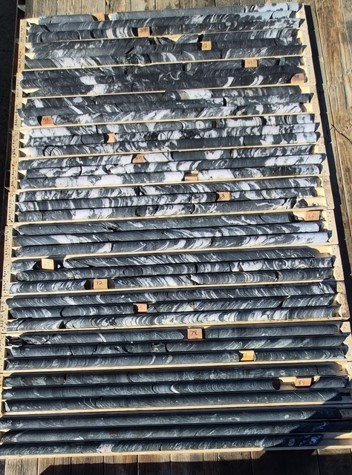
The more prominent quartz veins might once have received the greatest attention. But what about the intervening rock and the numerous smaller veins?
The answer requires systematic sampling. The presence of quartz, folding or deformation cannot establish gold content, and separate vein widths cannot simply be combined to demonstrate a larger deposit. However, if representative assays show gold extending through both the veins and surrounding host rock, intervals once considered separately could potentially form part of a broader mineralized envelope.
This possibility is central to Searchlight’s reassessment of the property.
In June 2024, the company announced an initial Exploration Target based on drilling records and three-dimensional geological modelling completed by Terra Modelling Services Inc. of Saskatoon. The study outlined a conceptual exploration target of two million to three million tonnes grading between 1.20 and 1.60 grams of gold per tonne, equivalent to approximately 77,000 to 154,000 ounces.
These figures are not a Mineral Resource estimate. Searchlight cautioned that the quantities and grades are conceptual, exploration has been insufficient to define a Mineral Resource, and there is no certainty that further work will establish one.
Nevertheless, the study reflects a different exploration perspective. Rather than concentrating exclusively on higher-grade veins, Searchlight is evaluating whether the geological system could contain wider intervals of gold mineralization.
An important part of that work involves understanding how the original drill core was sampled. Where operators selectively assayed the more promising-looking sections, potentially useful information may be missing from the record. Determining whether those gaps contain additional gold requires new sampling and analysis.
Searchlight advanced that effort in 2026. In April, the company announced that it had received a two-year drilling and surface exploration permit from the Saskatchewan Ministry of Environment. Following summer fieldwork that included efforts to locate old drill sites, Searchlight announced on September 9 that it was mobilizing a diamond drill rig and geological team for a five-hole program totalling approximately 1,000 metres.
The program was designed to verify reported gold intersections and known mineralized zones, helping establish a more reliable geological picture of Robinson Creek.
Modern drilling and analytical techniques offer an opportunity to revisit interpretations made decades ago, particularly where selective sampling may have left uncertainty about the distribution of gold. Any indication of broader mineralization would still require additional drilling to establish continuity, grade and geometry before its economic significance could be assessed.
That is where the bypassed-pay analogy becomes relevant. In oil and gas exploration, formations once considered secondary can become attractive targets when examined under different technical or economic conditions. In mineral exploration, a change in approach can similarly uncover opportunities that past programs were not designed to investigate.
Robinson Creek already has a substantial drilling record, documented gold intersections and an identifiable structural setting. What remains uncertain is whether mineralization extends beyond the higher-grade veins that dominated the original exploration programs.
For Searchlight, the opportunity lies in answering that question. New drilling may reveal a more extensive gold-bearing system or help define the limits of known mineralization. Either outcome would improve the geological understanding of the property.
At Robinson Creek, the next discovery may not depend on finding an entirely new gold occurrence, but on understanding what lies between the veins.