
Bunker Hill Mining expands high-grade silver-lead Cate-8 Vein near Bunker Hill mine, Idaho
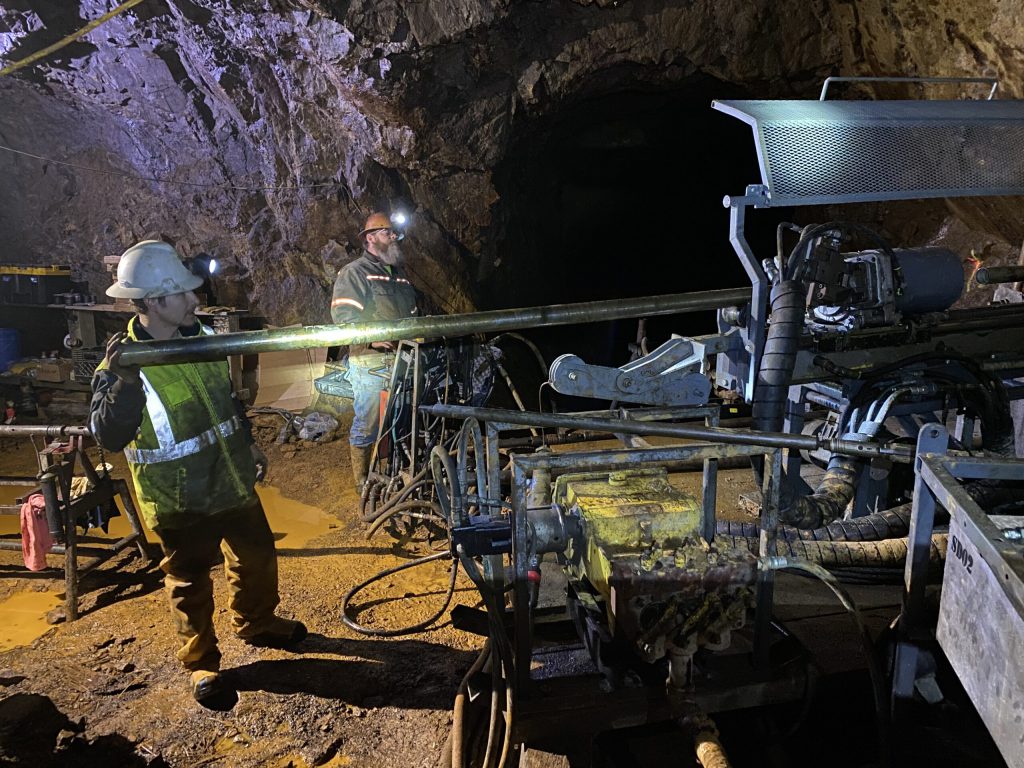
Bunker Hill Mining Corp. [TSX: BNKR; OTCQB: BHLL] reports further successful results from the ongoing exploration drill program testing the high-grade silver-lead Cate-8 Vein discovery adjacent to current development in the upper area of the Bunker Hill mine, Idaho. Seven holes have been drilled to date for a total of 2,750 feet from the 8 Level. Assay results for the first five drillholes show significant intercepts. The last two drill holes, BHE26-06 and BHE26-07, also both intersected siderite-galena veins ranging from 1 to 6 feet in length. These holes have been logged, and samples have been submitted to the assay lab.
Highlights: Exploration Target Model Estimate for Cate-8 Vein indicates a range of 50,174-167,821 tons at a grade of 9.32-5.75 oz/ton AgEq, with potential to expand through additional drilling.
Drill Hole BHE26-02: 28.6ft length at 5.06 oz AgEq per ton (173.6 AgEq g/t), 280 ft from current mine development.
Drill Hole BHE26-03: 15.5ft length at 11.34 oz AgEq per ton (388.79 AgEq g/t), 310 ft from current mine development.
This new high-grade silver discovery supports the objective of restoring the mine’s metal mix to its historic 50% silver and 50% base metals earlier than expected.
Sam Ash, President and CEO, commented: “As we prepare to restart operations this month, these results from the Cate 8 exploration program already exceed our expectations. In particular, the consistency, grade, and thickness of mineralization indicate a new discovery, which will assist with our goal of returning the mine to its historic 50% silver and 50% base-metal mix. Based on this, we are planning to expand the program to potentially define a resource that can be incorporated early in the mine plan. Because of its proximity to existing development and potentially significant tonnage and silver grades in preliminary target estimates, I anticipate that, with continued drill success, we will add the Cate I area to the mine plan in ways that could improve the 2027 and 2028 silver production profile.”
Intercepts are drilled length; true thickness is unknown from current data: estimated at 50% of drilled length for BHE26-02 and 03, 60% for BHE26-04, 95% for BHE26-02 and 80% for BHE26-05.
Strongly mineralized vein intervals were put on rush assay; lower-grade visually mineralized intervals surrounding these intercepts are awaiting results. Core recovery was good (>95%) in mineralized zones other than BHE26-03 (~25%) and BHE26-04 (50.7%), which were drilled at a very low angle to the Cate-8 structure; these intervals will be drilled from a more ideal location for inclusion of those zones in a potential future resource estimate.
The first five drill holes into the Cate-8 Target intercepted intervals of lead-silver-zinc mineralization comprised of multiple discrete high-grade vein structures. Geologic modeling indicates that the mineralization is subparallel to the largest historically mined orebody at Bunker Hill, the March Stope, which was worked continuously from 1885 to 1936, producing a total of approximately 567.6k tons of lead, 24.69M ounces of silver and 106.4k tons of zinc from 4.73M tons of material at grades of 12% lead, 5.22 oz/ton silver and 2.25% zinc.
The Cate-8 Target was initially interpreted as being in the “Galena-Quartz” series of veins (GQ Veins) based on high silver and lead grades; these veins were historically mined at lower levels of the Bunker Hill Mine and were the source of much of the historic silver production. The original exploration concept was that a segment of a GQ Vein had been dragged and offset within the Cate Fault Zone. Although this was a compelling target due to proximity to mine development, the geologic boundaries of the fault zone limited the potential target size.
The presence of abundant siderite (iron carbonate gangue mineral) with galena (lead sulfide) in detailed logging of all drillholes, coupled with their location below the Cate Fault Zone, indicates that the target is a Hybrid-Type body of mineralization. These were formed where Galena-Quartz Veins overprinted older Bluebird-Type sphalerite-siderite-pyrite veins, which were the source of the bulk of the zinc historically produced at Bunker Hill. Hybrid-Type mineralization is typified by silver-bearing galena deposition around earlier sphalerite-pyrite-siderite veins, resulting in silver, zinc and lead grades in the same zone. Hybrid mineralization provided a significant portion of historic mine production, with grades and tonnages generally exceeding those of discrete vein structures.
The projection of the modeled Cate-8 Vein indicates that the structure may continue to intersect with the Francis-Bar Vein system at depth, a GQ Vein set with substantial historic production at deeper levels of the Mine, including:
Francis Vein: 972k tons at 11.84% Pb, 5.68 oz/ton Ag and 4.47% Zn, containing 115.1k tons lead, 5.52M ounces of silver and 43.4k tons of zinc
Francis FW Vein: 117.6 k tons at 8.2% Pb, 4.47 oz/ton Ag, and 1.56% Zn, containing 9.6k tons. lead, 525.7k ounces of silver and 1.83k tons of zinc
Barr Vein: 254k tons at 8.5% Pb, 3.76 oz/ton Ag, and 0.88% Zn, containing 21.6k tons lead, 955.1k ounces of silver and 2.23k tons of zinc.
Hybrid ore bodies are generally subparallel to the Cate Fault Zone, a pre-existing zone of weakness that has been geologically reactivated numerous times. The new drill intercepts in the Cate-8 Target indicate good potential for untested hybrid mineralized zones in the footwall of the Cate Fault, an area almost entirely ignored by historic exploration.
Based on the results to date, the company is refocusing exploration efforts to advance this previously unrecognized mineralization to a drill spacing that will support a future resource estimate. Contingent on ongoing positive drill results, the proximity of the mineralization to existing mine workings would enable rapid inclusion into short-term mine plans. Critically, the identification of Hybrid-Type mineralization indicates strong potential for a sizeable, mineralized zone with relatively high combined metal grades and good continuity.
The Cate-8 Target is currently defined by five modern core holes and three historic drillholes, which outline a tabular zone of continuous lead-silver mineralization between the 7 and the 9 Levels of the Bunker Hill Mine (2,800 feet to 2,400 feet msl). The Cate-8 Veins strike at 340 azimuth, with a dip of 30 degrees to the west, and a current geologically modeled shape extending for 500 feet along strike, and 730 feet down dip based on interpretation of drill intercepts.
Two distinct veins have been identified: a lower footwall vein (V01) with a true thickness (from current geologic modeling) of 1.5–4 feet, and an upper vein (V02) with a true thickness of 2–11 feet. These veins are up to 13 feet apart in current modelling and coalesce at certain points.
The Bunker Hill geological team have developed an exploration target estimate for the Cate-8 Vein in Maptek Vulcan 3D mining software, comprising two distinct vein strands, based on 3D modeling of drill intercepts. Tonnage and grade ranges of the exploration target are preliminary and conceptual in nature, are not based on any economic factors other than metal prices and probable metal recoveries, and do not represent any mineral resource estimate. The exploration target estimate is being utilized by the company for exploration planning only.
Vein geometries were defined by drill intercepts only, with the lower V01 Vein extrapolated for 80 feet along strike and dip, and the upper V02 Vein extrapolated for 135 feet along strike and dip. Grade estimation was completed using inverse-distance cubed weighting and dynamically oriented search ellipses controlled by the block-model dip direction, dip, and plunge fields, allowing the estimation search to follow the interpreted vein geometry. A tonnage factor of 11.38 cu ft/ton was used from mine production and pre-feasibility studies. The statistical estimate is restricted to assay data from five current core holes and three historic core holes drilled by Bunker Hill Mining in the 1970s (1694, 1764, 1768).
Bunker geologists have original logs with hard-copy assay and survey data for the historic drill holes, but the drill cores have been discarded. Although they were drilled and sampled under contemporary industry standards, the holes predate NI 43-101 reporting requirements, and a qualified person has not reviewed the intervals. Bunker Hill geologists consider the historic drill data to be accurate and of adequate quality for exploration planning. These holes will not be used in any future resource estimates until these intervals have been re-drilled.
The exploration target model should be considered preliminary at this stage because the internal sample assays have not yet been returned. As a result, for targeting purposes, the V01 and V02 domains are currently treated together as a combined internal exploration shape. Supporting fields, including sample count, drillhole count, average sample distance, MINDEX, and estimation flag, were retained to provide an internal confidence hierarchy and to allow the model to be reviewed, filtered, and updated as additional assay data become available.
Due to the polymetallic nature of the Hybrid mineralization in the Cate-8 Vein, silver-equivalent grades were determined for each sample interval to directly assess the total metal value of mineralization in the exploration target model. Silver Equivalent grade (AgEq) was calculated using long-term metal price forecasts of US$76.36/troy ounce silver, $0.89/lb lead and $1.41/lb zinc, with recovery rates of 91.6% for silver, 88.6% for lead and 86.8% for zinc. Using these parameters, the metal equivalent factors are 1% zinc = 12.66 g/t AgEq, and 1% lead = 7.99 g/t AgEq, with total AgEq calculated with the formula: AgEq g/t=Ag g/t + (Zn% * 12.66) + (Pb% * 7.99)
Using an estimated cut-off grade of 4.38 oz/ton AgEq (150 g/t AgEq), the exploration target estimate for the Cate-8 Vein indicates the lower footwall vein, V01, contains 24k tons grading 8.37 oz/ton AgEq (287.11 g/t AgEq) for 202k oz AgEq, and the upper V02 Vein contains 92k tons at 6.41 oz/ton AgEq (219.94 g/t AgEq) for 591k oz AgEq.
The nature of the vein deposits indicates that tonnage and grade estimates could fluctuate with further exploration work. Low-grade disseminated galena mineralization was visible in all holes, variably above, between, and below the discrete vein intervals listed here. These shoulder samples are awaiting assay results and have not been included in the current modeling and target estimations.
The potential quantity and grade are conceptual in nature; there has been insufficient exploration to define a mineral resource, and it is uncertain if further exploration will result in the target being delineated as a mineral resource.
This target assessment does not constitute, nor is it implied to be, a mineral resource estimate. The quantity and grade of the exploration target are conceptual in nature, and there has not been sufficient exploration to define a mineral resource. A qualified person has not performed sufficient work on the historic drill data to include it in a current mineral resource, and the Company is only using the target estimate for the Cate-8 Vein for exploration targeting.
The company has designed four additional core holes from the existing drill station, for a planned total of ~3,800 feet in 10 holes from the 8 Level of the Bunker Hill Mine. The additional holes target extensions of the modelled Cate-8 Vein Target and infill drilling to provide spacing of intercepts for a potential future mineral resource estimate. Importantly, these drill holes will test the projected intersection of the Cate-8 Vein, the West March Bluebird-Type Vein, and the Barr-Francis series of Galena-Quartz Veins at depth.
Drill stations are being evaluated in the upper levels of the mine for additional drilling to potentially extend known mineralization up-dip on the Cate Vein above the 7 Level, which could add significant tonnage to the Cate-8 Vein Target near-mine exploration potential. Approximately 2,500 feet of drilling is planned from the upper drill stations.
Timberline Drilling is conducting underground core drilling at the Bunker Hill Mine using a Sandvik DE130 compact core drill rig, which is currently running NQ-size rods. Intercepting the Cate-8 Vein Target from the current drill station requires penetrating the Cate Fault Zone, one of the major structures exposed in the mine and subparallel to the Cate-8 Vein.
Holes at a low angle of intercept with the Fault and Vein resulted in difficult drilling conditions and poor local recovery within structural zones. Low-recovery intervals were almost entirely within unmineralized intervals, except for BHE26-03 with ~25% recovery from 476.6-503 ft and BHE26-04 with 50.7% recovery from 390-405 ft, both mineralized intervals along the margin of the Cate Fault Zone. These intervals will be redrilled at more ideal intersection angles to provide samples that can be incorporated into future mineral resource estimates.
Bunker Hill Mining is a U.S.-based exploration and development company focused on the restart of its flagship asset—the historic Bunker Hill Mine in northern Idaho’s prolific Coeur d’Alene mining district. The 1,800tpd operation is due to start in June 2026.
Resource World Magazine Inc. has prepared this editorial for general information purposes only and should not be considered a solicitation to buy or sell securities in the companies discussed herein. The information provided has been derived from sources believed to be reliable but cannot be guaranteed. This editorial does not take into account the readers investment criteria, investment expertise, financial condition, or financial goals of individual recipients and other concerns such as jurisdictional and/or legal restrictions that may exist for certain persons. Recipients should rely on their own due diligence and seek their own professional advice before investing.