
Granada Gold Mine’s structural interpretation defines more drill targets at Granada Gold Mine, Quebec
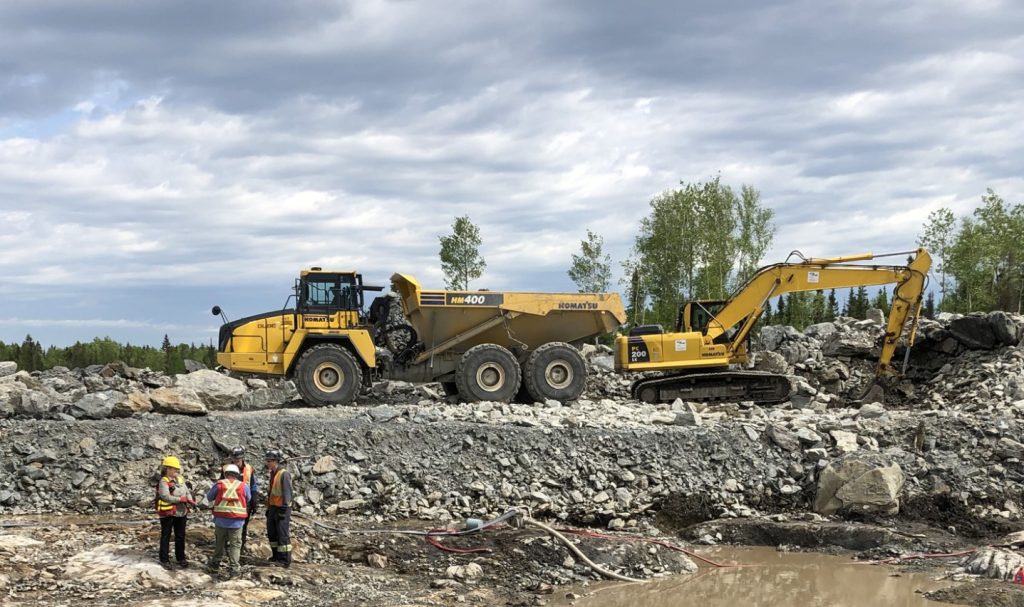
Granada Gold Mine Inc. [TSXV: GGM; OTC: GBBFF; Frankfurt: B6D] provided a structural interpretation by geological consultants. Historically, the Granada Gold Mine, Quebec, was mined through two shafts with an average gold grade of 9.7 g/t from veins 1 and 2 with 3 additional veins (#2a, #3, and #5) identified.
The company has completed 126,000 metres of drilling in 538 holes to date. With only 20% of the 2-km east-west mineralized structure explored, and with the mineralized package being open to depth, the potential exists for more vein structures to be identified with further drilling.
The interpretation identifies the southern part of the property as showing a higher structural complexity based on all geophysical and historical data, which extends eastwards and westwards the length of the property. Further work is required on the northwest- and northeast-trending faults and their relationship to the regional East-West trending structures.
The geological consultants further recommend creating an updated geological map for the property that integrates historical mapping, LiDAR and magnetic lineaments as well as compiling historical structural measurements into a database to create a more complete structural framework to support an updated 3D model.
On August 22, 2022 the company filed an updated NI 43-101 technical report supporting the resource estimate update for the Granada Gold project reporting that the Granada deposit contains an updated mineral resource, at a base case cut-off grade of 0.55 g/t Au for pit constrained mineral resources within a conceptual pit shell and at a base case cut-off grade of 2.5 g/t for underground mineral resources within reasonably mineable volumes, of 543,000 oz gold (8,220,000 tonnes at an average grade of 2.05 g/t Au) in the Measured and Indicated category, and 456,000 ounces of gold (3,010,000 tonnes averaging 4.71 g/t Au) in the Inferred category.
Granada Gold Mine continues to develop and explore its 100%-owned Granada Gold Property near Rouyn-Noranda, Quebec, and is adjacent to the prolific Cadillac Break. The Company owns 14.73 km2 of land in a combination of mining leases and claims. The company is currently undergoing a large drill program with 20,000 metres out of 120,000 metres completed. The drills are currently paused to provide the technical team with the necessary time to evaluate, assimilate existing data and wait for improved market conditions.
The Granada Shear Zone and the South Shear Zone contain, based on historical detailed mapping as well as from current and historical drilling, up to twenty-two mineralized structures trending east-west over 5.5 km. Three of these structures were mined historically from four shafts and three open pits. Historical underground grades were 8 to 10 g/t gold from two shafts down to 236 metres and 498 metres with open pit grades from 3.5 to 5 g/t gold.
The property includes the former Granada Gold underground mine which produced more than 50,000 ounces of gold at 10 g/t gold in the 1930’s from two shafts before a fire destroyed the surface buildings. In the 1990s, Granada Resources extracted a bulk sample (Pit #1) of 87,311 tonnes grading 5.17 g/t Au. They also extracted a bulk sample (Pit #2) of 22,095 tonnes grading 3.46 g/t Au.
Resource World Magazine Inc. has prepared this editorial for general information purposes only and should not be considered a solicitation to buy or sell securities in the companies discussed herein. The information provided has been derived from sources believed to be reliable but cannot be guaranteed. This editorial does not take into account the readers investment criteria, investment expertise, financial condition, or financial goals of individual recipients and other concerns such as jurisdictional and/or legal restrictions that may exist for certain persons. Recipients should rely on their own due diligence and seek their own professional advice before investing.