
Jaguar Mining launches directional drilling program at Pilar Gold Mine, Minas Gerais, Brazil
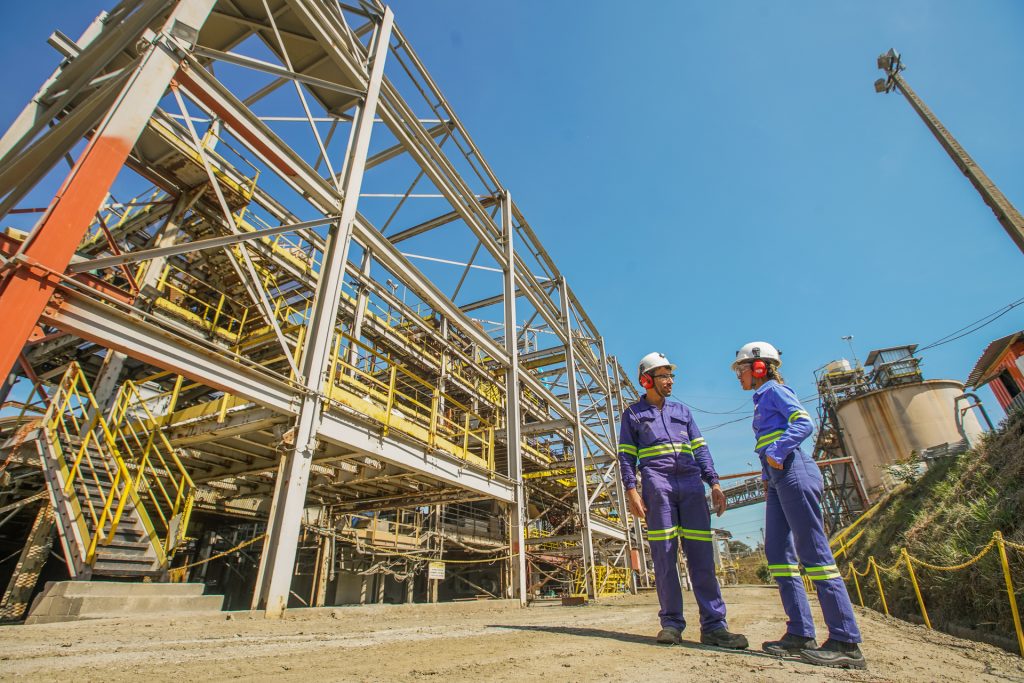
Jaguar Mining Inc. [TSX: JAG; OTCQX: JAGGF] reported that the planned directional drilling program at the company’s Pilar Gold Mine began earlier this week. The 5,000 metres of specialized drilling will explore three mineralized zones below the current Pilar mine workings which now extend to a depth of 1,100 metres (1.1km).
Drilling to be conducted across three zones, identified at the BA Zone, the LPA Zone and the BF Zone, will be completed in three phases. This program is part of the 227,200-metre, five-year exploration drilling program the Company announced last month, engaging both Geosol and Major Drilling companies, to focus on both green and brown field exploration. The Pilar drill program is expected to continue for the next 10-12 months.
“The objective of Pilar’s directional drilling program is to significantly extend the mineral resource potential at depth, thereby extending the life-of-mine beyond the current eight years,” commented CEO Luis Albano Tondo. “The Pilar Mine is the steady ‘workhorse’ of Jaguar’s gold production, producing over 40,000 ounces in 2025 with similar production anticipated for 2026.
“Jaguar’s overall strategic plan is defined as three pillars of growth. The first pillar focuses on maximizing the company’s core assets and resources, meaning we want to utilize the operating mills which all have excess capacity. To that end, we have the second pillar that encompasses both green and brown field exploration, under which this drill program at the Pilar mine falls. The third pillar targets accretive acquisition opportunities,” continued Tondo.
“While each of these growth pillars is important, extending Pilar’s mine life is one of the key components in achieving longer-term success of this strategy and allowing Jaguar to reach its ultimate goal of becoming a major gold producer in Brazil’s Iron Quadrangle where we operate.”
Both current mining and conventional drilling at the Pilar mine have proven that both grade and mineralization widths have been increasing at depth. Recent drilling results successfully targeted the down-plunge extensions of the BA Zone within the Pilar mine, demonstrating that high-grade mineralization remains robust and predictably continuous at depth. These results support a key component of the Company’s strategy to de-risk and convert its current exploration targets into formal mineral resources.
“Currently, the geometry of the BA, LPA, and BF ore bodies at the Pilar mine exhibits an east-west (E-W) elongation trend. As a result, the tight folds observed in the upper levels progressively transition into more open fold geometries at depth, leading to an increase in the mineralized area. In addition, the mineralized horizons show a noticeable thickening associated with a reduction in structural constriction,” explained Massacatto. “With respect to grade distribution, both mining exposures and drilling data indicate an overall increase in grade at depth when compared to the upper levels of the deposit. A direct consequence of this elongation is the geometry of additional mineralized lenses and a corresponding increase in grade variability. However, when both the mineralized area and grade are considered together, the ounces per vertical metre (oz/vm) ratio continues to increase, indicating gains in both mineralized mass and grade tenor at depth.”
While conventional drilling pushes straight down in a single vertical path, frequently requiring multiple drill rigs and a larger drill area footprint to access a large target, directional drilling intentionally steers the drill bit, allowing operators to curve, angle, and branch multiple boreholes from a single surface location to precisely intercept complex ore bodies.
The Pilar mine is located in the Iron Quadrangle (Quadrilátero Ferrífero), a world-class, prolific greenstone belt in the state of Minas Gerais, Brazil. This region is renowned for its significant iron and gold deposits, hosted within Archean and Paleoproterozoic sequences. Jaguar’s strategic land package in this district continues to offer substantial exploration upside.
Jaguar Mining is operating in Brazil with three gold mining complexes and a large land package with significant upside exploration potential from mineral claims. The company’s principal operating assets are located in the Iron Quadrangle, a prolific greenstone belt in the state of Minas Gerais and include the MTL complex (Turmalina mine and plant) and Caeté complex (Pilar and Roça Grande mines, and Caeté plant). The Roça Grande mine has been on temporary care and maintenance since April 2019.
The company also owns the Paciência complex (Santa Isabel mine), which had been on care and maintenance since 2012 and is now undergoing development work to restart in 2026.