
Rackla Metals drills 10.5 metres of 2.56 g/t gold at Grad Project, Yukon
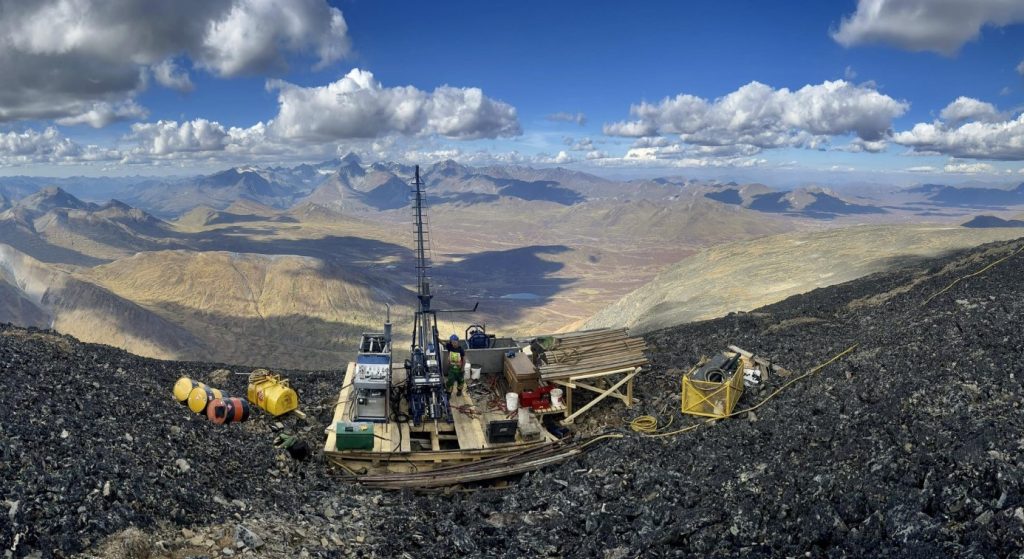
Rackla Metals Inc. [TSXV: RAK] has released analytical results from drill holes G25-009 and G25-010 from the 2025 campaign at the Grad property, Yukon Territory. These holes tested the intrusive-sediment contact south of the BiTe showing and continued well into the intrusive south of previously announced holes G25-004 to G25-008.
Rackla Metals reports a significant intercept of 10.5 metres grading 2.56 g/t gold in hole G25-009, which included an intercept of 8.45 g/t gold over 1.5 metres, the strongest result from the 2025 campaign. The gold intercepts show good correlation with bismuth and a moderate correlation with tellurium and tungsten. However, overall, the bismuth concentration in these holes is much less than was visually estimated during core logging.
The BiTe zone is located at the base of the steep cliff in the centre of the area drill tested. It has been mapped as an intensely altered quartz-sericite zone in quartz-monzonite with bismuth sulphide and/or tellurides. Surface sampling in 2024 and 2025 returned high-grade gold results in chip channel and grab samples. Talus fine sampling along the base of the cliff returned 500 metres averaging over one g/t gold with coincident anomalous bismuth and tellurium. Drilling to date has failed to return any continuity to the gold mineralization at depth nor has it returned any of the high-grade gold results returned from the surface samples.
A characteristic of reduced intrusion-related gold system deposits in the Tombstone gold belt is that vein density is typically an indication of grade. However, the results observed to date from the drilling at the Grad property indicate that vein density is not the determining factor as hole G25-010 is intensely veined yet returned only weak, sporadic gold intercepts.
Trenching at the Manta showing yielded low-grade results despite high-grade grab samples. The Manta showing is located in altered sedimentary rocks at the contact with the Manta intrusive body, 1.5 km south of the BiTe showing. Initial grab and one-metre chip samples from quartz-bismuthinite veins in metasomatically altered skarn zone at two locations returned five-multigram-gold results (5.73, 8.36, 11.75, 48.3 and 52.1 g/t gold). However, channel sampled trenches cut across each of these areas returned disappointing results with the best being 0.63 g/t gold over one m in the northern trench and 1.41 g/t gold over one metre in the southern trench.
Given the number of high-grade gold results obtained from the sampling at Grad and adjacent prospects, further work needs to be done in the region. The company is working with the data collected in the 2025 campaign to refine its model for the region and is planning a methodical approach for 2026 with the goal to unlocking the key to these gold discoveries in this very prospective region of the Tombstone gold belt.
Rackla has a co-operation and benefit agreement with the Sahtu Dene First Nation.
For the purposes of this release, contiguous mineralized intervals are defined as runs of mineralization greater than 0.3 g/t Au.
Rackla Metals is targeting reduced intrusion-related gold system mineralization on the southeastern part of the Tombstone gold belt in eastern Yukon and western Northwest Territories. Management believes that this area, which is underexplored for RIRGS deposit types, has the potential to be the next frontier for the discovery of these large gold systems.