
Scorpio Gold drills 2.56 g/t gold over 13.38 metres within Manhattan Caldera, Black Mammoth, Nevada
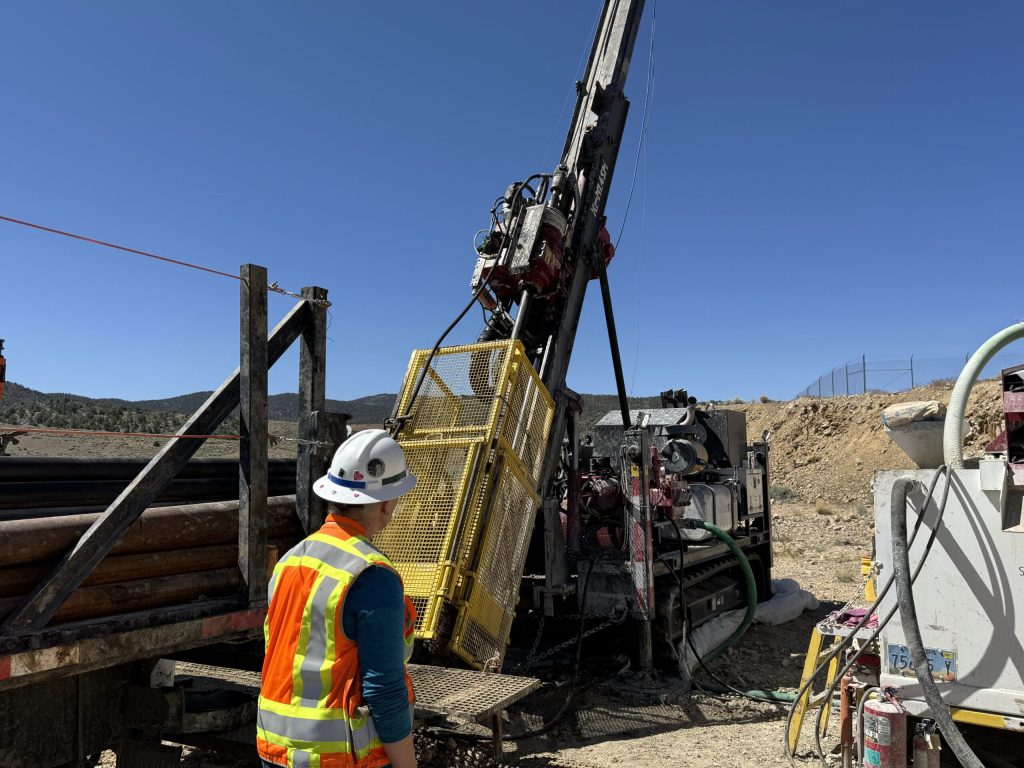
Scorpio Gold Corp. [TSXV: SGN; OTCQB: SRCRF; FSE: RY9] reported results from two step-out holes of the Phase Two drill program at the Manhattan District Project, Nevada, USA; namely holes 26MN-092 and 26MN-096.
Scorpio Gold has drilled 96 drill holes to date from its Phase Two diamond drilling program, 25MN-011 through 25MN-045, 26MN-046 through 26MN-108, for a grand total of 27,712 metres. With the results herein, Scorpio Gold has reported assays on 79 of these (25MN-011 through 25MN-045, 26MN-046 through 26MN-086, 26MN-088 through 26MN-089, 26MN-091 through 26MN-092), totalling 22,974 metres, and assays are pending from 19 holes (26MN-087, 26MN-090, 26MN-093 through 26MN-095, and 26MN-097 through 26MN-108), totalling 4,738 m. The pending results will be reported as they become available.
“These two step-out holes underscore the value of a second, volcanic-hosted mineralized corridor taking shape within the Manhattan Caldera. Hole 26MN-096 returned 2.56 g/t gold over 13.38 metres – including 8.38 g/t gold over 3.84 metres – hosted entirely within caldera volcanics, building on the caldera-hosted mineralization we have now intersected in holes 26MN-053, -069, -078 and -091. This is the same broad, volcanic-hosted style of mineralization that characterizes the nearby Round Mountain system, and we are increasingly confident it represents a distinct corridor running alongside, and complementary to, the sediment-hosted mineralization at Black Mammoth.
“At the same time, hole 26MN-092 reflects our continued success along the Zanzibar Trend, with multiple stacked intervals hosted in Zanzibar Formation limestones, including 0.83 g/t gold over 18.01 metres and a high-grade 5.80 g/t gold over 1.37 metres. Importantly, both holes were drilled more than 230 metres beyond the current resource-constraining pit, demonstrating that mineralization at Manhattan remains open well outside the 2025 block model – across two separate host lithologies – and giving us multiple high-priority vectors to continue testing in the current phase of drilling,” said Harrison Pokrandt, VP Exploration for Scorpio Gold.
Drill hole 26MN-092 is a 50-metre step-out, at Black Mammoth, to the southwest of hole 26MN-057. Drill hole 26MN-096 is a 50-metre step-out, also at Black Mammoth, to the east of hole 26MN-069. Both drill holes tested greater than 230 metres beyond the Inferred Resource Constraining Pit (IRCP), targeting new mineralization outside of the 2025 MRE block model.
Black Mammoth Results – 26MN-092: This drill hole tested mineralization in the Black Mammoth area, to the northwest of Goldwedge. The drill hole contains five intervals hosted in Ordovician Zanzibar Formation limestone and carbonaceous meta-mudstone units; 0.20 g/t gold over 8.02 metres from 139.20 metres; 0.57 g/t gold over 17.98 metres from 157.28 metres; 0.86 g/t gold over 8.69 metres from 178.30 metres; 1.30 g/t gold over 5.18 metres from 181.81 metres, including 5.80 g/t gold over 1.37 metres from 190.81 metres; and 0.83 g/t gold over 18.01 metres from 277.68 metres.
One interval of 1.26 g/t gold over 9.91 metres from 284.98 metres, begins in Ordovician Zanzibar Formation limestones and ends in Cambrian Gold Hill Formation fine grained meta-sediments, with the contact at 309.68 m. The drill hole contains two intervals hosted in the Cambrian Gold Hil Formation; 0.23 g/t gold over 6.46 metres from 319.98 m (clastic meta-mudstone) and 8.10 g/t gold over 1.52 metres from 450.35 metres (interbedded clastic and carbonate meta-mudstones).
Drill hole 26MN-096 also tested mineralization in the Black Mammoth area, to the northwest of Goldwedge, along the Manhattan Caldera margin. The drill hole contains two significant intervals hosted entirely within Oligocene Round Rock Formation (Manhattan Caldera) ash and lapilli tuff volcanic units with vein-hosted mineralization hosted; 0.17 g/t gold over 12.98 metres from 262.80 metres and 2.56 g/t gold over 13.38 metres from 293.28 m, including 8.38 g/t gold over 3.84 metres from 298.95 metres. One interval of 0.30 g/t gold over 25.18 metres from 360.39 metres begins in Manhattan Caldera volcanics and ends in Cambrian Gold Hill Formation brecciated fine grained clastic meta-sediments, with the contact at 374.93 metres.
These Black Mammoth intervals represent new mineralization outside the current IRCP, see cross-section A to A’ and cross-section B to B’.
The Manhattan District, located in the Walker Lane Trend of Nevada, USA, is road accessible and lies approximately 20 km south of the operating Round Mountain Gold Mine which has produced more than 15 million ounces of gold.
For the first time, the company has consolidated Manhattan’s past-producing mines under a single entity that holds valuable permitting and water rights. Historically, Manhattan has produced approximately 700,000 ounces of gold from high-grade placer and lode operations dating from the late 1890s through to the mid-2000s.
The maiden mineral resource estimate (MRE) covering the Goldwedge and Manhattan Pit areas of Manhattan is comprised of 18,343,000 tonnes grading 1.26 g/t gold for a total of 740,000 oz contained gold in the inferred category.
A historical mineral resource estimate covers the Black Mammoth, April Fool, Hooligan, Keystone, and Jumbo areas of Manhattan and comprises 1,652,325 tonnes grading 5.89 g/t gold for a total of 303,949 oz contained gold. The deposit is interpreted as a low-sulfidation, epithermal, gold-rich system situated adjacent to the Tertiary-aged Manhattan caldera in the Southern Toquima Range of Nevada.
prepared for New Concept Mining, Inc. and dated May 1997.
Scorpio Gold holds a 100% interest in the Manhattan District located in the Walker Lane Trend, Nevada. Scorpio Gold’s Manhattan District is ~4,780-hectares and comprises the advanced exploration-stage Goldwedge Mine, with a 400 ton-per-day maximum capacity gravity mill, and four past-producing pits that were acquired from Kinross in 2021).
The consolidated Manhattan District presents an exciting late-stage exploration opportunity, with over 140,000 metres of historical drilling, significant resource potential, and valuable permitting and water rights.